
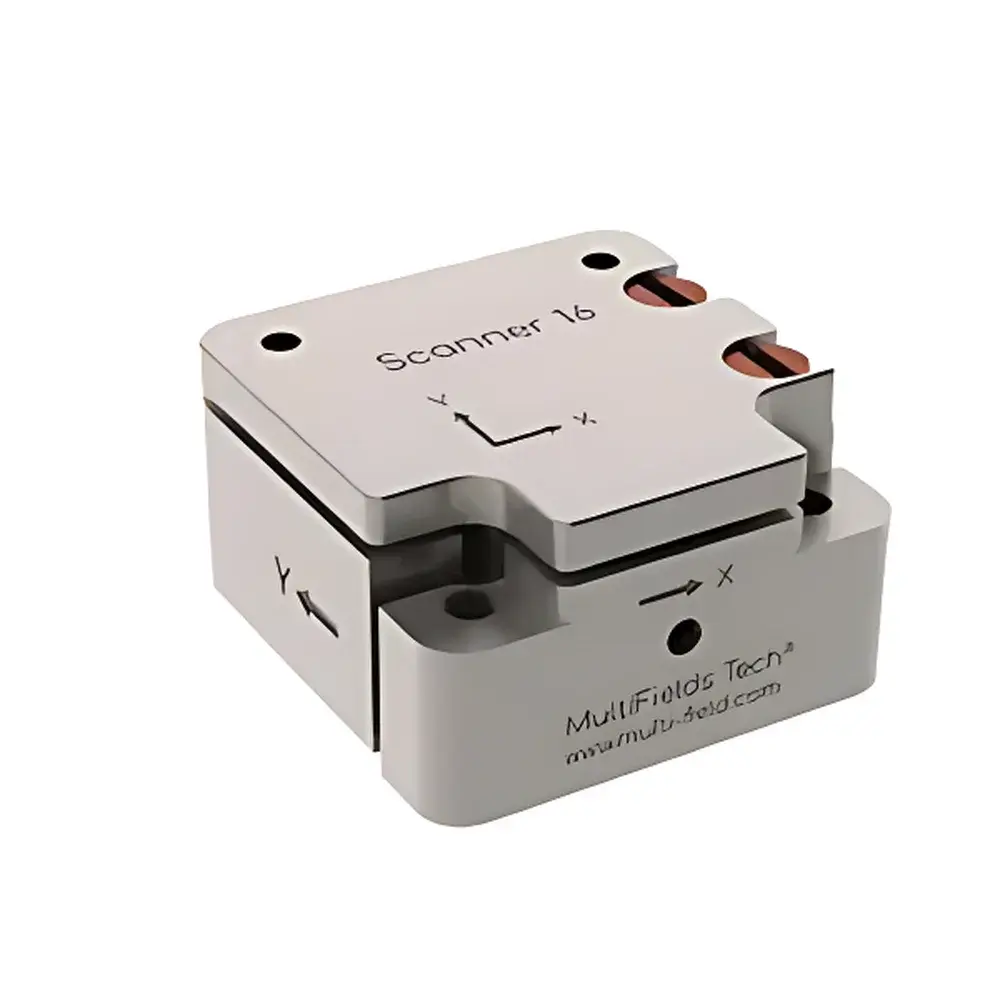
ZOLIX Scanner16-xy Piezoelectric XY Translation Stage
| Brand | ZOLIX |
|---|---|
| Origin | Beijing, China |
| Manufacturer Type | Direct Manufacturer |
| Product Category | Domestic |
| Model | Scanner16-xy |
| Product Type | Motorized Translation Stage |
| Dimensions | 16 × 16 × 9 mm |
| Weight | 8 g |
| Vacuum Compatibility | 2 × 10⁻¹¹ mbar (UHV) |
| Temperature Range | 1.4 K – 400 K (optional down to 30 mK) |
| Magnetic Field Tolerance | Up to 18 T |
| Construction Materials | Pure Titanium (Ti) body, Beryllium Copper (BeCu) flexures and electrodes |
| Scan Range @ 300 K | 30 × 30 µm |
| Resolution | 0.5 nm |
| Linearity Error | ~0.1 % (typical) |
| Repeatability | < 10 nm |
| Max. Load Capacity | 100 g |
| Drive Voltage | 75 V (max @ 300 K), 180 V (max @ 4 K) |
| Capacitance @ 300 K | 1 µF |
| Cable | Phosphor Bronze twisted pair, 20 cm length |
| Connector Pins | 2 per axis (BeCu/Polyester-glass-fiber-filled Peek insulator) |
Overview
The ZOLIX Scanner16-xy is a high-precision, ultra-compact piezoelectric XY translation stage engineered for demanding cryogenic, ultra-high vacuum (UHV), and high-magnetic-field environments. Based on monolithic flexure-guided piezo actuation, it delivers nanometer-scale positioning resolution and sub-10 nm repeatability without mechanical backlash or hysteresis-induced drift. Its operation relies on inverse piezoelectric effect—applying controlled voltage across integrated piezoceramic elements induces precise, non-magnetic, frictionless displacement in orthogonal X and Y axes. Designed specifically for integration into scanning probe microscopy (SPM), quantum transport measurement setups, low-temperature optical spectroscopy, and dilution refrigerator-based quantum device characterization, the Scanner16-xy maintains structural integrity and functional stability from 1.4 K up to 400 K, with optional configurations validated for operation at 30 mK in He-3 or dilution refrigerators.
Key Features
- Ultra-compact footprint: 16 × 16 × 9 mm³ volume enables direct mounting within confined cryostat sample chambers or multi-probe wiring stacks.
- Multi-environment compatibility: Certified for UHV conditions down to 2 × 10⁻¹¹ mbar; fully operational under static magnetic fields up to 18 Tesla.
- Non-magnetic construction: Body fabricated from pure titanium (Ti); flexures, electrodes, and electrical contacts use beryllium copper (BeCu), eliminating field-induced eddy currents or torque effects.
- Cryogenic-optimized actuation: Dual-voltage drive capability—75 V maximum at room temperature, scaled to 180 V at 4 K—to compensate for reduced piezoelectric coefficient at cryogenic temperatures.
- High stiffness-to-mass ratio: 8 g total mass with 100 g load capacity supports stable scanning of optomechanical components, SPM tips, or microfabricated sensors.
- Low-thermal-conductance cabling: 20 cm phosphor bronze twisted-pair leads minimize heat leak into the cold stage while preserving signal fidelity.
Sample Compatibility & Compliance
The Scanner16-xy is compatible with standard SPM-compatible sample carriers, TEM grid holders, and custom-machined chip mounts. Its Ti/BeCu material set meets ASTM F136 (surgical-grade titanium) and ISO 13485-compliant manufacturing traceability where applicable. Electrical insulation between pins uses glass-fiber-filled polyetheretherketone (PEEK), rated for continuous operation at ≤4 K and compatible with bake-out protocols up to 150 °C. The stage conforms to UHV cleanliness standards per ISO 14644-1 Class 4 when assembled under cleanroom conditions. For GLP/GMP-aligned laboratories, full material certification (mill test reports), vacuum outgassing data (TML/CVCM per ASTM E595), and magnetic susceptibility verification documentation are available upon request.
Software & Data Management
The Scanner16-xy operates as an open-loop positioning device, accepting analog voltage inputs (±10 V or 0–100 V range depending on configuration) from external motion controllers (e.g., Attocube ANC300, Piezosystem Jena E-712, or custom FPGA-based DAC systems). It does not include onboard electronics or digital interface; this design minimizes heat load and electromagnetic interference in sensitive measurement environments. Users integrate the stage into existing control architectures using standard LabVIEW, Python (via PyVISA or NI-DAQmx), or MATLAB instrument drivers. All voltage-to-displacement calibration curves—including temperature-dependent scaling factors and linearity correction tables—are provided in machine-readable CSV format for automated compensation in closed-loop feedback routines.
Applications
- Atomic force microscopy (AFM) and scanning tunneling microscopy (STM) in dilution refrigerators and superconducting magnet systems.
- In-situ optical alignment of single-photon emitters, quantum dots, or superconducting nanowires inside cryogenic confocal microscopes.
- Positioning of microwave antennas or coplanar waveguide probes during quantum circuit characterization.
- Sub-nanometer raster scanning for near-field optical imaging (SNOM) under UHV and milli-Kelvin conditions.
- Integration into multi-axis nanopositioning stacks for hybrid quantum-classical instrumentation requiring simultaneous XYZ + rotation degrees of freedom.
FAQ
Is the Scanner16-xy compatible with liquid helium cryostats?
Yes—it is qualified for continuous operation from 1.4 K to 400 K, including pumped He-4 and He-3 systems. Optional ULT versions undergo additional thermal cycling validation.
What is the recommended drive circuit for achieving 0.5 nm resolution?
A low-noise, 20-bit DAC with ≤10 µV RMS output noise and active guarding is required. We recommend pairing with a low-thermal-drift voltage amplifier (e.g., Thorlabs LDC501) to maintain stability over extended scans.
Can the stage be baked in vacuum?
Yes—the UHV version supports in-situ bake-out up to 150 °C for 24 hours. All adhesives, insulators, and solder joints are selected per ESA ECSS-Q-ST-70-02C requirements.
Does ZOLIX provide calibration certificates traceable to NIST?
Upon request, we supply factory calibration reports including step-response testing, linearity mapping, and temperature-dependent hysteresis characterization—all traceable to national metrology institutes via ISO/IEC 17025-accredited partners.
Are custom pinout configurations or cable lengths available?
Yes—standard configurations use 2-pin per axis (4-pin total); custom layouts (e.g., shielded coaxial, differential drive) and cable extensions up to 1 m can be ordered with lead-time adjustment.




