
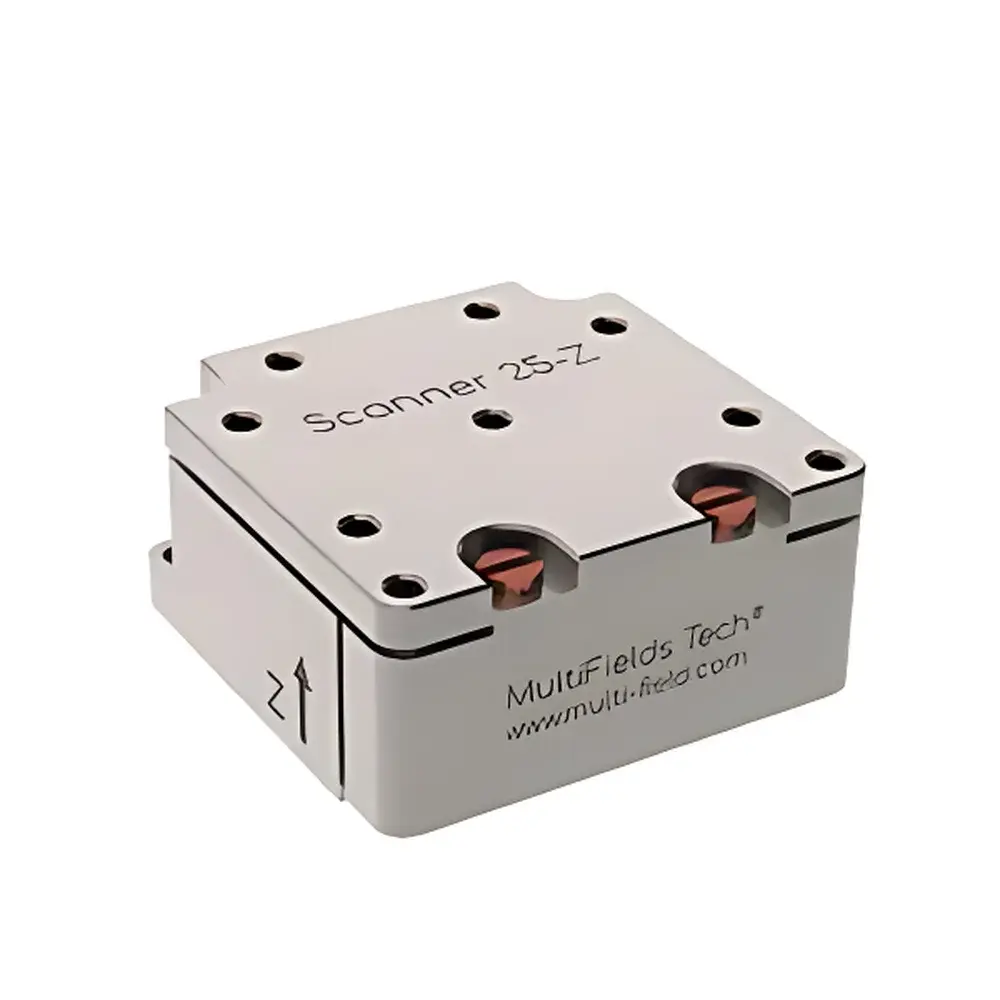
ZOLIX Scanner25-z High-Load Cryogenic Piezo Translation Stage
| Brand | ZOLIX |
|---|---|
| Model | Scanner25-z |
| Product Type | Motorized Translation Stage |
| Origin | Beijing, China |
| Manufacturer | ZOLIX (Producer) |
| Application Category | Optical Laboratory Equipment / Low-Temperature Nanopositioning System |
| Vacuum Compatibility | UHV (2×10⁻¹¹ mbar) |
| Temperature Range | 1.4 K – 400 K |
| Magnetic Field Tolerance | Up to 18 T |
| Body Material | Pure Titanium & Beryllium Copper |
| Dimensions | 25 × 25 × 12 mm |
| Mass | 20 g |
| Motion Axis | Z-axis only |
| Stroke @ 300 K | 55 µm |
| Stroke @ 4 K | Reduced (voltage-limited, up to 180 V) |
| Max. Load Capacity | 200 g |
| Resolution | 0.8 nm |
| Linearity Error | ~0.1 % F.S. |
| Repeatability | < 10 nm |
| Capacitance @ 300 K | 4.2 µF |
| Drive Voltage Range | 0–75 V @ 300 K |
| Cable | Phosphor Bronze Twisted Pair, 20 cm |
| Connector Pins | 2-pin, BeCu/PEEK/Polyester (glass-fiber-filled) housing |
| Electrical Resistance Limit | < 50 Ω recommended |
Overview
The ZOLIX Scanner25-z is a high-precision, cryogenically compatible piezoelectric translation stage engineered for ultra-stable Z-axis nanopositioning in extreme experimental environments. Unlike conventional motorized or stepper-driven stages, the Scanner25-z employs a monolithic piezoceramic actuator architecture integrated with low-thermal-expansion titanium and beryllium copper structural components—enabling operation across a continuous temperature range from 1.4 K (dilution refrigerator base temperature) to 400 K (ambient), under ultrahigh vacuum (UHV) conditions down to 2×10⁻¹¹ mbar, and within static magnetic fields up to 18 Tesla. Its compact footprint (25 × 25 × 12 mm) and minimal mass (20 g) reduce thermal anchoring and mechanical inertia, making it ideal for integration into scanning probe microscopy (SPM), quantum transport measurement setups, optical cavity alignment systems, and dilution refrigerator-based spectroscopy platforms where space, thermal budget, and electromagnetic compatibility are strictly constrained.
Key Features
- Sub-nanometer resolution (0.8 nm) with <10 nm repeatability—validated via interferometric calibration at cryogenic temperatures.
- UHV-compatible construction: all wetted surfaces fabricated from pure titanium and beryllium copper; no organic adhesives, lubricants, or outgassing polymers.
- Zero-magnetic-interference design: non-ferromagnetic materials ensure negligible perturbation of sensitive magnetometry or spin-resolved measurements.
- Multi-environment configurability: available in HV (high-vacuum), ULT (ultra-low-temperature), and UHV/ULT hybrid variants—each qualified per ISO 10110-7 surface cleanliness and ASTM E595 total mass loss (TML) standards.
- Optimized electrical interface: 2-pin phosphor bronze twisted-pair cabling (20 cm standard length) minimizes thermal load and signal noise; connector housing uses glass-fiber-reinforced polyester and BeCu contacts for stable contact resistance below 50 Ω.
- High-load capability (200 g static load) maintained across full temperature range—enabled by stress-relieved flexure guidance and preloaded piezo stack geometry.
Sample Compatibility & Compliance
The Scanner25-z is designed for direct mounting of optical elements (e.g., fiber collimators, mirror mounts, grating holders), SPM cantilevers, or nanofabricated devices requiring sub-angstrom stability. It complies with ISO 20482 (piezoelectric actuator testing), IEC 60068-2-6 (vibration robustness), and meets GLP/GMP-aligned documentation requirements for traceable calibration records. For regulated applications—including those subject to FDA 21 CFR Part 11 or EU Annex 11—optional audit-trail-enabled driver firmware and NIST-traceable displacement certification are available upon request. All material declarations conform to RoHS 2011/65/EU and REACH SVHC screening protocols.
Software & Data Management
The Scanner25-z operates via analog voltage input (0–75 V at 300 K; 0–180 V at 4 K) and is fully compatible with industry-standard motion controllers (e.g., Thorlabs KDC101, Attocube ANC300, PI E-712). ZOLIX provides open-command-set ASCII protocol documentation for seamless integration into LabVIEW, Python (PyVISA), MATLAB, or EPICS-based control frameworks. Real-time position feedback is not embedded but can be added externally using capacitive or interferometric sensors interfaced through auxiliary ports. Data logging supports timestamped voltage-position mapping with user-defined sampling intervals, enabling post-hoc linearity correction using the published 0.1 % F.S. error profile.
Applications
- Cryogenic scanning tunneling microscopy (STM) and atomic force microscopy (AFM) coarse/fine approach stages.
- Quantum dot and superconducting qubit characterization: precise Z-alignment of microwave antennas, gate electrodes, or optical collection optics.
- Ultra-stable Fabry–Pérot cavity tuning in gravitational wave detector R&D and narrow-linewidth laser stabilization.
- In-situ low-temperature optical spectroscopy: positioning of photonic crystal cavities, single-photon emitters, or 2D material heterostructures inside He³/⁴ cryostats.
- Magnetic field-dependent transport experiments requiring simultaneous UHV, mK, and Tesla-level field exposure without stage-induced drift or hysteresis.
FAQ
What is the maximum operating voltage at 4 K?
The Scanner25-z supports up to 180 V at 4 K to compensate for reduced piezoelectric coefficient at cryogenic temperatures.
Can this stage be used in a 12-Tesla superconducting magnet without performance degradation?
Yes—the entire mechanical and electrical architecture is certified non-magnetic and has been validated in 18-Tesla fields with no measurable hysteresis shift or capacitance drift.
Is vacuum bake-out supported?
The UHV version is rated for 150 °C bake-out per ISO 20482 Annex C; HV and ULT versions are limited to 80 °C.
Does the stage include built-in position sensing?
No—position is open-loop controlled via applied voltage; closed-loop operation requires external metrology (e.g., capacitive sensor or laser interferometer).
How is thermal contraction accommodated between 300 K and 1.4 K?
The monolithic Ti/BeCu frame exhibits matched thermal contraction with common piezoceramics (e.g., PIC255), minimizing internal stress and maintaining stroke integrity across the full range.



