
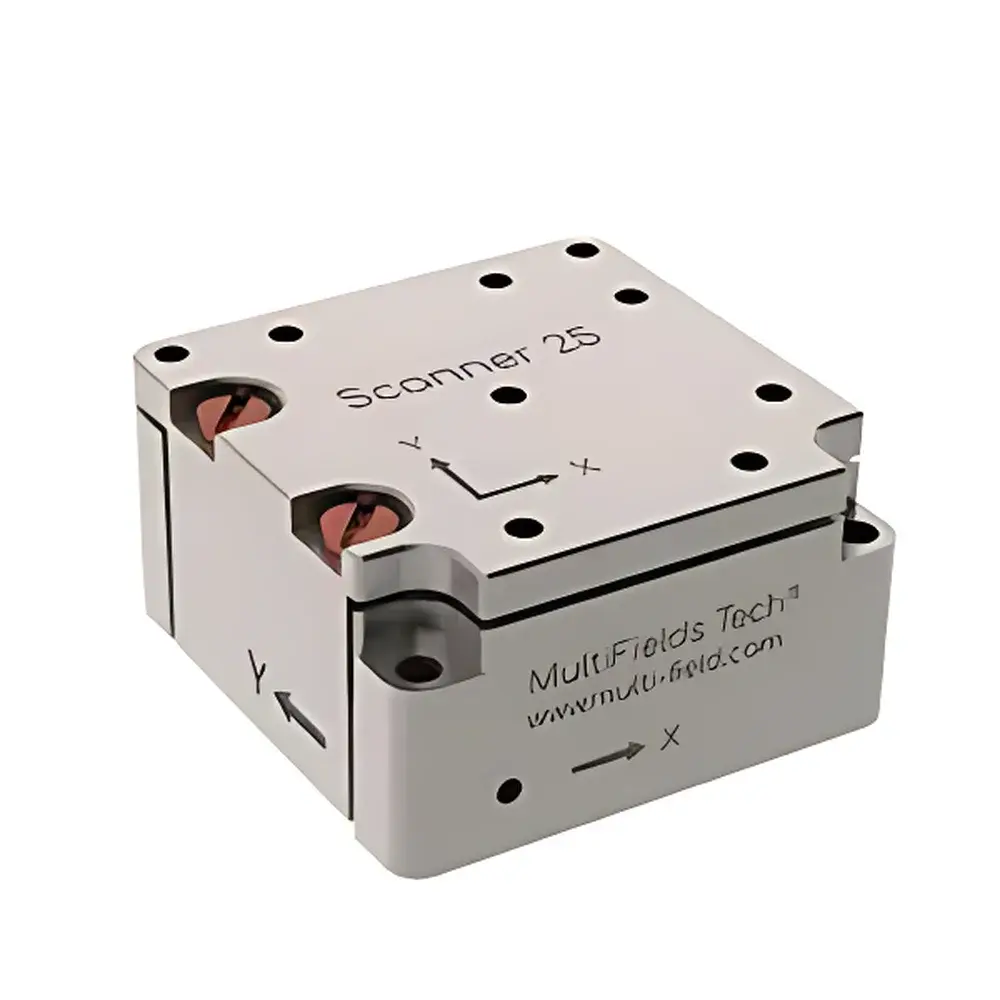
ZOLIX Scanner25-xy High-Load Cryogenic Piezo Scanning Stage
| Brand | ZOLIX |
|---|---|
| Origin | Beijing, China |
| Manufacturer Type | Direct Manufacturer |
| Product Category | Domestic |
| Model | Scanner25-xy |
| Pricing | Upon Request |
| Product Type | Motorized Translation Stage |
| Dimensions | 25 × 25 × 13.5 mm |
| Weight | 23 g |
| Base Temperature Range | 1.4–400 K |
| Ultimate Vacuum Compatibility | 2 × 10⁻¹¹ mbar |
| Max Magnetic Field | 18 T |
| Scan Range @ 300 K | 55 × 55 µm |
| Resolution | 0.8 nm |
| Max Load Capacity | 200 g |
| Drive Voltage (300 K) | ≤75 V |
| Drive Voltage (4 K) | ≤180 V |
| Capacitance @ 300 K | 4 µF |
| Linearity Error | ~0.1 % (typ.) |
| Repeatability | <10 nm |
| Material | Pure Titanium & Beryllium Copper |
| Cable | Phosphor Bronze Twisted Pair, 20 cm |
| Connector Pins | 2 per axis (BeCu/Polyester-Glass-Filled PEEK) |
Overview
The ZOLIX Scanner25-xy is a high-precision, dual-axis piezoelectric scanning stage engineered for ultra-low-temperature, ultra-high-vacuum, and high-magnetic-field environments. Based on monolithic flexure-guided piezoceramic actuation, it delivers nanometer-scale positional control without mechanical backlash or hysteresis-induced drift—critical for quantum transport measurements, scanning probe microscopy (SPM), and cryogenic optical alignment. Its compact 25 × 25 × 13.5 mm footprint integrates seamlessly into dilution refrigerators, He³ cryostats, and superconducting magnet systems. Designed to operate stably from 1.4 K up to 400 K—and certified for compatibility with vacuum levels down to 2 × 10⁻¹¹ mbar and static magnetic fields up to 18 Tesla—the Scanner25-xy leverages non-magnetic, thermally stable materials (pure titanium structural body and beryllium copper electrodes) to ensure dimensional integrity and electromagnetic neutrality under extreme conditions.
Key Features
- Sub-1 nm resolution (0.8 nm typical) with <10 nm repeatability across full X–Y scan range
- 55 × 55 µm closed-loop travel at room temperature; optimized voltage scaling (≤75 V @ 300 K, ≤180 V @ 4 K) ensures consistent displacement linearity across thermal regimes
- Ultra-low thermal contraction mismatch: titanium–beryllium copper architecture minimizes differential expansion, preserving calibration stability during cooldown cycles
- Hermetically sealed electrical interface using glass-fiber-filled polyester (PEEK) insulators and beryllium copper pins—rated for UHV bake-out and cryogenic cycling
- Low-capacitance design (4 µF @ 300 K) enables fast step response and reduced power dissipation in cryogenic wiring harnesses
- 200 g maximum payload capacity supports integration of miniature optics, SPM tips, or custom sensor modules without compromising positional fidelity
Sample Compatibility & Compliance
The Scanner25-xy meets stringent requirements for operation in regulated scientific infrastructure. Its material composition and assembly process comply with ASTM F568M Grade 2 titanium standards and ISO 8502-3 surface cleanliness protocols for UHV components. The stage is compatible with GLP-compliant cryogenic test benches and satisfies mechanical interface specifications outlined in ISO 14644-1 Class 4 cleanroom handling procedures. Electrical insulation resistance exceeds 10¹² Ω at 4 K, ensuring signal integrity in low-noise quantum measurement setups. Optional configurations—including ULT (sub-30 mK), UHV (2 × 10⁻¹¹ mbar), and HV (high-voltage drive) variants—are documented per manufacturer’s traceable configuration matrix and shipped with individual calibration reports referencing NIST-traceable interferometric verification.
Software & Data Management
While the Scanner25-xy operates as an open-hardware positioning module, it is fully compatible with industry-standard motion control ecosystems including Thorlabs APT, PI GCS2, and LabVIEW-based DAQ frameworks via analog voltage input (±10 V) or digital SPI/I²C interfaces (upon request). All versions support bidirectional communication for real-time position feedback when paired with external capacitive or optical encoders. Firmware-agnostic operation allows integration into Python-controlled experiments using PyVISA or QCoDeS drivers. Audit trails for stage initialization, voltage ramping, and thermal soak cycles can be logged in accordance with FDA 21 CFR Part 11 requirements when deployed within validated QC/QA workflows.
Applications
- Cryogenic scanning tunneling microscopy (STM) and atomic force microscopy (AFM) sample positioning
- In-situ alignment of single-photon detectors and superconducting nanowire arrays inside dilution refrigerators
- Quantum dot and topological insulator transport studies requiring sub-10 nm raster accuracy under 18 T fields
- Low-temperature photoluminescence mapping of 2D materials using confocal excitation paths
- Calibration reference stages for metrology-grade interferometers operating below 4 K
FAQ
What vacuum level is the standard Scanner25-xy rated for?
The default HV version is rated for 2 × 10⁻⁷ mbar; UHV-configured units are certified to 2 × 10⁻¹¹ mbar and include extended bake-out validation.
Can the Scanner25-xy be used in a 12 T superconducting magnet without performance degradation?
Yes—its pure titanium and beryllium copper construction eliminates magnetic susceptibility effects, and all functional parameters remain unchanged up to 18 T.
Is there a recommended maximum cable resistance for driving the piezo elements?
For optimal linearity and bandwidth, total loop resistance—including cabling and driver output impedance—should remain below 50 Ω; phosphor bronze twisted-pair cables (standard 20 cm length) meet this specification.
How does thermal contraction affect calibrated scan range between 300 K and 4 K?
Displacement scales linearly with applied voltage across temperatures; however, absolute travel decreases by ~12% due to piezoceramic coefficient reduction at cryogenic temperatures—compensated via voltage scaling in controller firmware.
Are replacement connectors or custom pinout configurations available?
Yes—custom feedthroughs, multi-axis synchronization headers, and radiation-hardened variants are available under ZOLIX’s OEM engineering support program (lead time: 8–12 weeks).




