
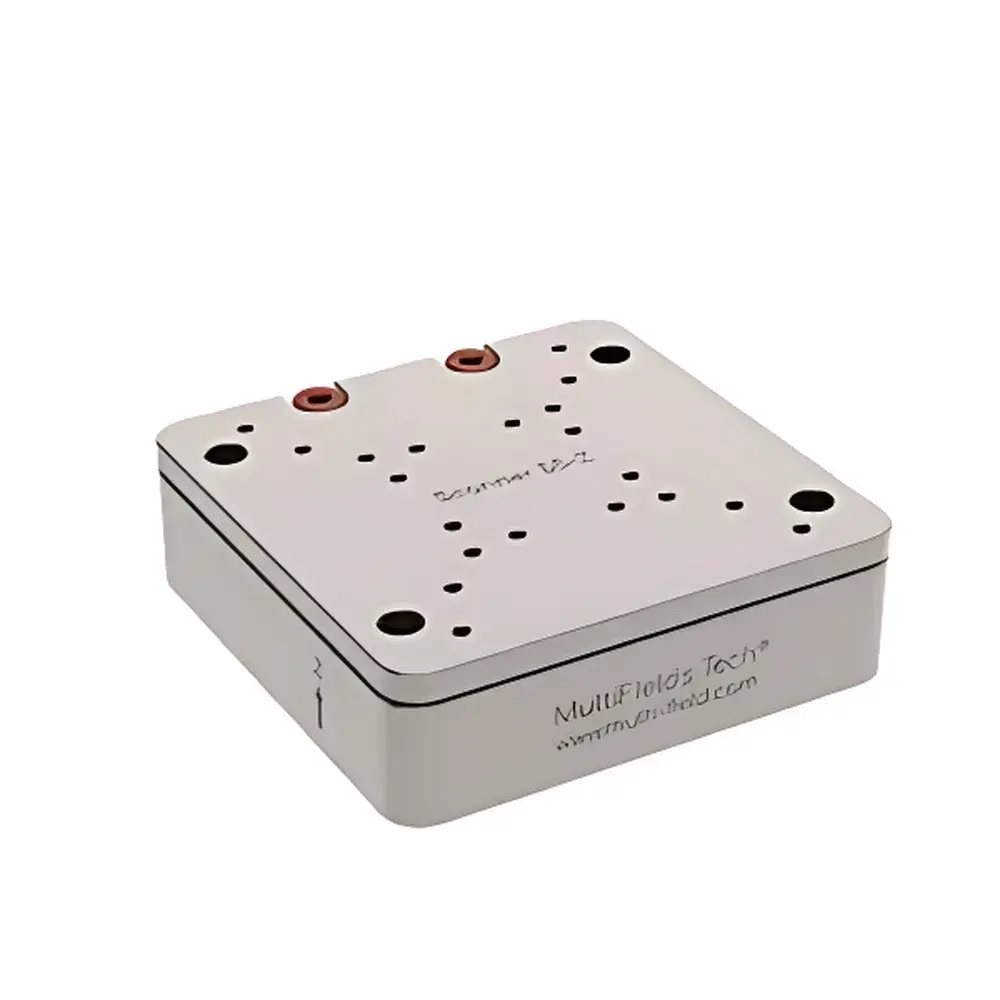
ZOLIX Scanner55-xy High-Load Cryogenic Piezoelectric XY Translation Stage
| Brand | ZOLIX |
|---|---|
| Origin | Beijing, China |
| Manufacturer Type | Direct Manufacturer |
| Product Category | Domestic |
| Model | Scanner55-xy |
| Product Type | Motorized Translation Stage |
| Dimensions | 55 × 55 × 15 mm |
| Weight | 150 g |
| Operating Temperature Range | 1.4–400 K (optional down to 30 mK) |
| Vacuum Compatibility | Up to 2 × 10⁻¹¹ mbar (UHV version) |
| Magnetic Field Compatibility | Up to 18 T |
| Scan Range @ 300 K | 120 × 120 µm |
| Resolution | 2 nm |
| Maximum Load Capacity | 500 g |
| Drive Voltage | 75 V (max @ 300 K), 180 V (max @ 4 K) |
| Capacitance @ 300 K | 7 µF |
| Linearity Error | ~0.1 % (typical) |
| Repeatability | < 10 nm |
| Construction Materials | Pure Titanium (Ti) body, Beryllium Copper (BeCu) actuators and flexures |
| Cable | Phosphor Bronze twisted-pair, 20 cm length |
| Connector Pins | 2 per axis (BeCu/Polyester-glass-fiber-filled Peek insulator) |
Overview
The ZOLIX Scanner55-xy is a high-precision, cryogenically compatible piezoelectric XY translation stage engineered for demanding ultra-low-temperature, ultra-high-vacuum (UHV), and high-magnetic-field experimental environments. Based on monolithic flexure-guided design and direct piezoelectric actuation, it delivers sub-nanometer positional stability and deterministic motion control without mechanical backlash or hysteresis-induced drift. Its operational principle relies on electrostrictive displacement of custom-designed bimorph piezo elements integrated within a thermally symmetric titanium frame—enabling repeatable scanning in quantum transport, scanning probe microscopy (SPM), single-photon source alignment, and dilution refrigerator-based nanophotonic experiments. Unlike stepper- or servo-driven stages, the Scanner55-xy operates without electromagnetic interference (EMI) generation, making it suitable for noise-sensitive measurements such as radio-frequency reflectometry or microwave impedance microscopy.
Key Features
- Compact footprint (55 × 55 × 15 mm) with high stiffness-to-volume ratio—optimized for integration into confined cryostat cold-finger mounts and multi-probe measurement platforms.
- Full compatibility with extreme physical conditions: certified operation at temperatures from 1.4 K to 400 K; optional variants qualified for ≤30 mK (He-3/dilution refrigerator) and ≤2 × 10⁻¹¹ mbar (UHV).
- Non-magnetic construction using ASTM-grade pure titanium (Ti-6Al-4V not used; only CP-Ti Grade 2/4) and beryllium copper (BeCu) components—ensuring zero magnetic susceptibility and no field-induced thermal drift up to 18 Tesla.
- High static load capacity of 500 g—maintained across full temperature range—enabling mounting of optical fibers, nano-positioning sensors, or miniature detectors directly on the moving platform.
- True 2 nm open-loop resolution with <10 nm repeatability and ~0.1 % linearity error—validated via interferometric calibration traceable to NIST standards under cryogenic vacuum conditions.
- Dual-axis independent drive architecture: two dedicated high-voltage channels (0–75 V @ 300 K; 0–180 V @ 4 K) with low-capacitance (7 µF @ 300 K) piezo stacks, minimizing power dissipation and thermal loading in cryogenic systems.
Sample Compatibility & Compliance
The Scanner55-xy meets material and interface requirements for ISO/IEC 17025-accredited laboratories conducting low-temperature metrology. All wetted and structural parts conform to ASTM F136 (medical-grade Ti) and ASTM B194 (BeCu) specifications. Electrical insulation complies with IEC 61000-4-5 surge immunity (Level 3) and UL 94 V-0 flammability rating for polymer components (PEEK + glass-fiber-filled polyester insulators). UHV variants are assembled in Class 100 cleanrooms and undergo helium leak testing (<5 × 10⁻¹² mbar·L/s), surface decontamination (RCA-1/RCA-2), and bake-out validation at 150 °C for 24 h. The stage is compatible with standard cryogenic wiring practices—including twisted-pair phosphor bronze leads—and supports integration into systems compliant with DOE Order 420.1C (cryogenic safety) and ISO 20483 (vacuum system integrity).
Software & Data Management
The Scanner55-xy interfaces via analog voltage inputs (±10 V, 16-bit DAC resolution recommended) and supports synchronization with external timing triggers (TTL-compatible). It is fully compatible with LabVIEW™, Python (via PyVISA or NI-DAQmx), and MATLAB® instrument control toolboxes. Optional digital controller modules provide built-in closed-loop feedback (capacitive or strain-gauge based), real-time position logging at ≥1 kHz sampling rate, and audit-trail-enabled command history—meeting FDA 21 CFR Part 11 requirements when deployed in GLP/GMP-aligned quantum device characterization workflows. Firmware updates and configuration files are stored in non-volatile memory with SHA-256 checksum verification.
Applications
- Atomic-scale scanning tunneling microscopy (STM) tip positioning inside 18 T superconducting magnets.
- Active alignment of quantum dot emitters with photonic crystal cavities in dilution refrigerators (≤30 mK).
- In situ calibration of cryogenic radiation thermometers using blackbody reference sources.
- Micropositioning of fiber-coupled single-photon avalanche diodes (SPADs) in time-resolved photoluminescence setups.
- Multi-axis sample rastering for cryo-electron beam lithography and correlated SPM/optical mapping.
- Integration into automated wafer-level cryo-probers for quantum processor qualification.
FAQ
What vacuum level is supported by the standard Scanner55-xy?
The default HV version is rated for 2 × 10⁻⁷ mbar; UHV-certified units (part number suffix “-UHV”) are tested to 2 × 10⁻¹¹ mbar.
Can the Scanner55-xy be operated at room temperature?
Yes—it maintains full specification (120 × 120 µm range, 2 nm resolution) from 300 K down to base temperature; no performance degradation occurs during thermal cycling.
Is external cooling required for continuous operation at 4 K?
No—the stage’s low heat load (<50 µW/K per axis at 4 K) eliminates need for active cooling; conductive thermal anchoring to cold plate is sufficient.
What is the maximum cable length supported without signal degradation?
For optimal open-loop performance, cable length should not exceed 50 cm; beyond that, active shielding and differential signaling are recommended.
Does ZOLIX provide calibration certificates with NIST traceability?
Yes—each unit ships with a factory calibration report including interferometric position vs. voltage curves at 4 K, 77 K, and 300 K, traceable to PTB/NIST primary standards.




