
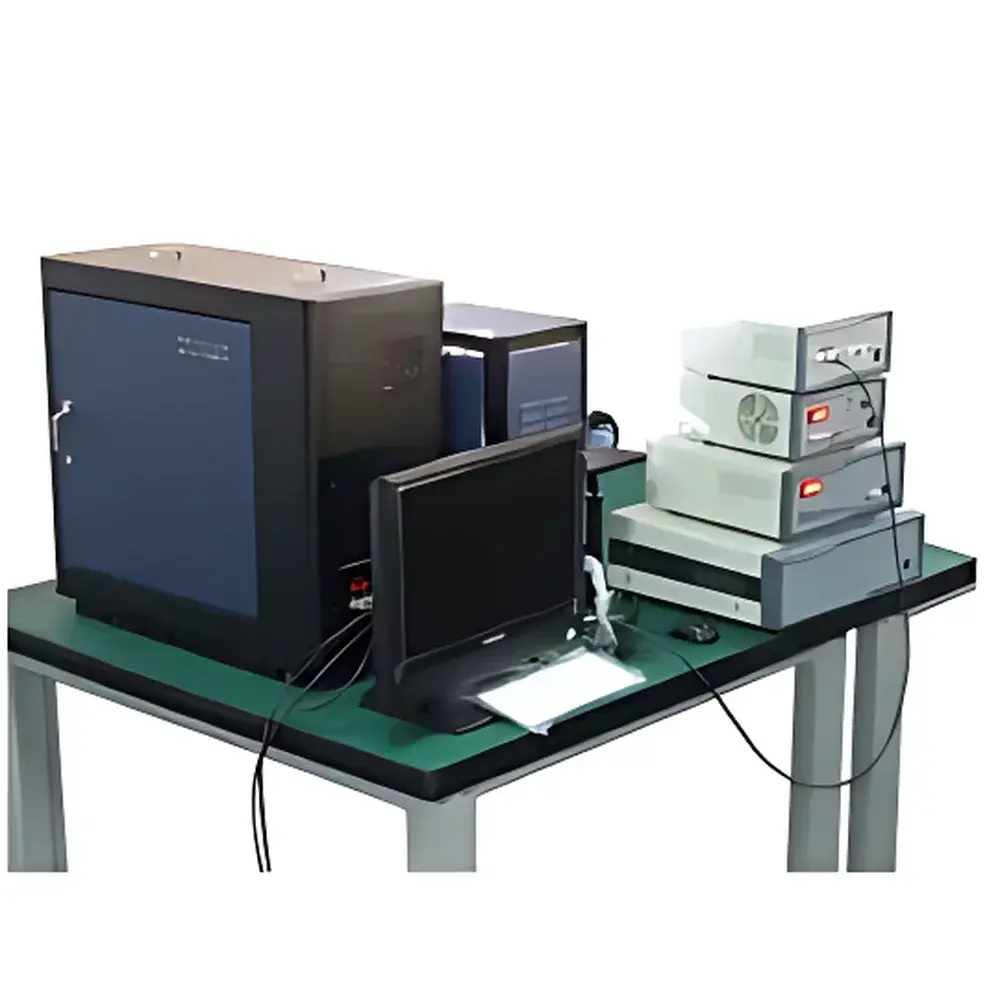
ZOLIX SCS10-DSSC Dedicated IPCE Measurement System for Dye-Sensitized Solar Cells
| Brand | ZOLIX |
|---|---|
| Origin | Beijing, China |
| Manufacturer Type | Manufacturer |
| Origin Category | Domestic |
| Model | SCS10-DSSC |
| Pricing | Upon Request |
| Measurement Mode | DC |
| Spectral Range | 300–1100 nm |
| Measurable Parameters | Spectral Responsivity, Incident Photon-to-Current Efficiency (IPCE), Short-Circuit Current Density (J<sub>sc</sub>) |
| Maximum Sample Area | 100 mm × 100 mm |
| Test Spot Size | 2–10 mm |
| Wavelength Accuracy | ±0.2 nm (@1200 g/mm grating) |
| Minimum Wavelength Step | 0.1 nm (recommended: 5 nm) |
| Filtering | Motorized multi-stage spectral rejection system with dual filter wheels |
| Detector | Calibrated standard silicon photodiode with NIST-traceable responsivity certificate |
| Data Acquisition Sensitivity | 100 nA |
| Sample Holder | Custom “sandwich”-style DSSC fixture |
| Required Optical Table Footprint | ≥1200 mm × 800 mm |
| Software Platform | Windows 7 (licensed), dedicated DSSC IPCE acquisition and analysis suite |
Overview
The ZOLIX SCS10-DSSC is a purpose-engineered quantum efficiency test system optimized exclusively for the characterization of dye-sensitized solar cells (DSSCs). It implements monochromatic photon flux calibration and precision photocurrent measurement under controlled bias conditions to determine incident photon-to-current conversion efficiency (IPCE), also known as external quantum efficiency (EQE), across the full photoactive range from ultraviolet to near-infrared (300–1100 nm). The system operates on a DC-based measurement principle—compliant with ASTM E1021 and IEC 60904-8 standards for spectral response evaluation—enabling high reproducibility in Jsc derivation and wavelength-resolved charge-collection analysis. Its vertically oriented, all-reflective optical path eliminates chromatic aberration, ensures uniform beam quality across the spectral scan, and permits stable horizontal sample mounting—a critical requirement for fragile, liquid-electrolyte-containing DSSC architectures.
Key Features
- Monochromator-driven DC photocurrent measurement with motorized, dual-wheel optical filtering for precise bias light control and stray-light suppression.
- Dual-filter-wheel configuration: one wheel positioned near the bias light source (75 W tungsten-halogen lamp) and another integrated into the main optical train; each wheel provides six selectable positions including neutral density filters (OD 0–2) and open apertures.
- Calibrated silicon reference detector traceable to national standards, supplied with full responsivity certification for absolute photon flux normalization.
- Integrated three-axis manual translation stage for micron-level alignment of monochromatic spot (2–10 mm diameter) onto the active area of DSSC devices up to 100 mm × 100 mm.
- Dedicated firmware and GUI software preconfigured for DSSC-specific protocols—including automated dark-current subtraction, bias-light sequencing, and real-time IPCE curve generation.
- Compliance-ready architecture: supports audit trails, user access levels, and parameter logging compatible with GLP/GMP documentation requirements.
Sample Compatibility & Compliance
The SCS10-DSSC accommodates standard “sandwich”-structured DSSCs fabricated on FTO/ITO-coated glass substrates, with or without liquid, quasi-solid, or solid-state electrolytes. Its horizontal sample stage and low-vibration optical layout minimize mechanical stress during long-duration scans. All optical components—including gratings, mirrors, and filter mounts—are selected for thermal stability and UV durability. The system meets essential electrical safety standards (IEC 61010-1) and optical radiation safety guidelines (IEC 62471). Measurement methodology aligns with ISO 18557 (photovoltaic spectral response testing) and supports traceable validation per ISO/IEC 17025 when used with certified reference detectors and calibrated lamps.
Software & Data Management
The bundled Windows 7–based application provides intuitive workflow management for IPCE acquisition, post-processing, and report export. Users define bias conditions (e.g., 0.1 Sun halogen illumination), select scan parameters (start/stop wavelength, step size, integration time), and configure automatic zero-current baseline correction. Raw current data are recorded with timestamp, wavelength, and bias state metadata. Export formats include CSV, ASCII, and XML for third-party analysis (e.g., MATLAB, Python, Origin). Audit-log functionality records operator ID, session start/end time, instrument configuration changes, and calibration events—facilitating 21 CFR Part 11 compliance when paired with electronic signature modules.
Applications
- Quantitative comparison of dye absorption profiles and electron injection efficiencies across molecular sensitizers (e.g., N719, C101, organic push-pull dyes).
- Evaluation of interfacial recombination losses via bias-dependent IPCE analysis (e.g., suppressed mid-gap response under forward bias).
- Validation of TiO2/ZnO mesoporous film thickness and scattering layer effectiveness through spectral shape analysis.
- Quality control of large-area screen-printed or spray-deposited DSSC modules under standardized illumination protocols.
- Support for academic and industrial R&D in next-generation photoelectrochemical systems, including perovskite-DSSC hybrids and tandem configurations.
FAQ
What bias light sources are supported?
The system integrates a 75 W tungsten-halogen lamp with two independently controllable filter wheels, enabling continuous adjustment of bias irradiance from 0 to 0.1 Sun (AM1.5G-equivalent) using calibrated neutral density filters (OD 0–2).
Can the system measure AC-coupled response?
No—the SCS10-DSSC is engineered exclusively for DC-mode operation to ensure compatibility with electrochemical stability requirements of liquid-electrolyte DSSCs; AC modulation (e.g., lock-in detection) is not implemented.
Is calibration traceability provided?
Yes: the included silicon photodiode carries a NIST-traceable responsivity certificate valid at specified wavelengths (300–1100 nm), and all spectral scans are normalized using this reference.
How is stray light minimized during NIR measurements?
Motorized multi-stage filtering—including order-sorting filters and dual-position ND wheels—suppresses higher-order diffraction and broadband leakage, particularly critical above 800 nm where silicon detector noise increases.
Does the software support batch processing of multiple samples?
Yes: users may define template measurement sequences and apply them across sample sets, with auto-generated file naming, folder structuring, and summary statistics per run.






