
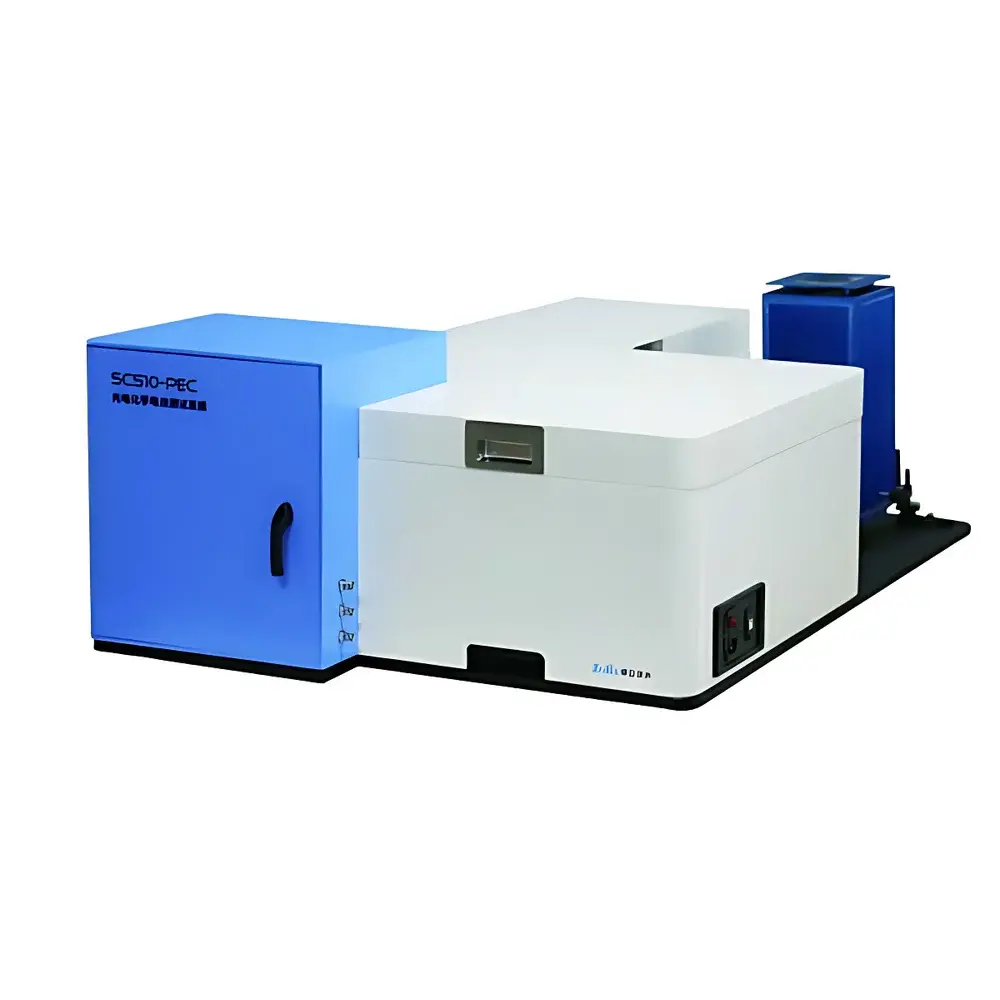
ZOLIX SCS10-PEC Photoelectrochemical Cell Measurement System
| Brand | ZOLIX |
|---|---|
| Origin | Beijing, China |
| Manufacturer Type | Manufacturer |
| Regional Category | Domestic (China) |
| Model | SCS10-PEC |
| Price Range | USD 70,000–100,000 (FOB) |
| Measurement Mode | DC |
| Spectral Range | 300–1100 nm |
| Light Source | Class ABA Solar Simulator |
| Irradiance | >400 µW/cm² |
| Electrode Configuration | Three-electrode system |
| Sample Size Capacity | 50 mm × 50 mm |
| Potentiostat Voltage Range | ±5 V |
| Voltage Resolution | 10 µV |
| Zero-Offset Error | <100 µV |
| Full-Scale Voltage Control Accuracy | <1 mV |
| Current Measurement Accuracy | <0.1% |
| Current Resolution | 100 pA (standard), 1 pA (with microcurrent extension) |
| Current Range | ±50 µA to ±5 mA (standard), up to ±1 A / 12 V (high-current option) |
| Compatible Electrochemical Techniques | CV, LSV, CA, CP, EIS (DC-biased) |
Overview
The ZOLIX SCS10-PEC Photoelectrochemical Cell Measurement System is an integrated instrumentation platform engineered for quantitative characterization of photoelectrodes and photoelectrochemical (PEC) solar cells under controlled illumination and electrochemical biasing conditions. It operates on the fundamental principle of separating photogenerated charge carriers at semiconductor–electrolyte interfaces and measuring their interfacial kinetics via simultaneous optical excitation and potentiostatic/galvanostatic control. The system combines a Class ABA solar simulator with spectral fidelity across 300–1100 nm—covering UV, visible, and near-infrared regions relevant to metal oxide, perovskite, and emerging chalcogenide photoanodes/cathodes—with a high-fidelity, low-noise potentiostat capable of sub-picoampere current resolution. Designed specifically for PEC research labs, it supports standardized protocols for incident photon-to-current efficiency (IPCE), external quantum efficiency (EQE), and action spectrum analysis in aqueous and non-aqueous electrolytes.
Key Features
- Class ABA-certified solar simulator delivering spectrally matched irradiance ≥400 µW/cm² at AM 1.5G conditions, traceable to NIST-calibrated reference cells
- Integrated three-electrode electrochemical cell configuration (working, counter, and reference electrodes) with corrosion-resistant fluidic interfaces compatible with common PEC electrolytes (e.g., Na₂SO₄, KOH, LiI/I₂)
- Dual-light-source architecture: switchable between broadband solar simulation and monochromatic illumination (300–1100 nm, continuous wavelength tuning via grating-based monochromator)
- Modular potentiostat with ±5 V compliance, 10 µV potential resolution, and <100 µV zero-offset error—validated per ASTM E2095 and ISO 17025 calibration practices
- DC measurement mode optimized for steady-state photocurrent quantification, including I/V curve acquisition under variable light intensity or bias, time-resolved I/T and V/T profiling, and dark current subtraction
- U-disk–based control firmware enabling standalone operation; no host PC required for basic measurements—supports GLP-compliant audit trails when connected to compliant software
Sample Compatibility & Compliance
The SCS10-PEC accommodates planar photoelectrode substrates up to 50 mm × 50 mm, including FTO/ITO/glass-supported metal oxides (TiO₂, BiVO₄, Fe₂O₃), silicon heterojunctions, and thin-film perovskites. All optical and electrochemical components comply with IEC 61215 and ASTM G173-03 spectral irradiance standards. The potentiostat module meets IEC 61000-4-3 immunity requirements and supports optional 21 CFR Part 11–compliant electronic signatures when paired with validated data acquisition software. System design adheres to ISO/IEC 17025 guidelines for measurement uncertainty estimation, particularly for EQE reproducibility (<±1.5% RSD across triplicate scans at λ = 450 nm).
Software & Data Management
Instrument control and data acquisition are managed via ZOLIX’s proprietary PEC-Studio software (Windows 10/11, 64-bit), which provides automated wavelength-swept EQE mapping, multi-step I/V protocol sequencing, and real-time overlay of photocurrent transients with concurrent light-intensity logging. Raw data export follows HDF5 format with embedded metadata (wavelength, bias, integration time, electrode area, electrolyte composition), ensuring FAIR (Findable, Accessible, Interoperable, Reusable) principles. Audit-trail functionality records user actions, parameter changes, and calibration events—fully traceable for GLP/GMP-regulated environments. Optional API integration enables MATLAB® and Python-driven batch analysis for machine learning–assisted PEC performance clustering.
Applications
- Quantitative IPCE/EQE mapping of photoanodes for water oxidation and CO₂ reduction
- Stability assessment of PEC devices via chronoamperometry under constant illumination and applied bias
- Charge transfer resistance extraction from DC-biased current–voltage sweeps combined with post-test EIS validation
- Interfacial recombination kinetics analysis using transient photocurrent decay under chopped illumination
- Comparative benchmarking of novel photocatalysts against NREL-traceable reference electrodes (e.g., Ag/AgCl, SCE)
- Development of tandem PEC configurations requiring spectral responsivity deconvolution across stacked absorbers
FAQ
Does the SCS10-PEC support electrochemical impedance spectroscopy (EIS)?
Yes—when operated in DC-biased mode, the system can superimpose small-amplitude AC perturbations (10 mV RMS, 0.1–100 kHz) for frequency-domain impedance analysis. EIS data are acquired synchronously with DC photocurrent monitoring.
Is calibration of the monochromator wavelength scale traceable to national standards?
Yes—the grating position encoder is factory-calibrated using Hg/Ne emission lines (404.7 nm, 546.1 nm, 589.3 nm, 656.3 nm), with certificate of calibration provided per ISO/IEC 17025.
Can the system measure photocurrents below 1 pA?
With the optional microcurrent extension module (active guarding, low-noise Faraday cage), the system achieves 1 pA resolution and <5 fA RMS noise floor (10 s integration), suitable for ultra-low-activity catalyst evaluation.
What electrolyte compatibility is verified by the manufacturer?
Standard wet-cell fixtures are validated for aqueous solutions (pH 0–14), acetonitrile-based redox shuttles, and molten salt electrolytes up to 200 °C—custom high-temperature/pressure cells available upon request.
Is remote operation supported?
Yes—via Ethernet-connected operation with secure TLS-encrypted command interface; full remote control, real-time data streaming, and alarm notification are enabled through optional ZOLIX CloudLink gateway.







