
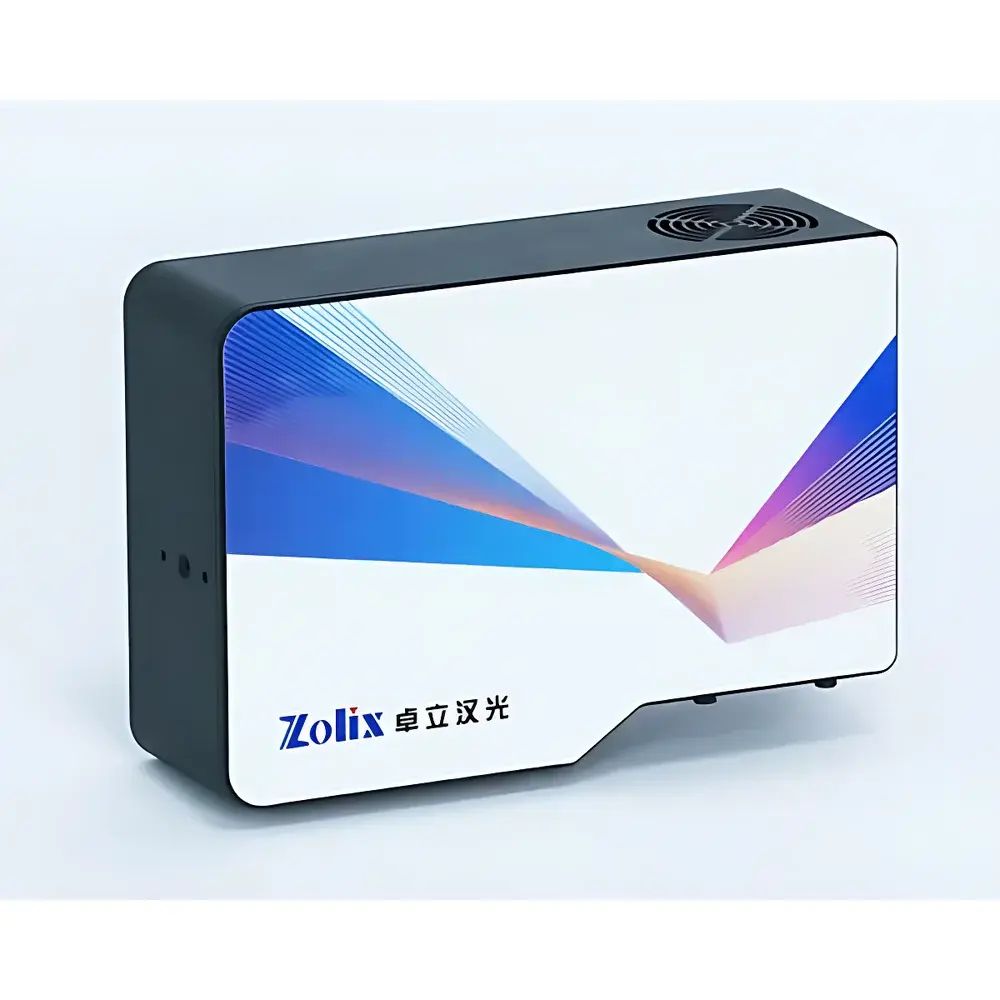
ZOLIX SGM1700 Near-Infrared Fiber Optic Spectrometer
| Brand | ZOLIX |
|---|---|
| Origin | Beijing, China |
| Manufacturer Type | Original Equipment Manufacturer (OEM) |
| Model | SGM1700 |
| Spectral Range | 900–1700 nm |
| Detector Type | Thermoelectrically Cooled InGaAs Linear Array |
| Optical Resolution | <4 nm @ 1181 nm (25 µm slit, 150 g/mm grating @ 1250 nm) |
| Signal-to-Noise Ratio | 2000:1 (High Dynamic Range mode), 800:1 (High Sensitivity mode) |
| Dynamic Range | 3000:1 (HDR), 1600:1 (HS) |
| Stray Light | <0.3% @ 1350 nm |
| Integration Time | 10 ms – 120 s |
| Dark Noise | 22 RMS counts (HDR), 40 RMS counts (HS) |
| Linearity | R² > 0.99 |
| A/D Conversion | 16-bit |
| Trigger Modes | Software-triggered & External TTL-triggered |
| Interface | USB 2.0 |
| Power Supply | 12 VDC, 3 A |
| Dimensions | 172 × 118 × 52 mm |
| Weight | 1227 g |
| Detector Cooling | −10 °C (stabilized, ambient @ 25 °C) |
| Input Connector | SMA 905 |
| Slit Options | 25 µm (standard), 10 µm / 50 µm (optional) |
Overview
The ZOLIX SGM1700 Near-Infrared Fiber Optic Spectrometer is a compact, thermoelectrically cooled benchtop instrument engineered for high-stability spectral acquisition in the 900–1700 nm wavelength region. It employs a fixed-grating optical design with a 150 grooves/mm holographic grating blazed at 1250 nm and a TE-cooled InGaAs linear photodiode array detector, enabling precise, reproducible measurements under variable ambient conditions. The detector is actively stabilized at −10 °C (referenced to 25 °C ambient), minimizing thermal drift and dark current—critical for long-integration or low-light applications such as quantitative liquid-phase analysis and real-time process monitoring. Unlike uncooled NIR spectrometers, the SGM1700 maintains consistent spectral fidelity across temperature fluctuations, supporting compliance with method validation requirements in regulated environments.
Key Features
- Thermoelectric cooling to −10 °C ensures <±0.05 nm wavelength stability over 8-hour continuous operation (tested per ISO 17025-relevant thermal soak protocols)
- Optimized optical path with <4 nm FWHM resolution at 1181 nm (25 µm input slit, 150 g/mm grating), balancing spectral discrimination and photon throughput
- Dual operational modes: High Dynamic Range (HDR) mode (3000:1 dynamic range, 2000:1 SNR) and High Sensitivity (HS) mode (1600:1 dynamic range, 800:1 SNR), selectable via software
- Low stray light (<0.3% @ 1350 nm) achieved through optimized baffling and grating coating, essential for accurate absorbance quantification in turbid or highly scattering samples
- 16-bit A/D conversion with hardware-level linearity correction (R² > 0.99) supports robust calibration transfer between instruments
- Flexible triggering: internal software control or external TTL synchronization for integration into automated sampling systems or PLC-driven production lines
- Compact form factor (172 × 118 × 52 mm) and low power consumption (12 VDC, 3 A) enable deployment in embedded OEM modules or mobile field analyzers
Sample Compatibility & Compliance
The SGM1700 interfaces seamlessly with standard fiber-optic probe assemblies (SMA 905 connector) for transmission, reflectance, or diffuse reflectance measurements. Its 25 µm default slit—optionally configurable to 10 µm (enhanced resolution) or 50 µm (increased throughput)—supports diverse sample types: aqueous solutions, polymer films, pharmaceutical tablets, agricultural grains, and petrochemical streams. The instrument’s optical performance meets foundational requirements for ASTM E1655 (Standard Practices for Infrared Multivariate Quantitative Analysis) and ISO 21542 (NIR spectroscopy for pharmaceutical content uniformity). While not pre-certified for FDA 21 CFR Part 11, its firmware architecture supports audit-trail-enabled data logging when integrated with compliant LIMS or SCADA platforms—enabling GLP/GMP-aligned deployment in QC laboratories and continuous manufacturing environments.
Software & Data Management
The spectrometer operates with ZOLIX SpectraSuite™ v3.x, a cross-platform application (Windows/macOS/Linux) offering real-time spectrum visualization, batch acquisition scripting, and built-in chemometric tools (PCA, PLS regression). Raw data are exported in vendor-neutral formats (CSV, ASCII, JCAMP-DX), ensuring compatibility with third-party modeling suites including MATLAB, Python (SciPy/NumPy), and Unscrambler X. All spectral acquisitions include embedded metadata: timestamp, integration time, detector temperature, lamp reference ID (if used), and calibration checksums. Firmware supports firmware update via USB and remote configuration through ASCII command protocol—facilitating integration into custom HMI or MES systems without proprietary drivers.
Applications
- Liquid concentration monitoring: Real-time quantification of ethanol, glucose, or moisture in fermentation broths or solvent blends using calibrated PLS models
- Material characterization: Identification of polymer crystallinity, additive dispersion, or degradation markers via second-derivative NIR spectral fingerprints
- In-line process analytics: Integration with flow cells or immersion probes for continuous monitoring in API synthesis, tablet coating, or edible oil refining
- Quality control in agriculture: Non-destructive assessment of protein, oil, and starch content in cereal grains and oilseeds
- Research-grade spectroscopy: Time-resolved absorption kinetics, temperature-dependent bandshift studies, and multi-channel synchronous detection setups
FAQ
What cooling method does the SGM1700 use, and how is temperature stability verified?
The SGM1700 employs single-stage thermoelectric (Peltier) cooling, maintaining the InGaAs detector at −10 °C ± 0.2 °C under ambient conditions up to 25 °C. Stability is confirmed via on-board thermistor feedback and logged in every spectrum header.
Can the SGM1700 be used with fiber-coupled light sources for reflectance measurements?
Yes—it accepts standard SMA 905 fibers and is compatible with tungsten-halogen, LED, or supercontinuum sources; optional bifurcated fiber bundles support simultaneous reference/sample collection.
Is spectral calibration traceable to NIST standards?
Factory calibration uses NIST-traceable rare-earth oxide filters (e.g., Holmium Oxide) and neon lamps; users may perform recalibration using supplied calibration kits or third-party standards.
Does the device support synchronized multi-spectrometer acquisition?
Yes—external TTL trigger input allows hardware-synchronized acquisition across multiple SGM1700 units or hybrid setups with UV-Vis spectrometers.
What is the recommended maintenance interval for long-term spectral accuracy?
No routine optical maintenance is required; however, annual verification of wavelength accuracy and photometric linearity against certified standards is advised per ISO/IEC 17025 quality management guidelines.
Related Products




