
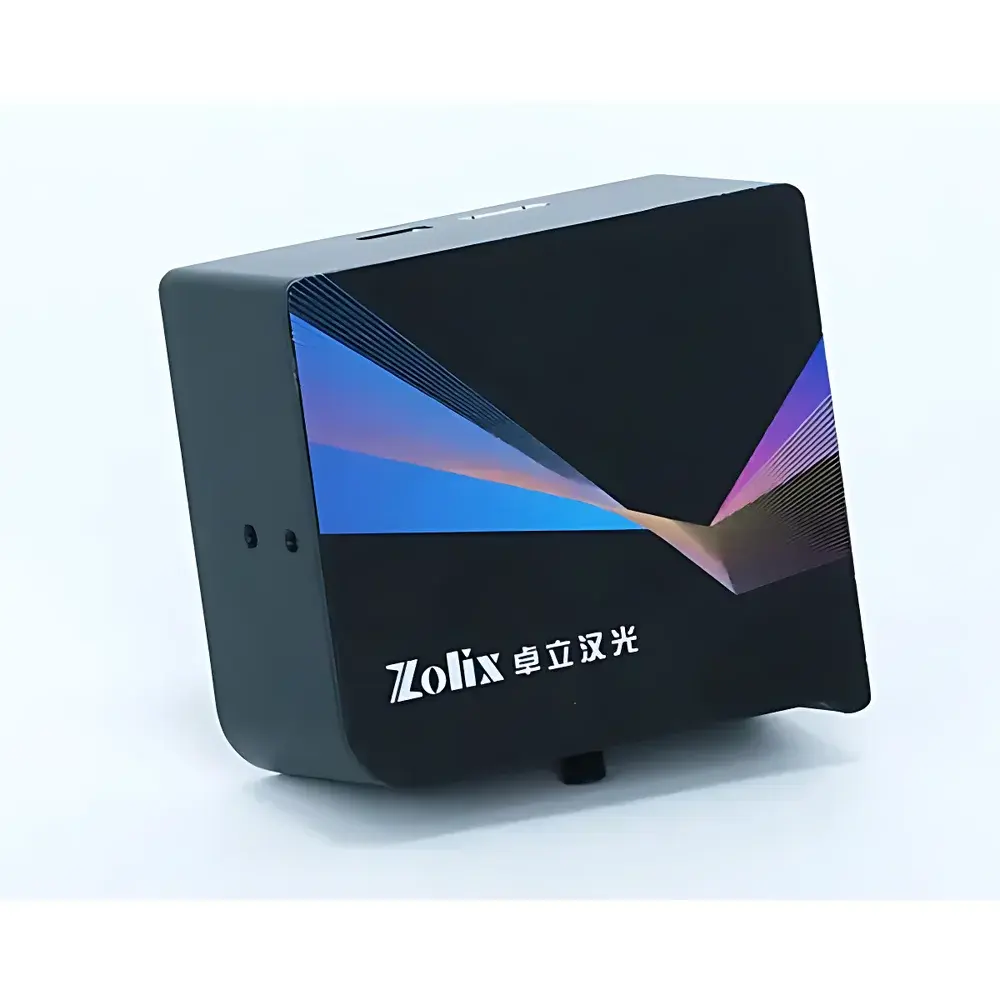
ZOLIX SGM30 Series Fiber Optic Spectrometer
| Brand | ZOLIX |
|---|---|
| Origin | Beijing, China |
| Manufacturer Type | Direct Manufacturer |
| Product Origin | Domestic (China) |
| Model | SGM30 Series |
| Spectral Range | 200–1150 nm |
| Optical Resolution | <1.6 nm @ 546 nm |
| Signal-to-Noise Ratio (SNR) | 300:1 (full signal) |
| Dynamic Range | 3000:1 |
| Stray Light | <0.3% @ 625 nm |
| Detector | Back-thinned CCD |
| A/D Conversion | 16-bit |
| Integration Time | 10 ms – 65 s |
| Input Interface | SMA905 |
| Slit Options | 10, 25, 50, 100, 200 µm |
| Dark Noise | 20 RMS counts |
| Dimensions | 74 × 69 × 35 mm |
| Weight | 211 g |
| Power Supply | 500 mA @ 5 VDC |
| Communication | USB 2.0 (plug-and-play, Windows-compatible) |
Overview
The ZOLIX SGM30 Series Fiber Optic Spectrometer is a compact, high-stability dispersive spectrometer engineered for precision spectral acquisition across the deep ultraviolet to near-infrared (DUV–NIR) range. Based on a Czerny–Turner (CT) optical architecture with optimized aberration correction, the SGM30 delivers consistent wavelength calibration and minimal thermal drift—critical for long-term unattended operation in both laboratory and industrial environments. Its core detector is a back-thinned CCD sensor, selected for high quantum efficiency across 200–1150 nm, enabling reliable detection from mercury line validation at 253.7 nm to broad-band NIR emission analysis up to 1100 nm. The spectrometer’s fixed mechanical design, combined with thermally stable optical mounting and low-stray-light grating coatings, ensures reproducible performance under variable ambient conditions—making it suitable for integration into OEM instrumentation, inline process monitoring systems, and field-deployable analytical platforms.
Key Features
- Czerny–Turner optical layout with kinematically mounted optics for long-term wavelength stability and minimal thermal shift
- Back-thinned CCD detector with peak QE >90% in visible range and extended DUV/NIR response
- Standard SMA905 fiber input interface compatible with industry-standard 200–600 µm core fibers
- Configurable slit options (10, 25, 50, 100, 200 µm) to balance resolution and throughput per application requirements
- 16-bit analog-to-digital conversion enabling high dynamic range capture without saturation or quantization loss
- USB 2.0 interface with vendor-neutral HID-class driver support; fully compatible with Windows 10/11 (x64/x86), no additional runtime dependencies
- Ultra-compact form factor (74 × 69 × 35 mm) and lightweight construction (211 g) for embedded or portable deployment
- Low dark noise (20 RMS counts) and calibrated stray light suppression (<0.3% @ 625 nm) supporting quantitative absorbance and reflectance measurements
Sample Compatibility & Compliance
The SGM30 series supports direct coupling to liquid cuvette holders, integrating sphere accessories, fiber-coupled light sources (e.g., deuterium-halogen, LED, or laser diodes), and probe-based sampling configurations. It complies with general-purpose spectroscopic measurement standards including ASTM E308 (computing colorimetric data), ISO 13406-2 (optical system characterization), and IEC 61223-3-5 (performance testing of medical optical devices). While not certified as a Class I medical device, its hardware architecture and firmware logging capabilities align with GLP/GMP documentation practices—supporting audit-ready timestamped spectral acquisition, user-defined metadata tagging, and raw data export in HDF5 and CSV formats. The absence of moving parts and sealed optical path eliminates recalibration drift, facilitating routine use in regulated QC/QA workflows where traceability and inter-unit consistency are required.
Software & Data Management
ZOLIX provides the SpectraMaster SDK—a cross-platform C/C++ and Python API—with full source examples, memory-mapped buffer access, and real-time callback hooks for high-throughput streaming. The included SpectraView GUI offers live spectrum display, baseline correction (Rubberband, polynomial), peak search with FWHM reporting, absorbance/transmittance conversion, and multi-scan averaging. All spectral acquisitions include embedded EXIF-like metadata: integration time, slit width, grating ID, detector temperature (monitored via on-board thermistor), and firmware revision. Export options include ASCII, CSV, and HDF5—enabling seamless ingestion into MATLAB, Python (NumPy/Pandas), LabVIEW, or LIMS environments. Audit trail functionality records operator ID, acquisition timestamp, and instrument configuration changes—meeting foundational requirements for FDA 21 CFR Part 11 compliance when deployed with validated IT infrastructure.
Applications
- Real-time UV-Vis absorbance monitoring in water quality analyzers (e.g., nitrate, COD, TOC estimation)
- Laser wavelength and linewidth verification in R&D and production test benches
- LED phosphor emission profiling and CCT/CRI calculation in lighting QA
- OEM integration into handheld spectrophotometers, agricultural sensors, and pharmaceutical dissolution testers
- Field-deployable environmental monitoring for solar irradiance, algal bloom detection, and atmospheric gas absorption screening
- Plasma emission analysis in semiconductor process chambers and thin-film deposition systems
FAQ
What spectral calibration options are available for the SGM30 series?
Factory calibration uses NIST-traceable Hg/Ar/Ne spectral lamps. Users may perform custom wavelength and intensity calibration using external standards; calibration files are stored in non-volatile memory and persist across power cycles.
Can the SGM30 operate in continuous acquisition mode at maximum frame rate?
Yes—maximum sustained acquisition rate is 120 spectra/s (at 10 ms integration time, full 2048-pixel readout), limited only by USB 2.0 bandwidth and host system buffering.
Is there thermal stabilization for the detector or optical bench?
The SGM30 relies on passive thermal management and low-coefficient materials; active TEC cooling is not integrated but can be implemented externally via custom housing if required for sub-0.1 nm wavelength stability over >8-hour runs.
Are OEM volume discounts and custom firmware features supported?
Yes—ZOLIX offers tiered volume pricing, private-label branding, and firmware customization (e.g., trigger logic, packet formatting, embedded algorithms) under NDA with documented change control and versioned release archives.
Related Products






