
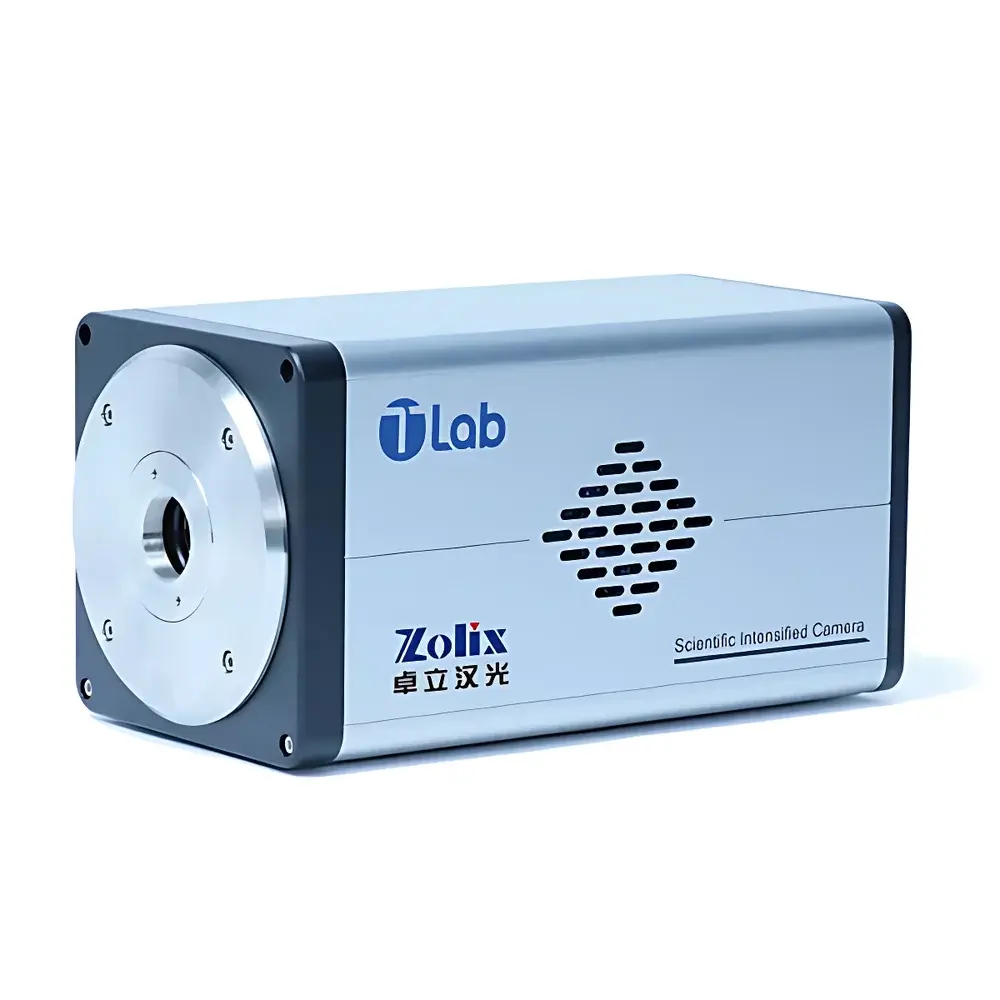
ZOLIX SIC Series Scientific Intensified sCMOS Camera
| Brand | ZOLIX |
|---|---|
| Origin | Beijing, China |
| Manufacturer Type | Original Equipment Manufacturer (OEM) |
| Product Category | Domestic High-Performance Scientific Imaging System |
| Model | SIC Series |
| Image Resolution | 4.0 MP (2048 × 2048), Back-Illuminated sCMOS Sensor |
| Pixel Size | 6.5 µm × 6.5 µm |
| Quantum Efficiency | >95% @ 600 nm |
| Optical Gate Width | <3 ns (Ultra-Fast Mode) |
| Delay & Gating Accuracy | 10 ps |
| Cathode Gating Repetition Rate | Up to 300 kHz |
| Fiber-Optic Taper Coupling (1 | 1) |
| Cooling | −35 °C below ambient |
| Readout Noise | 1.1 e⁻ (median), 1.2 e⁻ (RMS) @ −15 °C |
| Dark Current | 0.15 e⁻/pixel/s @ −15 °C |
| Bit Depth | 16-bit |
| Max Frame Rate | 35 fps (full frame, 1 ms exposure) |
| Spectral Response | 190–950 nm (configurable photocathode options: S20, S20B, S25Q) |
| Interface | USB 3.0 |
Overview
The ZOLIX SIC Series Scientific Intensified sCMOS Camera is a high-performance, cryogenically cooled gated imaging system engineered for ultrafast, low-light scientific applications requiring temporal precision at the picosecond scale. It integrates a high-gain microchannel plate (MCP) image intensifier—available in 18 mm or 25 mm active diameter—with a back-illuminated scientific CMOS sensor via 1:1 fiber-optic taper coupling. This architecture preserves spatial fidelity while enabling single-photon sensitivity and sub-nanosecond optical gating. The camera operates on the principle of intensified time-resolved imaging: incident photons strike a photocathode (S20, S20B, or S25Q), generating photoelectrons accelerated through the MCP, which multiply the signal before phosphor conversion and direct coupling to the sCMOS chip. With quantum efficiency exceeding 95% at 600 nm and an optical gate width as narrow as <3 ns, the SIC series delivers exceptional signal-to-noise ratio (SNR) in transient phenomena such as laser-induced fluorescence, plasma diagnostics, combustion imaging, and time-resolved spectroscopy.
Key Features
- Ultrafast optical gating: <3 ns minimum gate width (Ultra mode), with selectable Fast (50 ns) configurations
- Precision timing control: Integrated digital delay generator (DDG) with 10 ps resolution for delay and gate width adjustment over 0–10 s range
- Cryogenic sCMOS sensor: Thermoelectric cooling to −35 °C below ambient, reducing dark current to 0.15 e⁻/pixel/s at −15 °C and median readout noise to 1.1 e⁻
- High-fidelity coupling: 1:1 fiber-optic taper interface ensures minimal light loss and maintains full 2048 × 2048 spatial resolution (4.0 MP)
- On-chip integration (IOC) mode: Supports up to 300 kHz cathode gating frequency for efficient accumulation of high-repetition-rate weak signals
- Flexible triggering: External TTL input/output, direct gate trigger (sub-50 ns intrinsic latency), 50 Ω impedance, 3–5 V threshold, <100 ps jitter
- Region-of-interest (ROI) readout: Configurable sub-arrays (row count multiple of 8) enabling frame rates up to 600 fps at reduced resolution
Sample Compatibility & Compliance
The SIC Series supports broad spectral coverage across UV-VIS-NIR (190–950 nm), configurable via interchangeable photocathodes (S20: 200–850 nm; S20B: 190–850 nm; S25Q: 200–950 nm). Its design complies with standard laboratory instrumentation requirements for electromagnetic compatibility (EMC) per IEC 61326-1 and safety per IEC 61010-1. While not certified for clinical use, the system meets functional requirements for GLP-compliant time-resolved measurement workflows—including audit-trail-capable timestamping, hardware-triggered acquisition synchronization, and deterministic latency behavior required in ISO/IEC 17025-accredited analytical laboratories. Data integrity is maintained through lossless 16-bit raw image capture and metadata-embedded acquisition parameters (exposure, gate delay, DDG settings).
Software & Data Management
T-Lab View software provides unified control of the SIC camera and ZOLIX spectrometers (e.g., Omni-λ 300/500/750). It supports dual operational modes: imaging and spectroscopic acquisition. Key capabilities include real-time ROI selection, multi-track spectral acquisition, automatic background subtraction, statistical analysis of user-defined regions, and wavelength calibration. IOC mode configuration, DDG step-scan (delay/gate width sweep), and synchronized spectral imaging are implemented with deterministic timing. All acquisition parameters—including hardware timestamps, trigger source, gain settings, and thermal sensor logs—are embedded in TIFF or HDF5 output files. Export formats comply with FAIR data principles (Findable, Accessible, Interoperable, Reusable), supporting integration into MATLAB, Python (NumPy/H5Py), and LabVIEW environments. No proprietary binary formats are used; metadata conforms to the TIFF/EXIF and NeXus standards where applicable.
Applications
The SIC Series is routinely deployed in fundamental and applied research domains demanding high temporal resolution and photon-starved sensitivity. These include: time-resolved laser-induced breakdown spectroscopy (LIBS); nanosecond-resolved plasma emission mapping; combustion chemiluminescence imaging; ultrafast photoluminescence decay profiling; pump-probe microscopy; streak-camera alternative setups for 2D time-resolved spectroscopy; and synchrotron/XFEL beam diagnostics where single-shot, gated detection is essential. Its compatibility with ZOLIX spectrographs enables time-resolved emission spectra acquisition with <3 ns time slicing—critical for studying excited-state dynamics in quantum dots, perovskites, and organic semiconductors. The 18 mm and 25 mm intensifier options allow optimization between field-of-view and light collection efficiency in custom optical train integrations.
FAQ
What is the minimum achievable optical gate width?
The Ultra mode achieves an optical gate width of <3 ns, verified using a 50 ps pulsed laser and autocorrelation-based measurement.
Can the camera operate in continuous acquisition mode without gating?
Yes—the sCMOS sensor supports standard non-gated exposure (1 ms–10 s), though intensifier bias must be disabled to avoid damage during prolonged illumination.
Is USB 3.0 bandwidth sufficient for full-frame 16-bit streaming at 35 fps?
Yes, under optimal host conditions (Intel Core i7+, 64-bit OS, dedicated USB 3.0 controller), sustained throughput exceeds 350 MB/s, accommodating full-frame 16-bit data at maximum rate.
How is timing synchronization ensured between the DDG and external laser systems?
Via low-jitter TTL triggers (input/output), with intrinsic delay <120 ns (external) or <50 ns (direct gate), traceable to internal 100 MHz clock referenced to GPS-disciplined oscillator options.
Are firmware updates and driver support provided for long-term deployment?
ZOLIX provides 5-year firmware maintenance cycles, Windows/Linux drivers (x64), and SDKs (C/C++, Python bindings) with documented API for automated integration into custom experiment control frameworks.




