
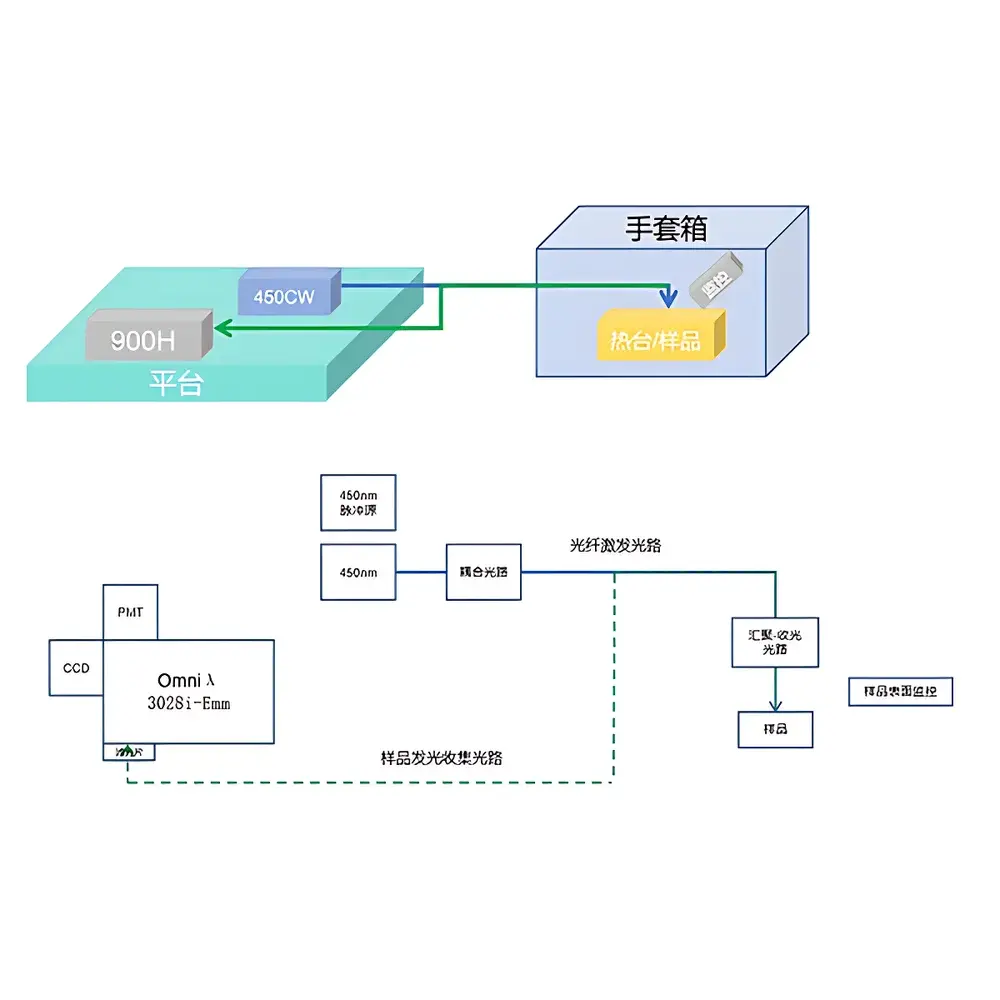
ZOLIX In-Situ Fluorescence Spectroscopy System for Glovebox Integration
| Brand | ZOLIX |
|---|---|
| Origin | Beijing, China |
| Manufacturer Type | Direct Manufacturer |
| Instrument Type | Steady-State & Time-Resolved Fluorescence Spectrometer |
| Dispersive Element | Grating + Bandpass Filters |
| Integration Configuration | Glovebox-Compatible Fiber-Coupled Optical Path (Y-Fiber Geometry) |
Overview
The ZOLIX In-Situ Fluorescence Spectroscopy System for Glovebox Integration is an engineered solution designed to enable non-invasive, real-time photoluminescence (PL) characterization of air-sensitive optoelectronic materials—particularly metal-halide perovskites—within inert-atmosphere gloveboxes. Unlike conventional benchtop fluorescence spectrometers requiring sample extraction and atmospheric exposure, this system implements a fully fiber-optic, in-situ measurement architecture based on collinear excitation-detection geometry. It operates on the principle of steady-state and time-resolved fluorescence spectroscopy, utilizing pulsed or CW laser excitation coupled via a Y-shaped multimode optical fiber. One arm delivers excitation light into the glovebox chamber; the other collects backscattered or front-emitted PL signal from the sample—whether spin-coated film, annealed thin-film device, or encapsulated prototype—and routes it to an external high-sensitivity spectrometer and time-correlated single-photon counting (TCSPC) module. This design preserves the integrity of oxygen- and moisture-sensitive samples throughout synthesis, processing, and testing phases—critical for reproducible quantum yield, lifetime, and spectral stability assessment under GLP-aligned experimental conditions.
Key Features
- Fiber-coupled Y-geometry optical path enabling full separation of excitation source and detection instrumentation from glovebox interior—no internal optical mounts or electronics required
- Simultaneous acquisition of steady-state emission spectra (200–1100 nm range, depending on grating selection) and nanosecond-to-microsecond fluorescence decay profiles via TCSPC
- Modular integration with standard N₂/Ar-purged gloveboxes (O₂ & H₂O < 0.1 ppm), compatible with common viewport configurations (e.g., 50 mm quartz windows, AR-coated)
- Optimized for low-light quantum efficiency measurements: includes thermoelectrically cooled back-illuminated CCD or intensified CMOS detector options
- Interchangeable excitation modules supporting 375 nm, 405 nm, 450 nm, and 532 nm diode or DPSS lasers—each with adjustable power (0.1–100 mW) and TTL synchronization
- Ruggedized fiber terminations with SMA905 connectors and vacuum-compatible feedthroughs rated for continuous operation at ≤10⁻³ mbar
Sample Compatibility & Compliance
The system supports in-situ characterization of thin-film semiconductors, quantum dots, 2D materials, and hybrid perovskite formulations deposited on glass, ITO, or flexible substrates. Sample stages may include hot/cold plates (−40 °C to 150 °C), spin coaters, thermal evaporators, or probe stations—all interfaced through standard glovebox ports. All optical components comply with ISO 17025 traceability requirements for calibration standards (NIST-traceable tungsten halogen and deuterium lamps). Data acquisition workflows support audit-ready metadata tagging (operator ID, timestamp, glovebox O₂/H₂O log, temperature setpoint), fulfilling foundational requirements for GLP and pre-GLP R&D documentation. While not FDA-certified as a medical device, the architecture aligns with principles outlined in USP Analytical Instrument Qualification and ASTM E2919-22 Standard Guide for Spectroscopic Measurement Uncertainty.
Software & Data Management
Control and analysis are performed via ZOLIX SpectraSuite™ v5.x—a platform compliant with 21 CFR Part 11 Annex 11 principles for electronic records and signatures. The software provides synchronized instrument control (laser trigger, spectrometer integration time, TCSPC histogram binning), automated background subtraction, lifetime multi-exponential fitting (Levenberg-Marquardt algorithm), and absolute quantum yield calculation using integrating sphere coupling (optional accessory). Raw data files (.spe, .sdt) are stored in vendor-neutral HDF5 format with embedded metadata schemas, enabling interoperability with MATLAB, Python (via h5py), and LabVIEW-based lab information management systems (LIMS). Audit trails record all parameter modifications, user logins, and export events with SHA-256 hashing—supporting laboratory QA/QC review cycles.
Applications
- In-situ monitoring of perovskite crystallization kinetics during anti-solvent dripping or thermal annealing inside gloveboxes
- Real-time degradation profiling under controlled illumination and bias stress in inert atmosphere
- Comparative PL quantum yield mapping across compositional gradients (e.g., Cs/FA/MA mixing ratios)
- Interface trap state analysis via time-resolved PL quenching at electron/hole transport layer junctions
- Validation of encapsulation barrier performance by tracking PL intensity and lifetime drift over 72+ hours
- Correlation of in-situ spectral shifts with XRD or FTIR data acquired on identical samples
FAQ
Can this system be retrofitted to an existing glovebox?
Yes—provided the glovebox features at least one optical-grade quartz viewport (≥40 mm clear aperture) and space for vacuum-rated fiber feedthroughs.
What is the minimum detectable PL intensity?
Detection limit depends on detector choice and integration time; typical SNR > 100:1 is achievable for 10⁴ photons/sec with 1 s integration using a cooled CCD.
Is laser safety certification included?
All integrated laser modules meet IEC 60825-1:2014 Class 3B or Class 4 requirements, with interlocked shutter controls and beam path enclosures compliant with ANSI Z136.1.
Does the system support polarization-resolved measurements?
Not natively—but optional motorized half-wave plates and wire-grid polarizers can be inserted into the excitation or collection arms upon request.
How is spectral calibration maintained during long-term glovebox operation?
Automated wavelength calibration is performed before each session using a built-in Hg/Ar pen-ray lamp; drift compensation algorithms correct for thermal lensing effects in real time.




