
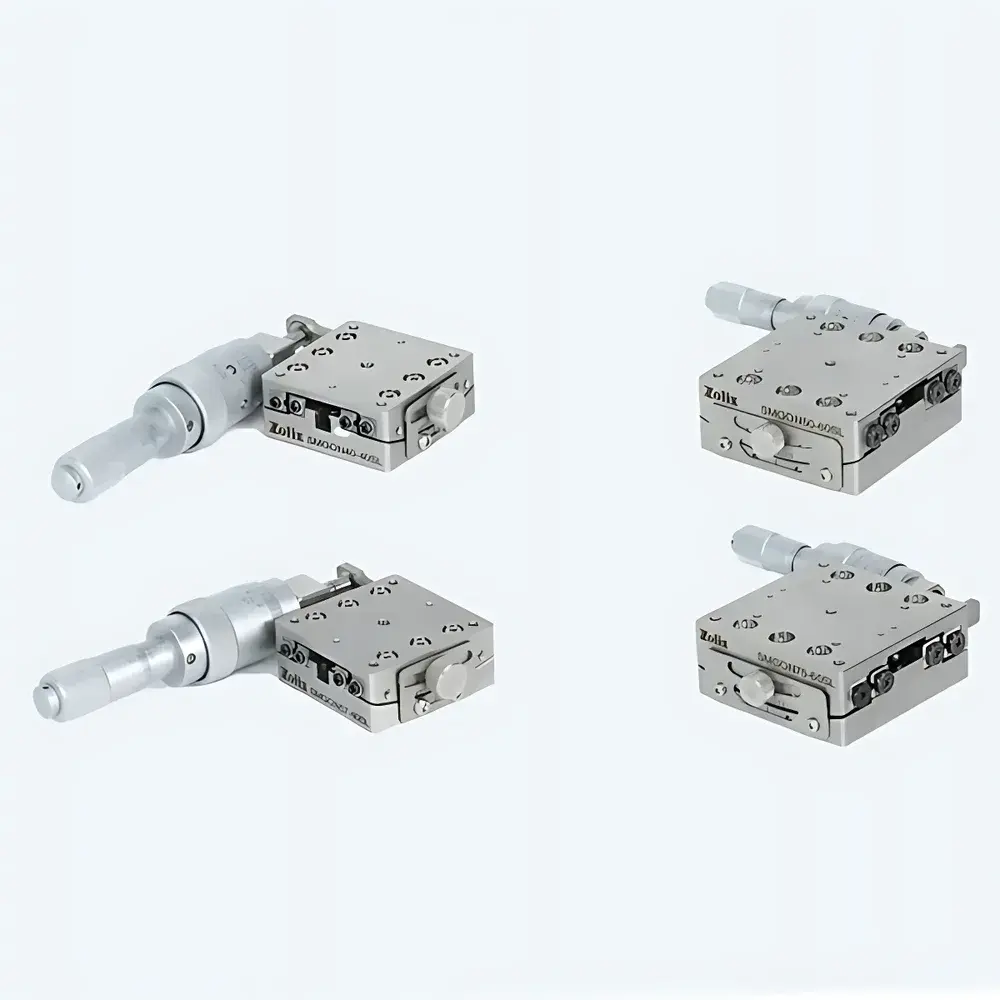
ZOLIX SMGON Series High-Precision Direct-Drive Manual Tip/Tilt Stage
| Brand | ZOLIX |
|---|---|
| Origin | Beijing, China |
| Manufacturer Type | Manufacturer |
| Product Category | Domestic |
| Model | SMGON |
| Price Range | USD 700–850 (FOB) |
| Product Type | Manual Translation Stage |
| Drive Mechanism | Differential Micrometer |
| Guidance | Arc-shaped V-groove Ball Bearing Rail |
| Construction Material | Stainless Steel |
| Motion Axes | θx, θy (Pitch & Yaw) |
| Mounting | Standard ISO/Metric Threaded Holes (e.g., M4, M6) on Top and Base |
Overview
The ZOLIX SMGON Series High-Precision Direct-Drive Manual Tip/Tilt Stage is a precision optical positioning device engineered for controlled angular adjustment about two orthogonal axes—pitch (θx) and yaw (θy). Unlike linear translation stages, tip/tilt stages enable fine rotational alignment of optical components such as mirrors, beam splitters, waveplates, or detectors within laser cavities, interferometers, or imaging systems. The SMGON stage employs a direct mechanical coupling between the differential micrometer actuator and the moving platform, eliminating backlash and gear-induced hysteresis. Its arc-shaped V-groove ball bearing rail system ensures high rigidity, repeatable motion, and minimal wobble during angular displacement—critical for maintaining beam pointing stability in alignment-sensitive applications. Designed and manufactured in Beijing by ZOLIX—a vertically integrated Chinese OEM specializing in optical motion control—the SMGON series meets the dimensional, material, and functional requirements typical of research-grade optical laboratories and industrial metrology setups.
Key Features
- Stainless steel monolithic base and platform construction for dimensional stability, corrosion resistance, and long-term thermal consistency
- Arc-shaped V-groove precision ball bearing guidance system offering high load capacity (up to 3 kg axial static load), low friction, and sub-arcsecond repeatability
- Differential micrometer drive with dual-scale vernier readout (typically 0.5 µm per division, translating to ~1.5–3 arcsec resolution depending on effective radius)
- Standardized mounting interface: top surface features a grid of M4 and M6 threaded holes conforming to common optical cage system spacing; base includes countersunk M6 holes for rigid integration into multi-axis stacks or breadboard mounts
- No lubrication required under normal lab conditions; maintenance-free operation over >100,000 adjustment cycles
- Zero-backlash kinematic design with preloaded contact geometry ensuring monotonic response and absence of stick-slip behavior
Sample Compatibility & Compliance
The SMGON stage is compatible with standard Ø1″, Ø2″, and 30 mm optical mounts via adapter plates or direct screw attachment. It supports passive and active optical elements up to 100 mm in diameter and 2.5 kg in mass without compromising angular stability. While not certified to ISO 9001 or CE for medical or aerospace use out-of-the-box, its mechanical design adheres to fundamental principles outlined in ISO 10110-7 (optical component mounting) and ANSI/OEOSC OP1.002 (optomechanical interface standards). All materials comply with RoHS Directive 2011/65/EU. For GLP/GMP-aligned labs, traceable calibration reports (angular deviation vs. micrometer reading) can be generated using autocollimators or digital theodolites per ISO 230-3.
Software & Data Management
As a fully manual stage, the SMGON requires no firmware, drivers, or software. However, its deterministic mechanical response enables straightforward integration into documented alignment workflows. Users may log micrometer readings alongside beam position data (e.g., from quadrant photodiodes or CCD-based alignment cameras) in LIMS or ELN platforms. When deployed in multi-axis configurations, positional metadata—including angular offsets, sequence timestamps, and environmental conditions (temperature, humidity)—can be recorded manually or via external scripting interfaces (e.g., Python-controlled stage logs using USB-digital caliper input). No FDA 21 CFR Part 11 compliance is applicable due to absence of electronic control or audit trail generation.
Applications
- Laser cavity alignment and resonator mode optimization in DPSS, Ti:sapphire, and fiber laser systems
- Interferometric null testing where mirror tilt must be adjusted iteratively to minimize fringe distortion
- Optical coherence tomography (OCT) reference arm path balancing
- Alignment of off-axis parabolic mirrors in ultrafast beam transport lines
- Calibration of angle-sensitive detectors including goniometers and position-sensitive diodes (PSDs)
- Education and training in undergraduate optics labs—demonstrating angular sensitivity, mechanical amplification, and error propagation in manual alignment
FAQ
What is the typical angular range for the SMGON stage?
Standard models provide ±2° total travel per axis (θx, θy), with optional extended-range variants offering ±4° upon request.
Can the SMGON stage be vacuum-compatible?
Yes—the stainless steel body and dry-running V-groove rails are suitable for UHV environments (<10−6 mbar) when assembled without adhesives or elastomeric seals.
Is thermal drift compensated in this design?
No active compensation is included; however, the low coefficient of thermal expansion (CTE ≈ 17.3 × 10⁻⁶/K) of 304 stainless steel minimizes thermally induced angular drift below 0.5 arcsec/°C over typical lab temperature gradients.
How is angular repeatability verified?
Repeatability is validated using an autocollimator traceable to NIST standards, with typical results showing ≤ ±1.2 arcsec over 50 bidirectional cycles at mid-range positions.
Are custom mounting patterns or material upgrades available?
Yes—ZOLIX offers OEM services including Invar base plates, non-magnetic 316L variants, and bespoke hole patterns aligned to customer-specific optomechanical standards (e.g., Thorlabs, Newport, or custom cage systems).





