
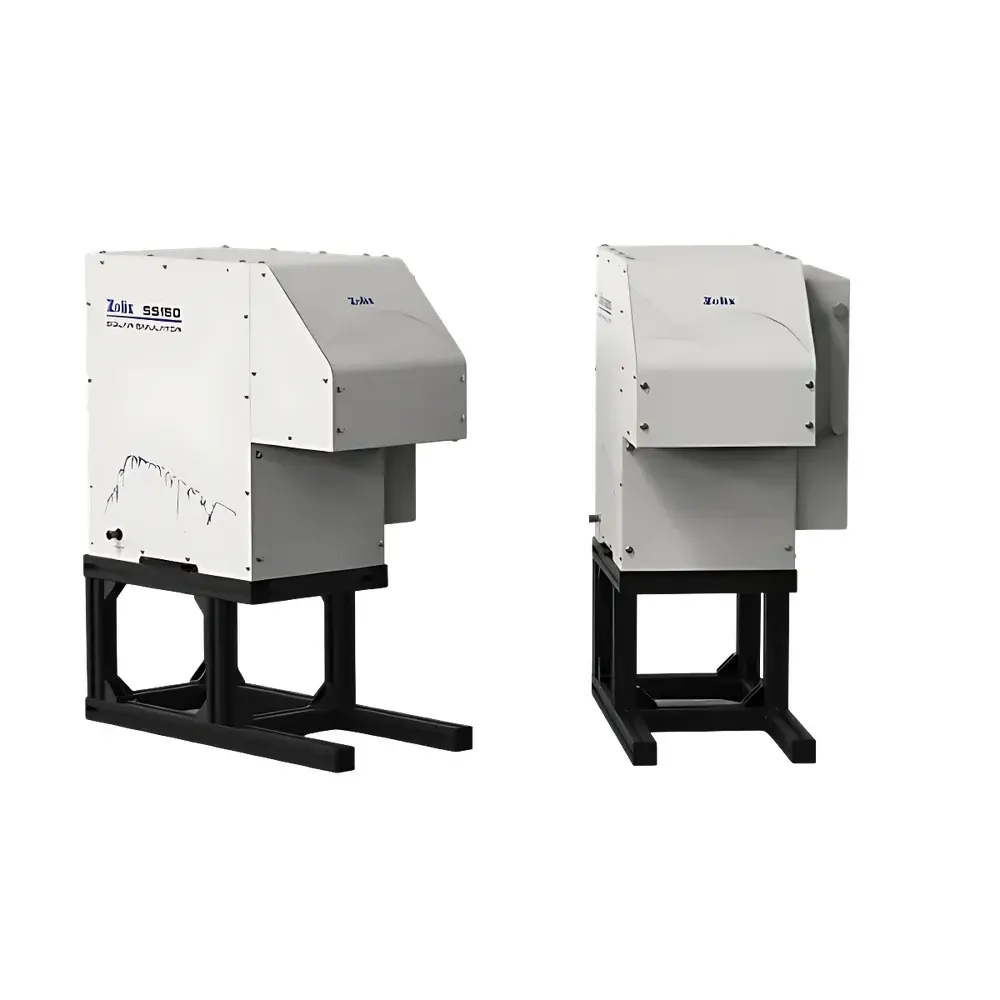
ZOLIX SolarS150 AAA-Class Steady-State Solar Simulator
| Brand | ZOLIX |
|---|---|
| Model | SolarS150 |
| Illumination Type | Steady-State |
| Spectral Classification | AAA (IEC 60904-9:2020) |
| Irradiance | 1200 W/m² (adjustable) |
| Uniformity | ≤2% (40 mm diameter field) |
| Spectral Match | Class A (300–1200 nm, ±25% tolerance vs. AM1.5G) |
| Temporal Stability | <2% over 10 min (Class A) |
| Light Source | Xenon arc lamp (150 W) |
| Beam Collimation | ≥±1.5° half-angle |
| Compliance | IEC 60904-9:2020, ASTM E927-22, JIS C 8912 |
Overview
The ZOLIX SolarS150 is a laboratory-grade, steady-state solar simulator engineered for high-fidelity photovoltaic (PV) device characterization under controlled indoor conditions. It operates on the principle of broadband xenon arc illumination, optically conditioned through precision collimating optics and spectral filtering to replicate the Air Mass 1.5 Global (AM1.5G) reference spectrum defined by IEC 60904-9:2020 and ASTM E927-22. Unlike pulsed or flash-type simulators, the SolarS150 delivers continuous, stable irradiance—enabling reliable current-voltage (I-V) curve tracing, quantum efficiency (QE) mapping, degradation studies, and long-term stability testing of solar cells and modules. Its optical architecture ensures minimal angular deviation (collimation angle ≤±1.5°), critical for minimizing measurement artifacts in devices sensitive to incidence angle—such as perovskite, organic photovoltaics (OPV), and multi-junction III-V cells.
Key Features
- AAA-class spectral match (Class A spectrum, Class A spatial uniformity, Class A temporal stability) per IEC 60904-9:2020 requirements
- Steady-state xenon lamp system (150 W) with integrated thermal management and real-time intensity feedback control
- Optimized collimated beam output with ≤2% irradiance non-uniformity across a 40 mm diameter test area
- Digital auto-timer with lamp-hour logging and predictive lifetime estimation based on operating voltage and arc stability metrics
- Modular filter set compatibility for spectral tailoring (e.g., UV-enhanced, IR-cut, or AM0 simulation)
- Front-panel interface with analog/digital I/O for external trigger synchronization and integration into automated test benches
Sample Compatibility & Compliance
The SolarS150 supports full-area and localized characterization of diverse PV technologies—including monocrystalline and polycrystalline silicon wafers, thin-film CIGS and CdTe substrates, dye-sensitized solar cells (DSSCs), organic photovoltaics (OPVs), perovskite mini-modules, and III-V multi-junction concentrator cells. Its 40 mm uniform field accommodates standard 1 cm² reference cells (e.g., KG5-filtered Si, GaAs, or Ge detectors) and small-area lab-scale devices. All performance specifications are validated against internationally recognized calibration protocols. The system meets full compliance with IEC 60904-9:2020 (Edition 3), ASTM E927-22 (Standard Specification for Solar Simulation for Photovoltaic Testing), and JIS C 8912. Traceable calibration certificates (NIST-traceable reference cell and spectroradiometer) are available upon request for GLP/GMP-aligned quality assurance workflows.
Software & Data Management
The SolarS150 integrates seamlessly with third-party source-measure units (SMUs) and data acquisition systems via IEEE-488 (GPIB), USB-TMC, or Ethernet (LXI). Optional ZOLIX PV-TestSuite software provides synchronized I-V sweep control, real-time irradiance normalization, temperature-compensated parameter extraction (Pmax, Voc, Isc, FF, η), and batch-mode reporting compliant with ISO/IEC 17025 documentation standards. Audit trails, user access levels, and electronic signatures support FDA 21 CFR Part 11 readiness when deployed in regulated R&D or QC environments. Raw spectral irradiance data (300–1200 nm, 1 nm resolution) and time-stamped intensity logs are exportable in CSV and HDF5 formats for post-processing in MATLAB, Python (NumPy/Pandas), or OriginLab.
Applications
- Primary and secondary calibration of reference solar cells and pyranometers
- Efficiency validation and certification pre-testing for ISO/IEC 17025-accredited laboratories
- Light-soaking and photo-stability assessment of emerging PV materials (e.g., halide perovskites)
- Spectral response (SR) and external quantum efficiency (EQE) measurements with monochromator coupling
- Accelerated aging studies under controlled irradiance and temperature profiles
- Teaching and training in photovoltaic engineering curricula requiring repeatable, standards-compliant illumination
FAQ
What does “AAA-class” mean for this solar simulator?
It denotes simultaneous Class A ratings for spectral match (300–1200 nm), spatial uniformity (≤2% over 40 mm), and temporal stability (<2% drift over 10 minutes), per IEC 60904-9:2020.
Can the SolarS150 be used for outdoor module testing?
No—it is designed exclusively for controlled laboratory use; its collimated beam and fixed irradiance level are not representative of natural insolation variability or large-area field conditions.
Is lamp replacement user-serviceable?
Yes; the xenon lamp module is field-replaceable with alignment fixtures and factory-provided collimation verification procedure.
Does it support automatic I-V curve acquisition?
Not natively—but it provides TTL-trigger and analog intensity monitoring outputs compatible with commercial SMUs (e.g., Keysight B2900 series, Keithley 2450) for fully automated sweeps.
How is irradiance calibrated and maintained?
Calibration uses a NIST-traceable reference cell and portable spectroradiometer; built-in photodiode feedback enables closed-loop intensity stabilization during operation.





