
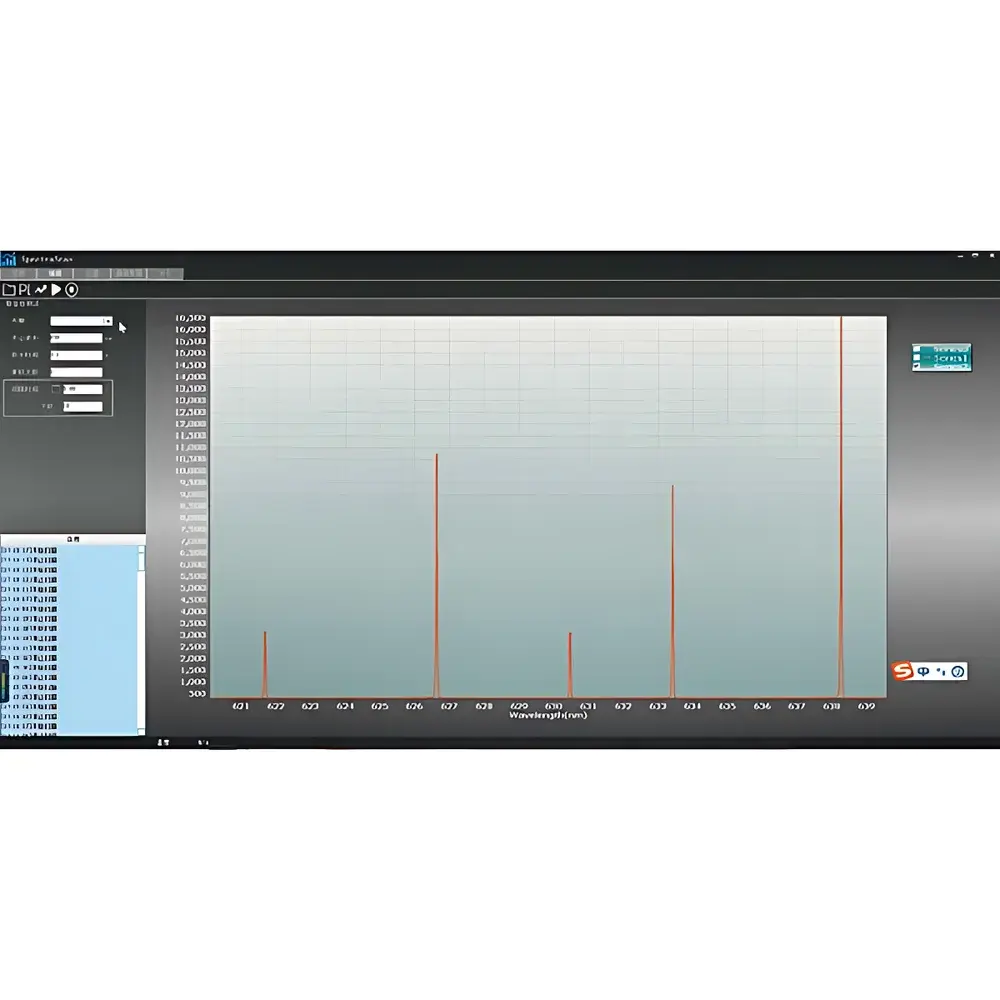
ZOLIX SpectraScan CCD Control Software
| Brand | ZOLIX |
|---|---|
| Origin | Beijing, China |
| Manufacturer | ZOLIX Optics Co., Ltd. |
| Product Type | Spectroscopy Instrument Control Software |
| Model | SpectraScan (Accessory Software Suite) |
| Compliance | Designed for ZOLIX omni-λ Series Monochromators & ZOLIX CCD Detectors |
| Interface | USB 2.0 / USB 3.0 |
| Supported Operating Systems | Windows 10/11 (64-bit) |
| Data Export Formats | CSV, TXT, ASCII, PNG, TIFF |
| Calibration Support | Wavelength & Intensity Calibration via NIST-traceable standards |
| Software Architecture | Native C++ with multi-threaded acquisition engine |
| Audit Trail | Optional GLP-compliant logging module (configurable) |
Overview
ZOLIX SpectraScan CCD Control Software is a purpose-built, native Windows application engineered to interface with ZOLIX omni-λ series monochromators and ZOLIX scientific-grade CCD detectors for high-fidelity spectral acquisition and imaging. Built on a deterministic, low-latency acquisition architecture, SpectraScan implements precise hardware synchronization between grating drive motors, filter wheel actuators, shutter solenoids, and CCD readout electronics—ensuring sub-pixel timing alignment critical for quantitative spectroscopic measurements. The software operates on the principle of wavelength-scanned photon counting and spatially resolved intensity mapping, enabling both conventional scanning spectroscopy and two-dimensional spectral imaging (e.g., spectral line profiling, zero-order alignment verification, and spatial-spectral correlation analysis). It is not a generic data logger but a tightly coupled instrument control layer compliant with fundamental spectroscopic workflows used in R&D laboratories, quality control environments, and academic spectroscopy facilities.
Key Features
- Hardware-Integrated Instrument Control: Direct command-level control over omni-λ monochromator parameters—including grating selection, entrance/exit slit width adjustment, filter wheel position, motorized shutter actuation, and wavelength calibration offset correction.
- CCD Acquisition Optimization: Real-time configuration of detector parameters including gain (EMCCD or standard CCD), readout speed (1–5 MHz selectable), exposure time (1 ms–60 s), and vertical binning modes (FVB and Multi-ROI).
- FVB (Frame Transfer Vertical Binning) Mode: Sums selected rows of the CCD sensor into a single effective row, increasing signal-to-noise ratio (SNR) by up to √N (where N = number of binned rows) without compromising spectral resolution along the dispersion axis.
- Multi-ROI (Region-of-Interest) Acquisition: Enables selective readout of user-defined vertical pixel ranges, eliminating dark-current contribution from unused rows and reducing total readout time—particularly advantageous for weak-emission detection in fluorescence or Raman applications.
- Live Imaging & Zero-Order Visualization: Supports real-time CCD preview at full frame rate; includes dedicated zero-order alignment mode for rapid optical path validation and monochromator collimation diagnostics.
- Calibration Management: Supports dual-axis (wavelength and intensity) calibration using NIST-traceable emission or broadband sources; stores multiple calibration profiles per instrument configuration.
Sample Compatibility & Compliance
SpectraScan is validated exclusively for use with ZOLIX omni-λ 150/300/500/750 monochromators and ZOLIX CCD cameras (including back-illuminated deep-depletion and UV-enhanced variants). It does not support third-party spectrometers or non-ZOLIX detectors. The software adheres to fundamental design principles aligned with ISO/IEC 17025 requirements for measurement traceability and instrument control integrity. While SpectraScan itself is not FDA 21 CFR Part 11 certified out-of-the-box, its optional GLP logging module provides configurable audit trail functionality—including user login tracking, parameter change timestamps, acquisition metadata stamping, and immutable export logs—supporting laboratory compliance under GxP frameworks when deployed with appropriate IT governance controls.
Software & Data Management
SpectraScan employs a modular, event-driven architecture written in optimized C++, ensuring deterministic response times during synchronized hardware operations. Acquired spectra are stored in memory-mapped buffers prior to disk write, minimizing I/O bottlenecks during rapid sequential scans. Data export supports CSV (tabular wavelength-intensity pairs), ASCII (for legacy instrument integration), and lossless TIFF/PNG (for publication-ready spectral images). Built-in processing routines include polynomial background subtraction, Savitzky-Golay smoothing (3rd–7th order, 5–21 point windows), peak detection with centroid fitting, spectral normalization (max, area, or reference band), arithmetic operations (add/subtract/multiply/divide spectra), and stray-light correction via user-defined dark-frame referencing. All processing steps are non-destructive and preserve original raw data integrity.
Applications
- Photoluminescence quantum yield (PLQY) measurement with excitation wavelength scanning
- Raman spectral mapping of heterogeneous materials using step-scan acquisition
- UV-Vis-NIR absorbance/transmission characterization of thin films and nanoparticles
- Time-resolved spectroscopy when triggered via external TTL input (hardware sync supported)
- Emission line profiling in plasma diagnostics and laser-induced breakdown spectroscopy (LIBS)
- Calibration validation of monochromator linearity and stray light performance
FAQ
Is SpectraScan compatible with non-ZOLIX spectrometers or detectors?
No. SpectraScan is designed exclusively for ZOLIX omni-λ monochromators and ZOLIX CCD detectors. It does not support generic USB spectrometers or OEM modules from other manufacturers.
Does SpectraScan support automated wavelength calibration?
Yes. The software includes a guided calibration wizard supporting Hg/Ar/Ne lamp lines or custom reference spectra. Calibration files are saved per instrument ID and can be recalled automatically upon device connection.
Can SpectraScan acquire spectra continuously for kinetic studies?
Yes. It supports time-series acquisition with user-defined interval timing (down to 100 ms inter-scan delay) and metadata tagging for temporal correlation.
What operating systems are officially supported?
Windows 10 and Windows 11 (64-bit only); Windows Server editions are not validated or supported.
Is source code or SDK available for custom integration?
ZOLIX provides a documented COM-based API for third-party software integration, including MATLAB, LabVIEW, and Python (via pywin32). Full SDK access requires execution of a ZOLIX Developer License Agreement.



