
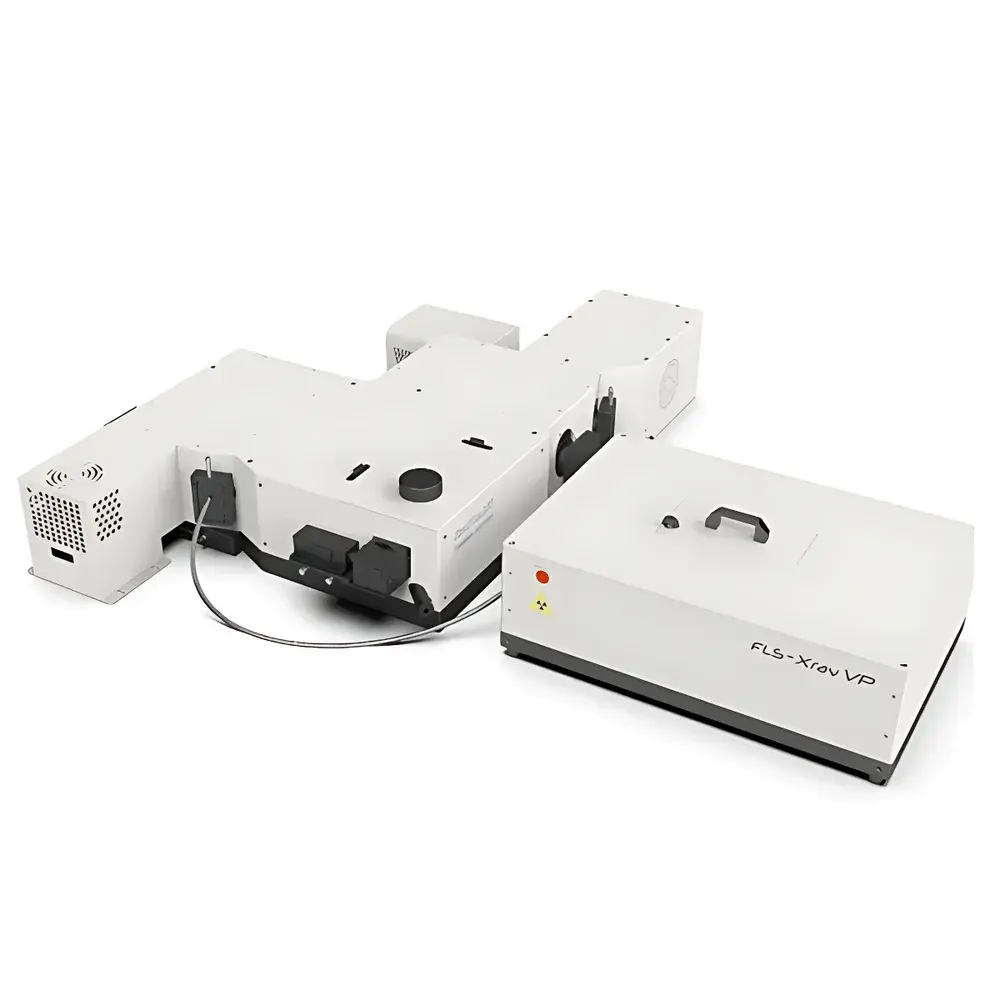
ZOLIX Steady-State & Time-Resolved Fluorescence–Scintillator Comprehensive Characterization System
| Brand | ZOLIX |
|---|---|
| Origin | Beijing, China |
| Manufacturer Type | Direct Manufacturer |
| Regional Category | Domestic (China) |
| Quotation | Upon Request |
Overview
The ZOLIX Steady-State & Time-Resolved Fluorescence–Scintillator Comprehensive Characterization System is a modular, research-grade instrumentation platform engineered for quantitative photophysical and radioluminescent evaluation of scintillating materials. It integrates time-correlated single-photon counting (TCSPC) and gated-integration detection architectures to simultaneously acquire steady-state photoluminescence (PL), nanosecond-to-microsecond transient PL decay profiles, X-ray-excited luminescence (XEL), and time-resolved X-ray luminescence (TR-XEL). The system operates on fundamental principles of radiation-matter interaction: high-energy X-ray photons induce ionization cascades in scintillator matrices, generating secondary electrons that thermalize into excited electronic states; subsequent radiative relaxation yields UV–vis–NIR photons whose intensity, spectral distribution, temporal profile, and spatial localization encode intrinsic material properties—including light yield, energy transfer efficiency, defect-mediated nonradiative pathways, afterglow kinetics, and radiation hardness. Designed for rigorous materials development in nuclear medicine, homeland security imaging, high-energy physics detector R&D, and industrial NDT, the system provides traceable, reproducible characterization under controlled excitation conditions compliant with ISO/IEC 17025-aligned laboratory practices.
Key Features
- Integrated dual-excitation architecture: pulsed UV–vis laser diodes (266–405 nm, <100 ps FWHM) + tunable microfocus X-ray source (5–60 kV, 0–1 mA, with programmable pulse width down to 10 µs)
- High-sensitivity detection: back-thinned CCD/EMCCD for spectral imaging (200–1100 nm, <0.1 nm pixel resolution) + fast PMT/SPAD modules for lifetime acquisition (time resolution <50 ps, dynamic range >4 orders of magnitude)
- Radiation-safe sample chamber: motorized lead–tungsten alloy shutter with real-time dosimetry feedback; dose rate at sample position ≤10 µSv/h when shutter closed during maximum X-ray output (compliant with GBZ 115–2023 for low-energy X-ray devices)
- Modular functional expansion: supports optional cryogenic stage (4–300 K), motorized XYZ translation for X-ray fluorescence mapping, confocal scanning unit for µm-resolution lifetime imaging, and temperature-controlled gas/vacuum environment cell
- Hardware-synchronized timing engine: all excitation sources, detectors, shutters, and motion stages are locked to a common 10 MHz master clock with sub-nanosecond jitter, ensuring phase-coherent data acquisition across modalities
Sample Compatibility & Compliance
The system accommodates solid-state scintillators (single crystals, ceramics, thin films), powder pellets, liquid organic scintillators, and gas-filled proportional counters. Sample holders comply with standard DIN 55301 and IEC 61547 mechanical interfaces. All radiation safety interlocks, shielding integrity, and beam collimation meet national regulatory requirements per GBZ 115–2023 and are verified via third-party dosimetric certification. For regulated environments (e.g., medical device R&D labs operating under GLP or ISO 13485), the system supports audit-ready operation logs, electronic signatures, and 21 CFR Part 11–compliant data archiving when paired with validated ZOLIX LabManager software.
Software & Data Management
ZOLIX LabManager v4.x provides unified control of optical/X-ray excitation, detector acquisition, and stage motion through a Python- and MATLAB-scriptable API. Data files adhere to HDF5 format with embedded metadata (excitation parameters, calibration coefficients, environmental conditions) following the NeXus standard. Lifetime analysis includes multi-exponential deconvolution, stretched exponential fitting, and global decay modeling with parameter constraints. Spectral imaging datasets support principal component analysis (PCA), cluster mapping, and spatially resolved lifetime histograms. Raw and processed data export options include ASCII, CSV, and vendor-neutral .spe formats compatible with Igor Pro, OriginLab, and MATLAB toolboxes. Audit trails record user actions, parameter changes, and instrument status timestamps with SHA-256 hashing for data integrity verification.
Applications
- Quantitative comparison of light yield and energy resolution in Ce-doped YAG, LYSO, BGO, CsI:Tl, and perovskite nanocrystal scintillators
- Mapping trap depth distributions via thermally stimulated luminescence (TSL) combined with TR-XEL decay analysis
- Correlating afterglow persistence (ms–s scale) with defect density measured by positron annihilation lifetime spectroscopy (PALS)
- Optimizing pixelated scintillator array fabrication by evaluating spatial uniformity of X-ray response using 39-line-pair/mm resolution test patterns
- Accelerated radiation damage studies: in situ monitoring of PL quantum efficiency degradation under cumulative X-ray fluence up to 10⁶ Gy(Si)
- Development of dual-mode (optical + X-ray) responsive probes for multimodal molecular imaging and theranostics
FAQ
Does the system support absolute light yield quantification relative to NIST-traceable standards?
Yes—calibrated using NIST SRM 2035 (BaSO₄ reflectance standard) and SRM 2241 (scintillation light yield reference), with uncertainty budgets documented per ISO/IEC Guide 98-3.
Can TR-XEL measurements be performed under vacuum or inert atmosphere?
Yes—the chamber accepts optional gas-handling modules for O₂-free N₂ or Ar purge, or high-vacuum (<10⁻⁵ mbar) configurations with feedthrough-compatible detectors.
Is the X-ray source capable of synchrotron-compatible timing synchronization?
Yes—external TTL trigger input accepts 1–10 MHz clock signals with <2 ns jitter tolerance, enabling pump–probe experiments at storage ring facilities.
What is the minimum detectable X-ray dose for lifetime acquisition?
At 10 kV/100 µA, the system achieves <1 ns temporal resolution with signal-to-noise ratio >10:1 for samples exhibiting ≥10⁴ photons/pulse, corresponding to effective dose thresholds of ~0.5 mGy per acquisition cycle.
Are software updates and calibration services included post-warranty?
ZOLIX offers annual maintenance contracts covering firmware/software upgrades, recalibration against primary standards, and remote diagnostic support with SLA-backed response times.





