
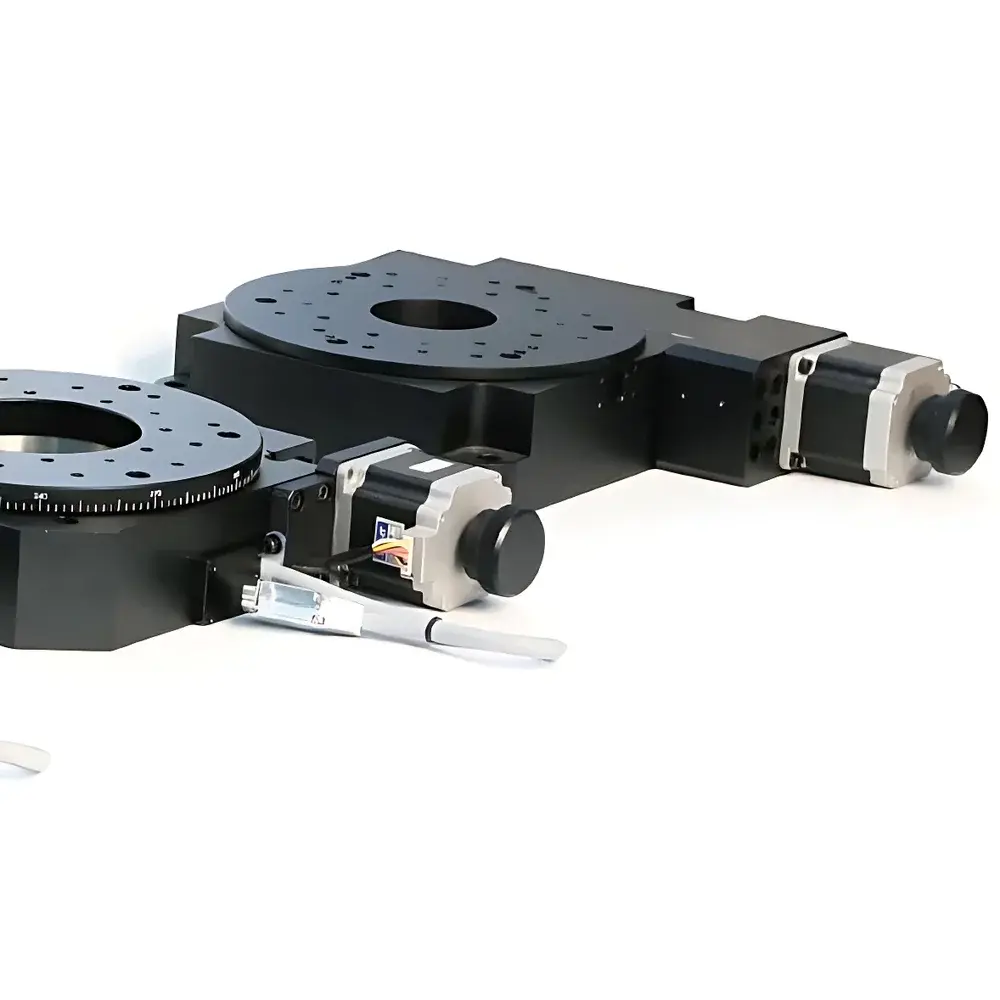
ZOLIX TBRF Series Industrial-Grade Wear-Resistant Motorized Rotary Stage
| Brand | ZOLIX |
|---|---|
| Model | TBRF |
| Origin | Beijing, China |
| Manufacturer Type | Direct Manufacturer |
| Product Category | Motorized Translation Stage |
| Drive Mechanism | Precision Worm Gear (Reduced Ratio) |
| Construction | Hard-Anodized Aluminum Body with Tin-Bronze Worm Wheel & Hardened Steel Worm |
| Guidance System | Precision Crossed-Roller Bearing Ring |
| Mounting Flexibility | Horizontal, Vertical, or Inverted Installation |
| Standard Motor | Bipolar Stepper Motor (1.8° Step Angle) |
| Optional Motor | Compatible with Third-Party Servo Motors |
| Integrated Home Sensor | Built-in Photointerrupter Zero-Position Switch |
| Compliance | Designed for GLP/GMP-aligned industrial automation environments requiring long-term repeatability and mechanical robustness |
Overview
The ZOLIX TBRF Series Industrial-Grade Wear-Resistant Motorized Rotary Stage is an engineered solution for high-cycle, high-reliability rotational positioning in demanding optical, metrology, and automated manufacturing systems. Unlike conventional rotary stages optimized solely for angular resolution, the TBRF platform prioritizes mechanical durability and dynamic response under continuous operation. Its core motion architecture employs a low-ratio worm gear train—specifically designed to increase rotational speed while maintaining load-bearing integrity and service life. The worm wheel is fabricated from high-purity tin bronze (C90300 equivalent), selected for its exceptional galling resistance and low coefficient of friction against hardened steel. The mating worm shaft undergoes high-frequency induction hardening (HRC 58–62), ensuring dimensional stability and minimal wear-induced backlash over >10⁶ operational cycles. The stage body is precision-machined from 6061-T6 aluminum alloy and finished with Class II hard anodization (25–30 µm thickness), providing corrosion resistance and surface hardness exceeding 350 HV. This structural foundation supports bidirectional repeatability of ≤±10 arcsec and axial runout <5 µm across all standard aperture sizes (TBRF60L to TBRF200).
Key Features
- Optimized worm gear ratio (15:1 to 30:1 depending on model) enables up to 2× higher maximum rotational velocity versus legacy TBR-series stages, without compromising torque transmission efficiency.
- Crossed-roller bearing ring guidance system delivers radial and axial load capacity up to 45 kg (TBRF200), with static moment rigidity exceeding 12 N·m/rad—enabling stable mounting in inverted or vertical orientations without performance degradation.
- Integrated photointerrupter-based home sensor provides deterministic zero-reference positioning with sub-millisecond response time and immunity to electromagnetic interference typical in factory-floor environments.
- Modular motor interface accepts standard NEMA 17, 23, and 34 stepper motors; optional encoder feedback paths support closed-loop servo integration per IEC 61800-3 EMC requirements.
- Backlash compensation mechanism—mechanically adjustable via dual-preload worm housing—permits fine-tuning of engagement clearance to balance positional hysteresis (<8 arcsec) against drive torque requirements.
- Operating temperature range certified from 0 °C to +50 °C ambient, with thermal expansion coefficients matched between aluminum housing and bronze/steel drivetrain components to minimize drift during thermal cycling.
Sample Compatibility & Compliance
The TBRF series accommodates optical payloads ranging from compact collimators (4 mm at 250 VAC), and absence of internal lubricants make it suitable for cleanroom Class 1000 (ISO 6) deployment when paired with compatible motor drivers. Design documentation includes traceable material certifications (RoHS 2011/65/EU, REACH SVHC-free declaration) and full GD&T drawings available upon request for OEM integration validation.
Software & Data Management
ZOLIX provides native ASCII command protocol (RS-232/USB-CDC) supporting industry-standard motion control syntax (e.g., “MO”, “PA”, “WH”) for seamless integration into LabVIEW, MATLAB, Python (pySerial), or custom PLC-based sequencing. Optional ZOLIX Motion Studio software offers GUI-driven calibration routines—including automatic backlash mapping and step-loss detection—and exports position logs in CSV format with microsecond timestamp resolution. Audit trails record all parameter changes, firmware updates, and homing events in non-volatile memory, satisfying FDA 21 CFR Part 11 requirements for electronic records when deployed in regulated QC/QA workflows. Firmware versioning follows semantic versioning (vX.Y.Z), with release notes publicly archived and digitally signed.
Applications
- Automated optical alignment stations for laser cavity optimization and fiber coupling efficiency measurement.
- Rotary indexing modules in semiconductor wafer inspection tools requiring consistent angular placement under vacuum or nitrogen purge.
- Multi-position filter wheels in hyperspectral imaging systems where thermal drift must remain below 0.02°/°C.
- Robotic end-effector orientation stages in precision assembly cells handling fragile optomechanical subassemblies.
- Environmental test fixtures simulating cyclic torsional stress on aerospace-grade optical mounts (MIL-STD-810G Method 514.6 compliant mounting).
FAQ
What is the difference between TBR and TBRF series in terms of positioning accuracy?
The TBRF series trades nominal angular resolution (±8 arcsec typical repeatability vs. ±5 arcsec for TBR) for increased rotational speed and extended wear life—making it preferable for applications where cycle time outweighs sub-arcsecond fidelity.
Can the TBRF stage be operated in vacuum environments?
Standard units are not vacuum-rated due to outgassing potential from anodization sealants and internal adhesives; however, vacuum-compatible variants (with dry-film lubrication and epoxy-free assembly) are available under custom order (lead time: 12 weeks).
Is encoder feedback supported natively?
No integrated encoder is included, but the motor mounting flange conforms to DIN 42950, allowing direct attachment of incremental or absolute encoders with ≤30 mm diameter and ≤15 mm axial projection.
What maintenance intervals are recommended for continuous 24/7 operation?
No scheduled lubrication is required; periodic verification of worm preload (annually) and home sensor alignment (quarterly) is advised using ZOLIX-provided alignment jigs and torque specifications.
How does thermal expansion affect angular positioning stability?
Coefficient mismatch between aluminum housing (23.6 ppm/°C), bronze wheel (17.8 ppm/°C), and steel worm (11.7 ppm/°C) results in net angular drift of ≤0.015° per 10 °C ambient change—mitigated by active thermal stabilization or open-loop compensation algorithms.




