
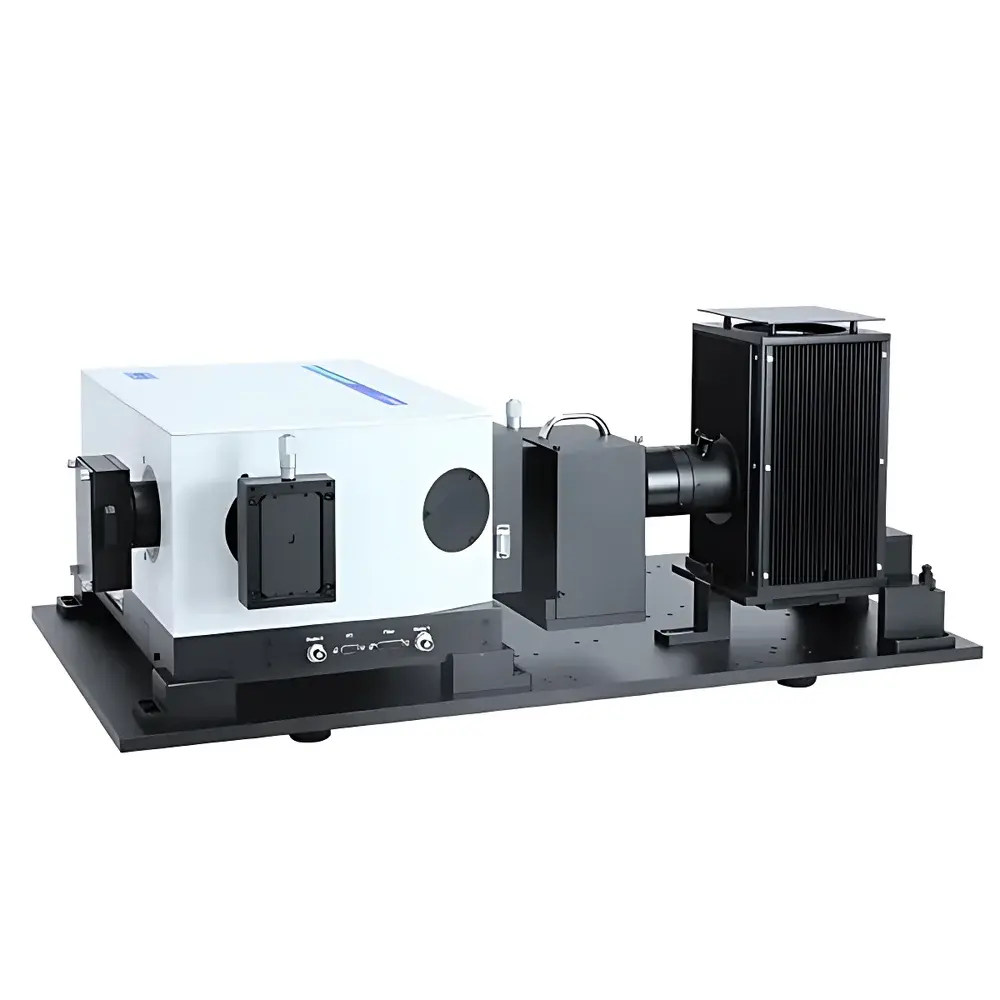
ZOLIX TLS2 Series Tunable Monochromatic Light Source
| Brand | ZOLIX |
|---|---|
| Origin | Beijing, China |
| Manufacturer Type | OEM Manufacturer |
| Product Origin | Domestic (China) |
| Model | TLS2 Series |
| Light Source Type | Broadband Lamp-Based Tunable Source |
| Illumination Mode | External Illumination |
| Spectral Range | 200–1000 nm (varies by lamp/grating) |
| Wavelength Accuracy | ±0.2–±0.4 nm |
| Wavelength Repeatability | 0.1–0.2 nm |
| Spectral Bandwidth (FWHM) | 0.15–23 nm (grating-dependent) |
| Grating Options | Multiple ruled gratings (e.g., 1200 g/mm, 300 g/mm, etc.) |
| Focal Length | 200 mm Czerny-Turner Monochromator |
| Lamp Stability | ≤1% RMS intensity drift (over 8 h) |
| Output Configurations | Free-space, fiber-coupled, integrating sphere |
Overview
The ZOLIX TLS2 Series Tunable Monochromatic Light Source is a precision-engineered optical instrument designed for laboratory-grade spectral characterization and quantitative photometric applications. Built around a high-stability broadband lamp (Xenon, Deuterium-Xenon, Tungsten-Halogen, or EQ-series plasma sources) coupled to a 200 mm focal length Czerny-Turner monochromator, the TLS2 delivers narrowband, wavelength-selectable output with calibrated accuracy and reproducibility. Its core measurement principle relies on dispersion-based spectral isolation: broadband radiation enters the monochromator via optimized coupling optics, is diffracted by interchangeable ruled gratings, and exits through an adjustable exit slit—yielding quasi-monochromatic light with defined bandwidth (FWHM), central wavelength, and spectral purity. The system achieves low stray light (<10⁻⁴ relative to peak intensity), essential for high-dynamic-range responsivity measurements such as quantum efficiency (QE) of photodetectors or external quantum efficiency (EQE) of photovoltaic devices.
Key Features
- High-intensity, low-noise broadband illumination from multiple lamp options—including 75 W to 500 W Xenon arc lamps (standard and UV-enhanced), 150–250 W tungsten-halogen lamps, and EQ77/EQ99 plasma light sources—ensuring broad spectral coverage from 200 nm (deep UV) to 2400 nm (NIR) depending on configuration.
- Modular 200 mm Czerny-Turner monochromator with motorized grating turret supporting up to three user-replaceable ruled gratings (e.g., 1200 g/mm for high resolution, 300 g/mm for high throughput), enabling flexible trade-offs between spectral resolution and radiant flux.
- Wavelength accuracy of ±0.2 nm (with 1200 g/mm grating) and repeatability better than 0.1 nm, verified against NIST-traceable calibration standards; real-time wavelength feedback via integrated encoder ensures long-term stability.
- Dedicated software control (TLS Control Suite) with LabVIEW-compatible ActiveX/COM drivers, supporting automated wavelength scanning, intensity normalization, and integration with external shutters, choppers, and lock-in amplifiers.
- Standard mechanical interface for optional accessories: integrated chopper mount (5–500 Hz), fiber coupling adapters (SMA905, Ø13 mm), collimating off-axis parabolic mirrors, and high-reflectivity gold-coated integrating spheres (IS-050 to IS-200 series, >98% spatial uniformity at 555 nm).
Sample Compatibility & Compliance
The TLS2 accommodates diverse sample geometries and measurement modalities via configurable output modes: free-space collimated beam (ideal for reflectance/transmittance spectroscopy), SMA905-fiber-coupled delivery (for remote or confined-access setups), and integrating sphere output (for diffuse reflectance, total hemispherical transmittance, or absolute irradiance calibration). All configurations maintain traceable radiometric integrity when paired with NIST-calibrated reference detectors (e.g., Hamamatsu S1337 series, Gentec-EO UP19K). The system complies with ISO/IEC 17025 requirements for measurement uncertainty reporting and supports GLP/GMP documentation workflows through audit-trail-enabled software logging. While not FDA 21 CFR Part 11 certified out-of-box, its deterministic control architecture and timestamped data export (CSV, HDF5) facilitate validation under regulated environments including photovoltaic cell certification (IEC 60904-8, ASTM E2527) and detector calibration (ISO 15739, CIE S 025/E:2015).
Software & Data Management
The TLS2 operates under ZOLIX’s TLS Control Suite—a Windows-native application offering intuitive GUI-based wavelength selection, slit width adjustment, grating switching, and intensity monitoring. It provides real-time spectral preview, multi-point calibration mapping (wavelength vs. encoder position), and batch acquisition scripting. For system integrators, comprehensive COM/ActiveX APIs enable seamless interoperability with MATLAB, Python (via pywin32), LabVIEW, and custom C++ applications. All acquired datasets include embedded metadata: timestamp, lamp hours, grating ID, slit width, ambient temperature, and user-defined experiment tags. Export formats include ASCII CSV (tab-delimited), XML metadata wrappers, and binary HDF5 for large-scale spectral libraries—ensuring FAIR (Findable, Accessible, Interoperable, Reusable) data principles.
Applications
The TLS2 serves as a foundational excitation source in metrology-critical optical testing: quantum efficiency mapping of CMOS/CCD image sensors per JEDEC JESD22-A121; spectral responsivity calibration of photodiodes and photomultiplier tubes (IEC 60794-1-21); EQE characterization of perovskite, silicon, and multijunction solar cells (ASTM E1021, IEC 60904-8); fluorescence excitation profiling in life sciences; photochemical reaction kinetics studies; and optical filter transmission verification. Its stable output and calibrated bandwidth make it suitable for validating spectroradiometers and calibrating hyperspectral imaging systems used in remote sensing and industrial inspection.
FAQ
What lamp options are available for the TLS2, and how do they affect spectral range?
The TLS2 supports Xenon (200–1000 nm), UV-enhanced Xenon (200–1000 nm, higher DUV output), tungsten-halogen (350–2400 nm), and EQ-series plasma sources (200–1000 nm). Lamp choice directly defines usable spectral limits—e.g., tungsten-halogen extends into NIR but lacks UV output, while UV-Xenon enables deep-UV work down to 200 nm.
Can the TLS2 be integrated into an automated test station?
Yes. Full COM/ActiveX API support enables deterministic control of wavelength, grating, slit width, and lamp status from external platforms. Synchronization signals (TTL trigger in/out) allow precise timing with detectors, choppers, or motion stages.
Is stray light performance characterized across the full spectral range?
Stray light is measured per ISO 14851 using a double-monochromator reference method. Typical values are <5×10⁻⁵ at 50 nm separation from peak (e.g., 500 nm ±50 nm) and <1×10⁻⁴ at 20 nm separation, validated for all grating/lamp combinations.
How is wavelength calibration maintained over time?
Each unit undergoes factory calibration using Hg/Ne/Ar emission lines. Users may perform field recalibration via built-in spectral line recognition or external reference lamps. Encoder-based positioning ensures mechanical repeatability independent of thermal drift.
Are custom optical interfaces supported beyond standard SMA905 and Ø13 mm ports?
Yes. ZOLIX offers OEM mechanical redesign services—including kinematic mounts, vacuum feedthroughs, fiber collimator integration, and custom flange interfaces (CF, KF, or ANSI)—subject to minimum order quantity and NRE agreement.




