
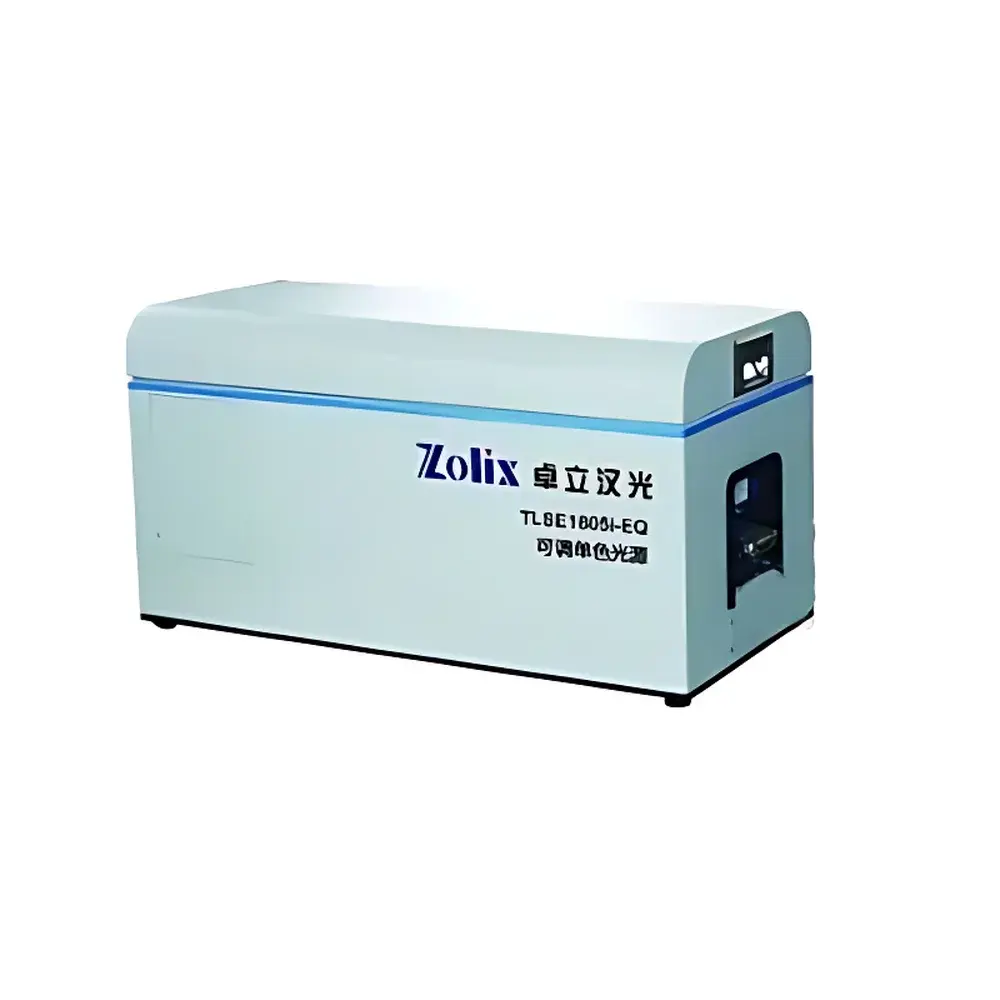
ZOLIX TLSE1805i-EQ Enhanced Tunable Broadband White Light Source
| Brand | ZOLIX |
|---|---|
| Model | TLSE1805i-EQ |
| Light Source Type | Laser-Driven Light Source (LDLS) |
| Spectral Range (recommended) | 200–1500 nm |
| Output Bandwidth (recommended) | 1–10 nm |
| Output Bandwidth Tuning Range | 0.3–20 nm |
| Monochromator | Omni-λ1805i Imaging-Corrected Monochromator |
| Grating Options | 1200 g/mm @ 300 nm, 600 g/mm @ 750 nm |
| UV-Enhanced Optics | Yes (200–400 nm), with N₂ purge capability |
| Output Power | ≥1 mW (@ 500 nm, 5 nm bandwidth, 1200 g/mm grating) |
| Power Stability | <0.5% RMS (over 8 hours) |
| Enclosure | Fully enclosed, integrated monolithic design |
| Optional LDLS Modules | EQ99 (standard power), EQ1500 (high-power) |
Overview
The ZOLIX TLSE1805i-EQ is an engineered tunable broadband white light source designed for high-precision optical spectroscopy, photoluminescence excitation mapping, ellipsometry calibration, and quantum efficiency measurements. It integrates Energetiq’s Laser-Driven Light Source (LDLS) technology—specifically the EQ99 or EQ1500 modules—with the ZOLIX Omni-λ1805i imaging-corrected monochromator. Unlike conventional arc lamps (e.g., xenon or mercury), the LDLS principle employs a pulsed laser to sustain a high-temperature plasma in a fused silica cavity, generating continuum radiation from deep UV (170 nm) to near-IR (2000 nm) with exceptional spatial coherence and radiance. The small plasma size (<100 µm) enables efficient coupling into narrow entrance slits of high-resolution spectrometers, minimizing étendue loss and maximizing throughput. Combined with the aberration-corrected optical path of the Omni-λ1805i—featuring off-axis parabolic mirrors and kinematically aligned gratings—the system delivers superior spectral purity, intensity uniformity, and long-term irradiance stability.
Key Features
- High-brightness LDLS core: EQ99 (up to 10 W UV-VIS output) or EQ1500 (up to 30 W total radiant flux), enabling high signal-to-noise ratio in low-light detection scenarios
- Imaging-optimized monochromator: Omni-λ1805i with dual-grating turret (1200 g/mm @ 300 nm, 600 g/mm @ 750 nm), supporting diffraction-limited line profiles and minimal stray light (<10⁻⁵ relative to peak)
- UV-optimized optical train: All reflective optics feature dielectric multilayer coatings enhanced for 200–400 nm, with optional nitrogen purging to suppress ozone-induced absorption and oxygen quenching
- Precision bandwidth control: Continuous slit adjustment (0.01–3 mm) coupled with selectable gratings enables fine-tuned resolution from 0.3 nm to 20 nm FWHM
- Monolithic integrated architecture: Fully sealed, vibration-damped housing eliminates alignment drift; no external beam paths or manual coupling required
- Thermal and mechanical stability: Active temperature regulation of LDLS plasma chamber and monochromator baseplate ensures <0.5% RMS irradiance stability over 8-hour continuous operation
Sample Compatibility & Compliance
The TLSE1805i-EQ is compatible with standard optical breadboards, fiber-coupled accessories (SMA905, FC/PC), and vacuum-compatible sample chambers (via optional flange adapters). Its collimated free-space output (12.5 mm diameter, f/5.6) interfaces directly with ellipsometers, microspectrophotometers, and custom-built photodetector arrays. Reflective UV-enhanced optics meet ISO 17025 calibration traceability requirements when used with NIST-traceable reference detectors (e.g., Hamamatsu S1337 series). The system supports GLP-compliant operation through hardware interlocks, real-time power logging, and configurable shutter control—all accessible via RS232/USB. While not FDA-certified as a medical device, its stable UV output and documented spectral responsivity make it suitable for ASTM E275, ISO 11664-3, and CIE S 014/E:2006 compliant material characterization workflows.
Software & Data Management
ZOLIX provides the OmniDriver SDK (Windows/Linux/macOS) for full remote control of wavelength scanning, slit width, grating selection, and shutter actuation. Integration with LabVIEW, MATLAB, and Python (PyVISA) is supported via native DLLs and documented API calls. Spectral acquisition logs include timestamped metadata (wavelength, bandwidth, grating ID, lamp status, ambient temperature), ensuring audit readiness for ISO/IEC 17025 accredited labs. Optional firmware upgrades enable synchronized triggering with gated CCD/CMOS cameras (TTL-out) and compliance with 21 CFR Part 11 via optional electronic signature modules and encrypted audit trails.
Applications
- Photoluminescence excitation (PLE) spectroscopy of perovskites, quantum dots, and 2D materials
- Calibration of hyperspectral imagers and satellite sensor simulators across 200–1500 nm
- Reflectance and transmittance measurements of anti-reflective coatings and EUV mask blanks
- Time-resolved fluorescence lifetime studies requiring stable, narrowband UV excitation
- Development and validation of solar cell quantum efficiency (QE) test systems per IEC 60904-8
- Fundamental studies of photochemical reaction kinetics under controlled monochromatic irradiance
FAQ
What is the difference between LDLS and traditional xenon arc lamps?
LDLS technology offers higher radiance (>10×), smaller plasma size (9,000 hours), and superior short-term stability (<0.5% vs. 1–2% for xenon), especially below 300 nm where electrode erosion and ozone generation limit conventional sources.
Can the system operate continuously in vacuum environments?
The TLSE1805i-EQ is not vacuum-rated by default; however, optional CF-63 or KF-40 flange-mounted output ports are available for integration into UHV chambers (≤10⁻⁶ mbar), with all internal optics rated for bake-out up to 80°C.
Is N₂ purging mandatory for UV operation?
Not mandatory, but strongly recommended below 220 nm to mitigate atmospheric O₂ absorption; the integrated purge port supports continuous flow at 1–2 L/min with standard lab-grade nitrogen (99.999%).
How is wavelength calibration performed and maintained?
Factory calibration uses Hg/Ne/Ar emission lines traceable to NIST SRM 2034; users may perform recalibration using optional internal hollow-cathode lamps or external reference sources, with polynomial coefficients stored in non-volatile memory.
Does the system support automated grating and filter wheel sequencing?
Yes—the Omni-λ1805i includes motorized grating turret and optional 6-position filter wheel (200–1500 nm range); both are programmable via OmniDriver with user-defined macro sequences and interlock logic.






