
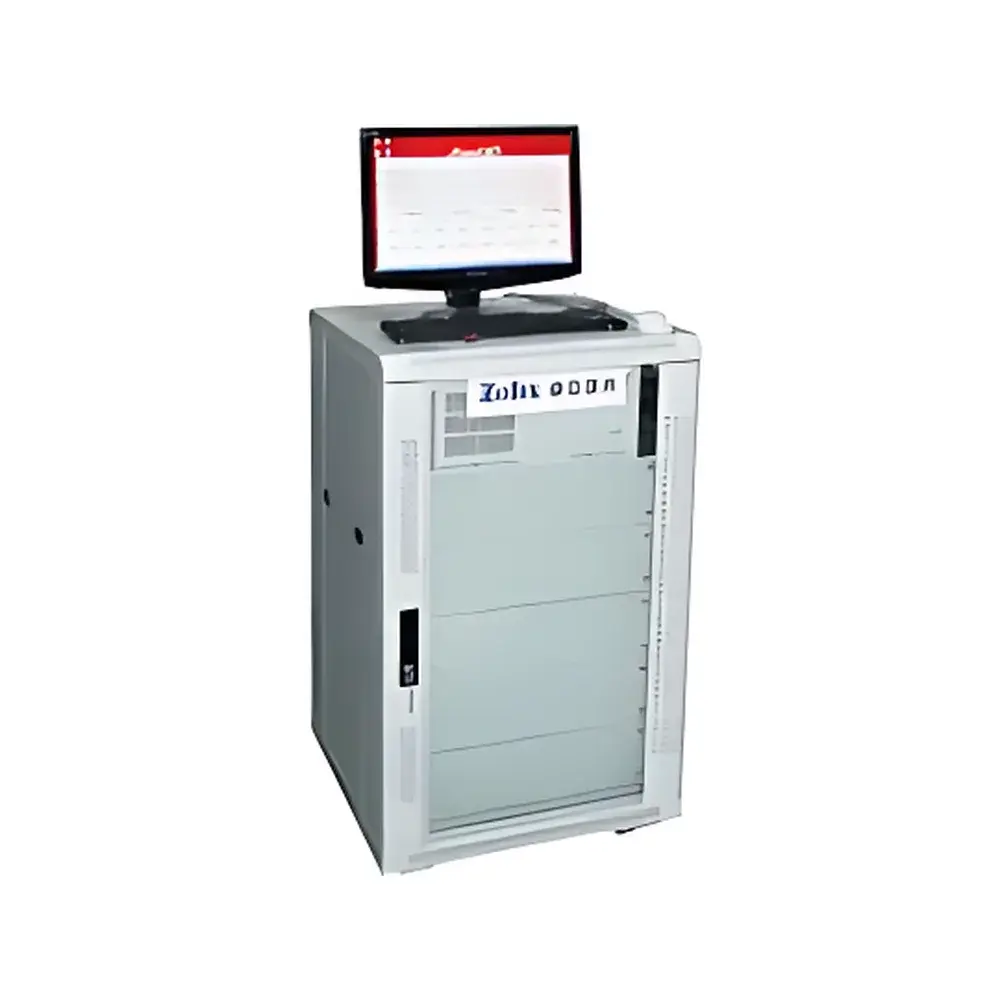
ZOLIX TMC Full-Function Multi-Axis Motion Control System
| Brand | ZOLIX |
|---|---|
| Origin | Beijing, China |
| Manufacturer Type | OEM Manufacturer |
| Product Category | Domestic (China-Made) |
| Model | TMC |
| Pricing | Upon Request |
Overview
The ZOLIX TMC Full-Function Multi-Axis Motion Control System is an industrial-grade, modular motion control platform engineered for precision optical positioning and synchronized multi-axis automation in research-grade optical laboratories and photonics instrumentation setups. Built upon a deterministic real-time architecture, the system implements high-fidelity trajectory generation using hardware-accelerated interpolation engines compliant with standard motion control protocols (e.g., STEP/DIR, PWM, analog ±10 V velocity/torque command interfaces). It supports both open-loop and closed-loop operation via encoder feedback integration (incremental quadrature or absolute SSI/EnDat), enabling sub-micron repeatability across translation stages, rotation mounts, linear actuators, and direct-drive rotary tables. Designed explicitly for optical alignment, interferometry, spectroscopic scanning, and automated microscopy staging, the TMC system delivers deterministic timing, low-jitter axis coordination, and deterministic latency (<1 ms loop cycle time under typical configuration), making it suitable for applications requiring strict phase coherence between axes—such as beam steering, multi-channel spectrometer calibration, and adaptive optics test benches.
Key Features
- Modular architecture comprising a central control cabinet (TMC-S/M/L/D series) and interchangeable drive modules (Drive-Box DBx-xxxx)
- Scalable axis count from 1 to >16 axes, configurable via single or multiple PCIe-based motion control cards (1–8 axes per card)
- Native support for stepper motors (2-phase, 3-phase, 5-phase), AC servo motors (Panasonic, Yaskawa), DC servo drives, linear motors (TR/TE series), and direct-drive rotary (DDR) stages
- Real-time interpolation capabilities: 2-axis and 3-axis linear interpolation, circular interpolation, and synchronized multi-axis motion profiles
- Deterministic motion execution with programmable acceleration/deceleration profiles, jerk-limited ramping, and position/velocity/torque mode switching
- Integrated Windows-based HMI with intuitive graphical interface: motor model auto-import, parameter-driven setup, and drag-and-drop motion sequence programming
- Advanced script engine supporting C-style syntax for conditional logic, nested loops, time-based delays, and inter-axis synchronization triggers
- Simultaneous execution of up to four independent motion programs with isolated memory spaces and priority-based scheduling
Sample Compatibility & Compliance
The TMC system interfaces seamlessly with ZOLIX and third-party optical translation stages—including manual-to-motorized retrofits—and is compatible with industry-standard stage drivers adhering to NEMA frame sizes and common encoder protocols (RS422, TTL, EnDat 2.2, BiSS-C). All hardware modules comply with CE marking requirements for electromagnetic compatibility (EN 61326-1) and safety (EN 61000-6-2/-6-4). Firmware and host software are designed to support audit-ready operation in regulated environments: motion logs include timestamped command history, axis status snapshots, and error codes traceable to ISO/IEC 17025-compliant calibration records. While not pre-certified for FDA 21 CFR Part 11, the system architecture permits integration with external electronic lab notebook (ELN) systems for full data integrity and electronic signature workflows.
Software & Data Management
The TMC Control Suite runs on embedded Windows OS and provides three primary operational layers: Basic Motion Control (single/multi-axis jog, absolute move, homing), Interpolation Mode (G-code-like syntax for path planning), and Script-Based Automation (structured procedural language with variables, arrays, and I/O event handling). All motion commands generate ASCII-formatted log files (.csv/.txt) containing timestamps, commanded vs. actual position (if encoder enabled), velocity profiles, and fault flags. Data export supports direct integration into MATLAB, Python (via COM/ActiveX API), and LabVIEW through documented DLL interfaces. Configuration files are encrypted and version-stamped; firmware updates require signed binaries verified at boot time to ensure runtime integrity.
Applications
- Precision optical alignment in laser cavity construction and fiber coupling stations
- Automated wavelength scanning in monochromators and tunable filter systems
- Multi-axis sample positioning for confocal Raman spectroscopy and photoluminescence mapping
- Synchronized stage motion for Fourier-transform infrared (FTIR) interferometer mirror control
- Beam combiner and waveplate rotator sequencing in polarization-resolved measurements
- Calibration of multi-channel detector arrays using coordinated linear and angular motion
- Integration into OEM optical instruments requiring deterministic, repeatable motion sequences under PC-based supervision
FAQ
Does the TMC system support encoder feedback for closed-loop operation?
Yes—encoder inputs (quadrature A/B/Z or absolute serial encoders) are supported per axis when configured with compatible motion control cards and drive modules.
Can different motor types be controlled simultaneously on the same motion control card?
No—each motion control card is configured for one motor type (e.g., stepper or servo); mixed motor types require separate cards or dedicated drive modules with appropriate signal conditioning.
Is custom firmware development available for proprietary motion profiles?
ZOLIX offers OEM firmware customization services under NDA, including custom interpolation algorithms, trigger-based I/O synchronization, and protocol extensions (e.g., EtherCAT master emulation).
What is the maximum achievable synchronization accuracy between axes?
Under nominal conditions with matched drive modules and optimized tuning, inter-axis position deviation remains within ±1 encoder count (typically ≤0.1 µm for 1 µm-resolution stages) during coordinated moves.
Are API libraries provided for integration into third-party software?
Yes—COM, .NET, and C/C++ SDKs are included, with full documentation, example projects, and source-level debugging support for Windows platforms.




