
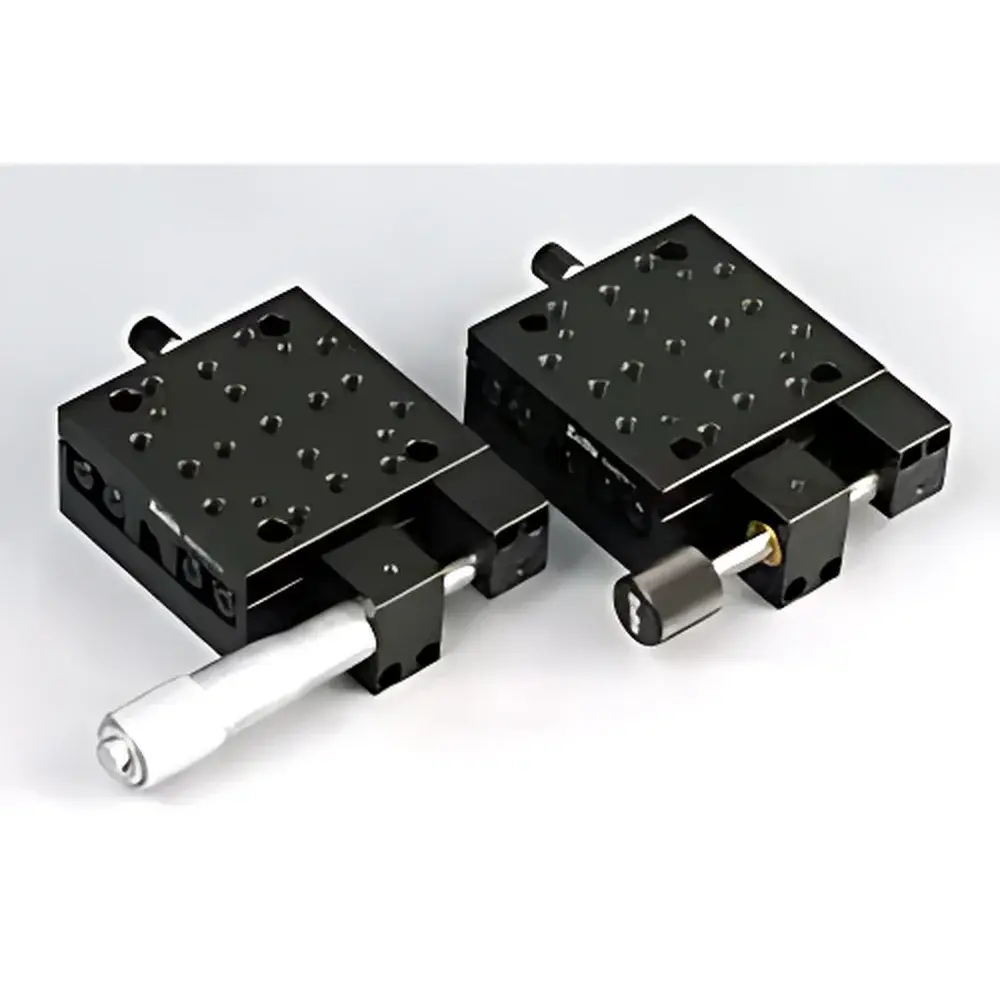
ZOLIX TSM25 Series Precision Manual Translation Stage
| Brand | ZOLIX |
|---|---|
| Model | TSM25 Series |
| Origin | Beijing, China |
| Manufacturer Type | Direct Manufacturer |
| Drive Mechanism | Fine-pitch M6×0.25 screw with micrometer head (A-suffix) or precision-ground leadscrew (S-suffix) |
| Guide Rail | Linear ball-bearing rail (standard) or precision-lapped dovetail rail (D-suffix) |
| Travel | 25 mm |
| Positioning Accuracy | ±0.005 mm |
| Repeatability / Sensitivity | 0.002 mm |
| Minimum Graduation | 0.01 mm |
| Load Capacity | 5 kg |
| Table Dimensions | 54 × 54 mm |
| Base & Table Mounting Pattern | Standard ISO/Metric tapped hole array (M4 or M6, 25 mm pitch) |
| Axial Backlash Compensation | Integrated preloaded spring mechanism |
| Weight | 0.35–0.45 kg (variant-dependent) |
| Compliance | Designed for laboratory-grade optical alignment per ISO 10110-7 and GB/T 22968–2008 optical component mounting standards |
Overview
The ZOLIX TSM25 Series Precision Manual Translation Stage is an engineered mechanical positioning solution designed for high-stability, repeatable linear displacement in optical alignment, laser beam steering, interferometry setups, and micro-optical component integration. Built upon fundamental principles of mechanical metrology and kinematic constraint design, the stage employs a dual-constraint motion architecture: linear ball-bearing rails ensure low-friction, high-rigidity guidance, while a fine-pitch M6×0.25 threaded drive rod—paired with either a calibrated micrometer head (A-variant) or a precision-ground leadscrew (S-variant)—delivers deterministic translation with sub-micron controllability. The integrated spring-preloaded backlash elimination system actively compensates for axial play in the screw-nut interface, enabling consistent unidirectional positioning behavior without hysteresis—a critical requirement in closed-loop alignment workflows where direction-independent repeatability is mandated by ISO 9283 and ANSI B5.54 standards.
Key Features
- 25 mm travel range with bidirectional repeatability of ≤0.002 mm and static positioning accuracy of ±0.005 mm under 5 kg axial load
- Modular guide rail options: standard linear ball-bearing rail for low-drag operation, or optional precision-lapped dovetail rail (D-suffix) for enhanced moment stiffness and thermal stability
- Two standardized drive configurations: side-mounted micrometer head (A-variant) with 0.01 mm vernier scale, or center-driven precision-ground leadscrew (S-variant) for improved torque transmission and reduced off-axis loading
- Interchangeable mounting interface compliant with ISO 8512-2 and DIN 2080 patterns—54 × 54 mm top plate and base feature metric tapped arrays (M4 at 25 mm pitch) for seamless integration into multi-axis stacks (e.g., XYZ, X-Y-θ)
- Passive thermal compensation via symmetric aluminum alloy (6061-T6) construction, minimizing differential expansion between rail, carriage, and drive train
- No lubrication required during normal lab operation; all moving interfaces are dry-running or factory-greased for >10⁵ cycle service life
Sample Compatibility & Compliance
The TSM25 series is compatible with standard optical components including lens mounts (e.g., SM1, SM2), kinematic mirror cells, fiber launchers, and photodetector carriers. Its dimensional footprint and mounting geometry conform to widely adopted optical breadboard grid systems (e.g., Thorlabs, Newport). From a regulatory standpoint, the stage meets mechanical safety requirements outlined in IEC 61000-6-2 (immunity) and ISO 14121-1 (risk assessment for manually operated equipment). While not a medical or process-critical device, its dimensional traceability supports GLP-aligned calibration documentation when used in ISO/IEC 17025-accredited laboratories—particularly where stage-induced drift must be quantified per ASTM E2500 Annex A3 for optical system qualification.
Software & Data Management
As a purely manual, non-motorized stage, the TSM25 does not incorporate embedded electronics, firmware, or digital communication interfaces. Consequently, it requires no driver installation, firmware updates, or cybersecurity configuration. All positional data is recorded externally via calibrated measurement tools (e.g., dial indicators, capacitive sensors, or laser interferometers) traceable to NIST or CNAS-certified standards. For labs maintaining electronic lab notebooks (ELN) or LIMS systems, position logs may be entered manually or imported from external metrology devices supporting CSV or XML export formats. No FDA 21 CFR Part 11 compliance is applicable—however, audit trails for stage usage (e.g., calibration dates, maintenance logs) should be retained per internal SOPs governing optical infrastructure integrity.
Applications
- Precision alignment of collimated laser beams in cavity ring-down spectroscopy (CRDS) and optical parametric oscillator (OPO) tuning
- Sub-pixel registration of imaging sensors in multispectral camera calibration rigs
- Controlled translation of diffraction gratings or etalons in wavelength-scanning interferometers
- Stage-based focus scanning in confocal reflectance microscopy where motor-induced vibration must be eliminated
- Integration into custom-built vacuum-compatible optical tables (with optional black-anodized finish and dry-lubricated variants)
- Teaching platforms for undergraduate optics laboratories—demonstrating Abbe error, cosine error, and mechanical amplification principles
FAQ
Is the TSM25 compatible with vacuum environments?
Standard units are rated for ambient air operation only. Vacuum-compatible versions require optional dry-film lubrication, stainless steel fasteners, and outgassing-certified anodization—contact ZOLIX engineering support for custom configuration.
Can multiple TSM25 stages be stacked to form an XYZ system?
Yes—the standardized 54 × 54 mm mounting pattern and 25 mm hole pitch enable rigid mechanical coupling using M4 socket-head cap screws. Stacking height and torsional rigidity should be validated per application-specific load/moment requirements.
What is the recommended recalibration interval?
No periodic recalibration is required for mechanical specification retention. However, users performing metrology-grade alignment should verify positioning accuracy annually using a certified length standard (e.g., NIST-traceable gauge block or interferometer).
Does ZOLIX provide mounting adapters for non-standard optical components?
Yes—custom adapter plates (e.g., SM1-threaded inserts, kinematic baseplates) are available as OEM accessories under part numbers prefixed “TSM-ADPT-”.
How is thermal drift managed across temperature gradients?
The monolithic aluminum body and matched CTE rail/carriage assembly limit relative displacement to <0.5 µm/°C over the 15–30 °C operational range, verified per ISO 230-3 Annex D testing protocols.





