
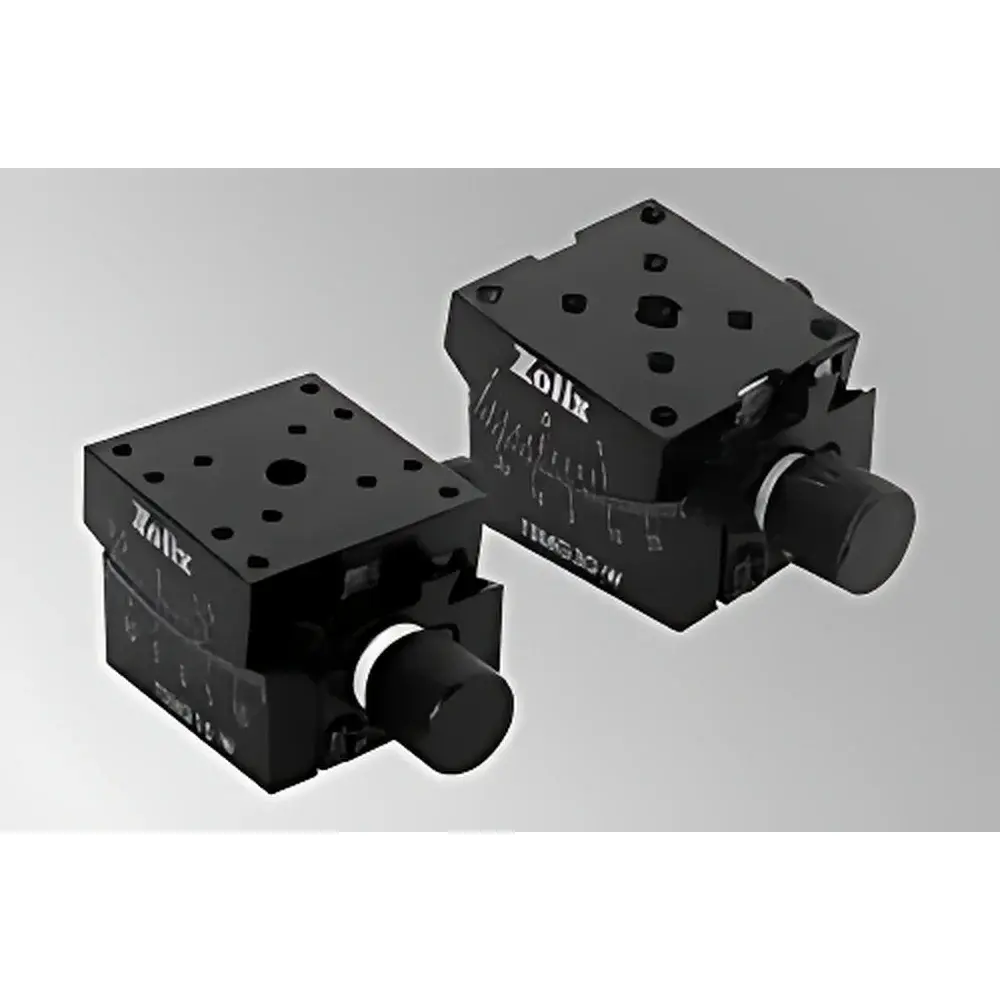
ZOLIX TSMG30/15-W Precision Angular Rotation Stage
| Brand | ZOLIX |
|---|---|
| Origin | Beijing, China |
| Manufacturer Type | Direct Manufacturer |
| Product Category | Domestic (China-made) |
| Model | TSMG30/15-W |
| Pricing | Available Upon Request |
| Adjustment Range (TSMG30-W) | ±30° |
| Adjustment Range (TSMG15-W) | ±10° |
| Center Height (TSMG30-W) | 12.5 mm |
| Center Height (TSMG15-W) | 32.5 mm |
| Graduation Interval (TSMG30-W) | 2° |
| Graduation Interval (TSMG15-W) | 1° |
| Minimum Readability (TSMG30-W) | 0.2° |
| Minimum Readability (TSMG15-W) | 0.1° |
| Load Capacity | 2 kg |
| Stage Height | 20 mm |
| Drive Mechanism | Worm Gear Pair |
| Locking Method | Manual Knob Lock |
| Compatibility | Stackable Dual-Stage Configuration for Coaxial Goniometric Motion |
Overview
The ZOLIX TSMG30/15-W Precision Angular Rotation Stage is a manually operated, high-stability goniometric positioning system engineered for demanding optical alignment tasks in research laboratories and precision instrumentation setups. Designed around the principle of coaxial dual-axis angular adjustment, this stage pair enables precise, decoupled rotation about a common virtual pivot point—achieved through intentional geometric offset between the two stages’ rotational axes. The TSMG30-W provides coarse angular control over ±30°, while the TSMG15-W delivers fine-tuned tilt adjustment within ±10°, with both units sharing identical mechanical height (20 mm) to ensure seamless mechanical stacking without vertical misalignment. Its core motion mechanism employs a hardened worm gear pair, offering inherent self-locking behavior, backlash-free operation, and long-term repeatability under static load conditions. This architecture eliminates reliance on motorized actuators or electronic feedback, making it ideal for vacuum-compatible, EMI-immune, or radiation-hardened environments where passive mechanical integrity is prioritized.
Key Features
- Coaxial dual-stage configuration: TSMG30-W (±30° range, 12.5 mm center height) and TSMG15-W (±10° range, 32.5 mm center height) are dimensionally matched to intersect at a shared optical pivot point when stacked—enabling true two-dimensional goniometric adjustment without parasitic translation.
- High-resolution manual readout: Engraved angular scales with 2° graduation (TSMG30-W) and 1° graduation (TSMG15-W), coupled with vernier-assisted readability of 0.2° and 0.1° respectively, support visual alignment verification traceable to mechanical reference marks.
- Worm gear drive with integrated friction lock: Precision-machined bronze worm wheel and hardened steel worm provide smooth torque transmission, zero backdrive, and stable holding under up to 2 kg payload—critical for maintaining alignment during vibration-prone experiments or long-duration measurements.
- Low-profile, stackable architecture: Uniform 20 mm stage body height ensures mechanical compatibility with standard optical rails, breadboards, and multi-axis kinematic mounts; no adapter plates required for integration into existing optical tables.
- Passive, maintenance-free operation: No electrical connections, cables, or firmware dependencies—reducing failure modes and simplifying qualification for ISO/IEC 17025-accredited calibration labs or GLP-compliant optical test protocols.
Sample Compatibility & Compliance
The TSMG30/15-W is compatible with standard Ø25.4 mm and Ø50.8 mm optical components—including mirrors, waveplates, polarizers, and collimators—when mounted using industry-standard retaining rings or kinematic clamps. Its aluminum alloy construction (6061-T6) offers dimensional stability across ambient lab temperatures (15–30 °C) and low thermal expansion coefficient (23.6 µm/m·K). While not certified to specific international standards as a standalone device, its mechanical design conforms to dimensional and functional expectations outlined in ISO 10110-7 (optical component mounting interfaces) and supports compliance workflows aligned with ISO/IEC 17025 Clause 6.4.1 (equipment suitability for intended use). The absence of electronics renders it inherently compliant with electromagnetic compatibility (EMC) requirements per IEC 61326-1 for laboratory equipment used in non-medical settings.
Software & Data Management
This stage operates exclusively in manual mode and does not incorporate embedded electronics, sensors, or digital interfaces. Consequently, it requires no driver installation, firmware updates, or software licensing. Angular position data is recorded visually via scale reading and documented manually or entered into laboratory notebooks, LIMS, or ELN systems (e.g., LabArchives, Benchling) as discrete metadata fields. For traceability-critical applications, users may assign unique asset IDs and log positional settings alongside experimental parameters—supporting audit readiness for FDA 21 CFR Part 11 (if electronic records are maintained) or internal GLP documentation requirements. Calibration certificates (available upon request) include uncertainty budgets derived from scale linearity testing per ISO/IEC 17025 Annex A.3.
Applications
- Laser cavity alignment and resonator optimization in tunable diode laser systems
- Angle-resolved reflectance and transmittance measurements for thin-film characterization
- Kinematic mounting of interferometric optics in Michelson, Mach–Zehnder, and Sagnac configurations
- Beam steering and polarization state control in ellipsometry and Mueller matrix setups
- Calibration of angular encoders and autocollimators against NIST-traceable angle standards
- Integration into custom-built spectrometers requiring precise grating or detector tilt adjustment
FAQ
Can the TSMG30-W and TSMG15-W be used independently?
Yes—each stage functions as a standalone angular adjuster with full ±30° or ±10° range, respective center heights, and independent locking capability.
Is the stage vacuum-compatible?
The base material (6061-T6 aluminum) and lubricant-free worm gear interface are suitable for high-vacuum environments (<10⁻⁵ mbar); however, users must verify outgassing performance per ASTM E595 prior to chamber deployment.
What is the recommended torque for the locking knob?
Apply moderate hand-tightening only—overtightening may deform the brass bushing and degrade long-term repeatability; typical operational torque is 0.3–0.5 N·m.
Does ZOLIX provide calibration documentation?
Yes—traceable calibration reports (including angular deviation vs. reference autocollimator) are available as an optional service, compliant with ISO/IEC 17025 requirements.
Are replacement scales or verniers available?
Yes—original engraved scale plates and vernier overlays are stocked and supplied under part numbers TSMG30-SCALE and TSMG15-VERNIER, respectively.





