
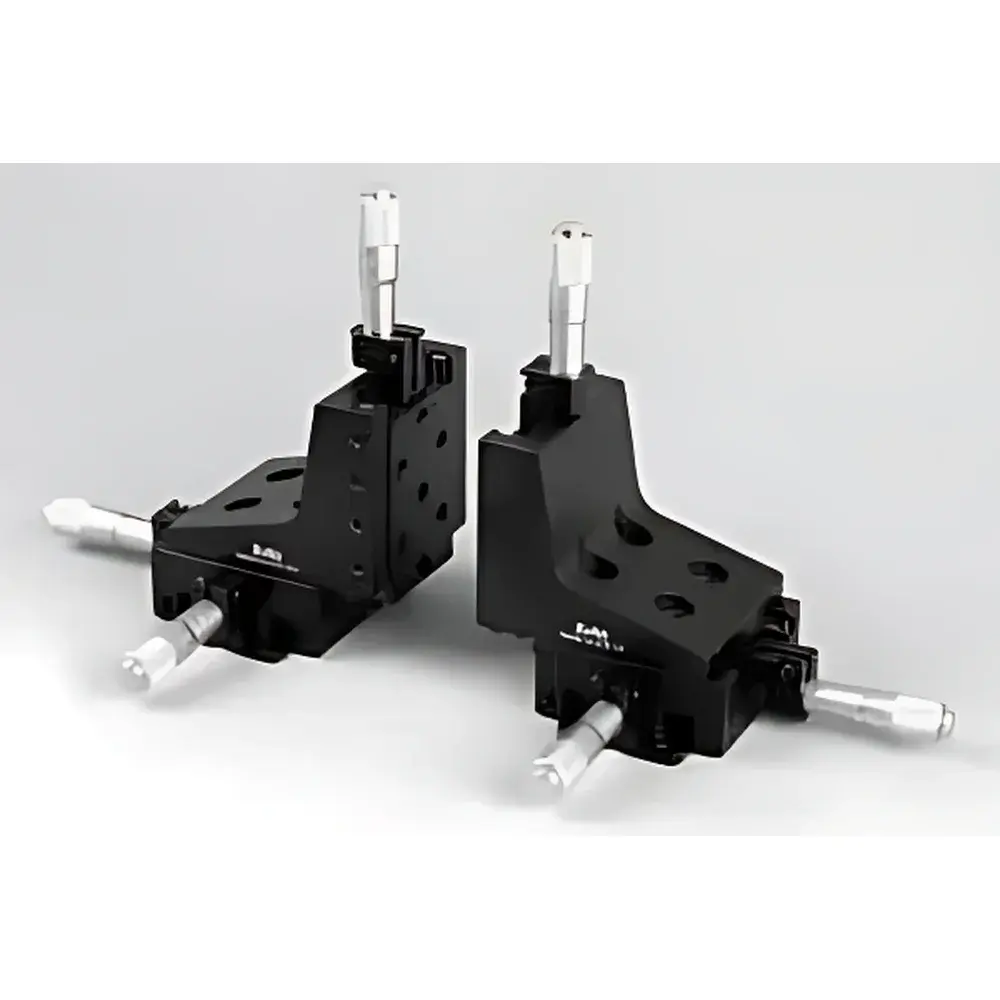
ZOLIX TSMW13-XYZ-1A(L) Integrated Multi-Axis Translation Stage
| Brand | ZOLIX |
|---|---|
| Origin | Beijing, China |
| Manufacturer Type | Direct Manufacturer |
| Country of Origin | China |
| Model | TSMW13-XYZ-1A(L) |
| Pricing | Upon Request |
| Axes | XYZ (3-axis orthogonal translation) |
| Travel Range per Axis | 13 mm |
| Wobble Error | < 30 arcseconds |
| Drive Mechanism | Precision Micrometer Head |
| Minimum Graduation | 0.01 mm |
| Sensitivity (Repeatability) | 0.001 mm |
| Load Capacity | 2.5 kg |
| Net Weight | 0.9 kg |
Overview
The ZOLIX TSMW13-XYZ-1A(L) Integrated Multi-Axis Translation Stage is a compact, high-stability mechanical positioning platform engineered for precision optical alignment and micro-adjustment tasks in research-grade optical laboratories. Designed around a monolithic aluminum alloy base with integrated XYZ orthogonal kinematic architecture, this stage eliminates inter-stage coupling and stacking-induced parasitic motion—common limitations in modular multi-stage assemblies. Its operation relies on three independently adjustable micrometer-driven linear axes, each incorporating hardened stainless-steel lead screws and brass nut bushings to ensure consistent torque transmission and minimal backlash. The stage operates on the principle of direct mechanical displacement amplification via fine-pitch micrometer threads (typically 0.5 mm pitch), enabling sub-micron positional sensitivity without electronic feedback or motorization. It is intended for use in static or quasi-static alignment workflows where thermal drift, vibration isolation, and long-term mechanical stability outweigh the need for automated scanning.
Key Features
- Monolithic structural design minimizes cumulative angular error and enhances rigidity across all three translational degrees of freedom.
- Orthogonal XYZ configuration with precisely aligned dovetail-guided carriages ensures cross-axis orthogonality within ±15 arcseconds as verified during final calibration.
- Micrometer heads feature engraved dual-scale dials (metric and imperial optional) with locking thumbscrews to prevent unintended drift during optical setup or environmental fluctuation.
- Surface-hardened sliding surfaces and low-friction PTFE-coated contact interfaces reduce hysteresis and improve repeatability over repeated adjustment cycles.
- Integrated mounting holes conform to standard 1/4″-20 UNC and M6 thread patterns on all base and top plates, facilitating compatibility with cage systems, post holders, and optical breadboards.
- No electrical components or power requirements—ideal for ultra-low-noise environments including interferometry, quantum optics, and cryogenic optical setups.
Sample Compatibility & Compliance
The TSMW13-XYZ-1A(L) accommodates optical components up to 2.5 kg with center-of-gravity positioned within the central 8 × 8 mm footprint of the top platform. Typical compatible payloads include laser diode mounts, fiber collimators, mirror mounts (kinematic or gimbal), waveplates, and small photodetectors. All structural materials comply with RoHS Directive 2011/65/EU and are free from cadmium, lead, mercury, hexavalent chromium, PBBs, and PBDEs. Surface finishes meet ISO 8501-1 Sa2½ blast cleaning standards prior to anodization, ensuring uniform corrosion resistance and dimensional stability under ambient laboratory conditions (15–30 °C, RH < 70%). While not certified to ISO 9001 at the unit level, ZOLIX maintains ISO 9001:2015 certification for its manufacturing quality management system, supporting traceable production records and metrological validation of critical dimensions.
Software & Data Management
This is a manually operated mechanical stage with no embedded electronics, firmware, or digital interface. Consequently, it does not require driver installation, software configuration, or data logging functionality. Positional data is recorded manually using the micrometer scale readings, and users may integrate it into broader experimental documentation workflows compliant with GLP (Good Laboratory Practice) or internal SOPs. For labs operating under FDA 21 CFR Part 11 requirements, handwritten or digitally transcribed position logs must be contemporaneously dated, signed, and archived alongside optical alignment reports—no electronic audit trail is generated by the device itself, consistent with Class I non-active medical device analogues used in optical diagnostic instrumentation.
Applications
- Precision alignment of single-mode fiber couplers and free-space optical isolators in telecom R&D labs.
- Iterative beam steering and focus optimization in ultrafast laser amplifier chains and OPA pump-probe configurations.
- Co-alignment of multiple laser sources onto shared optical paths in atomic physics experiments involving magneto-optical traps (MOTs).
- Calibration reference positioning for optical encoders, autocollimators, and laser Doppler vibrometers.
- Stable mounting platform for miniature spectrometers and CCD-based imaging sensors requiring sub-10 µm spatial registration.
- Integration into custom vacuum-compatible optical viewports (with optional black anodized or gold-plated variants upon request).
FAQ
Is this stage compatible with vacuum environments?
Standard units are rated for ambient atmospheric operation only; vacuum-compatible versions require optional surface treatments and material substitutions (e.g., stainless steel fasteners, vacuum-baked anodization) and must be specified at time of order.
Can the micrometer heads be replaced with motorized actuators?
The mechanical interface supports third-party stepper or piezo-driven micrometer replacements, though ZOLIX does not supply or validate such integrations—mechanical interference, load moment limits, and thermal expansion mismatches must be assessed independently.
What is the typical angular deviation between axes after factory calibration?
Orthogonality error is measured and documented per unit using autocollimator-based verification; mean deviation is ≤12 arcseconds, with maximum reported values below 15 arcseconds across shipped units.
Does the stage include mounting hardware?
Yes—each unit ships with six M3 × 8 mm socket-head cap screws for top-plate attachment and four M4 × 10 mm screws for base mounting; additional fasteners are available as optional accessories.
How is positional repeatability validated during quality control?
Each stage undergoes 10-cycle bidirectional repeatability testing at three points per axis (0 mm, 6.5 mm, 13 mm) using a calibrated laser interferometer (Renishaw XL-80), with results logged in the unit-specific certificate of conformance.



