
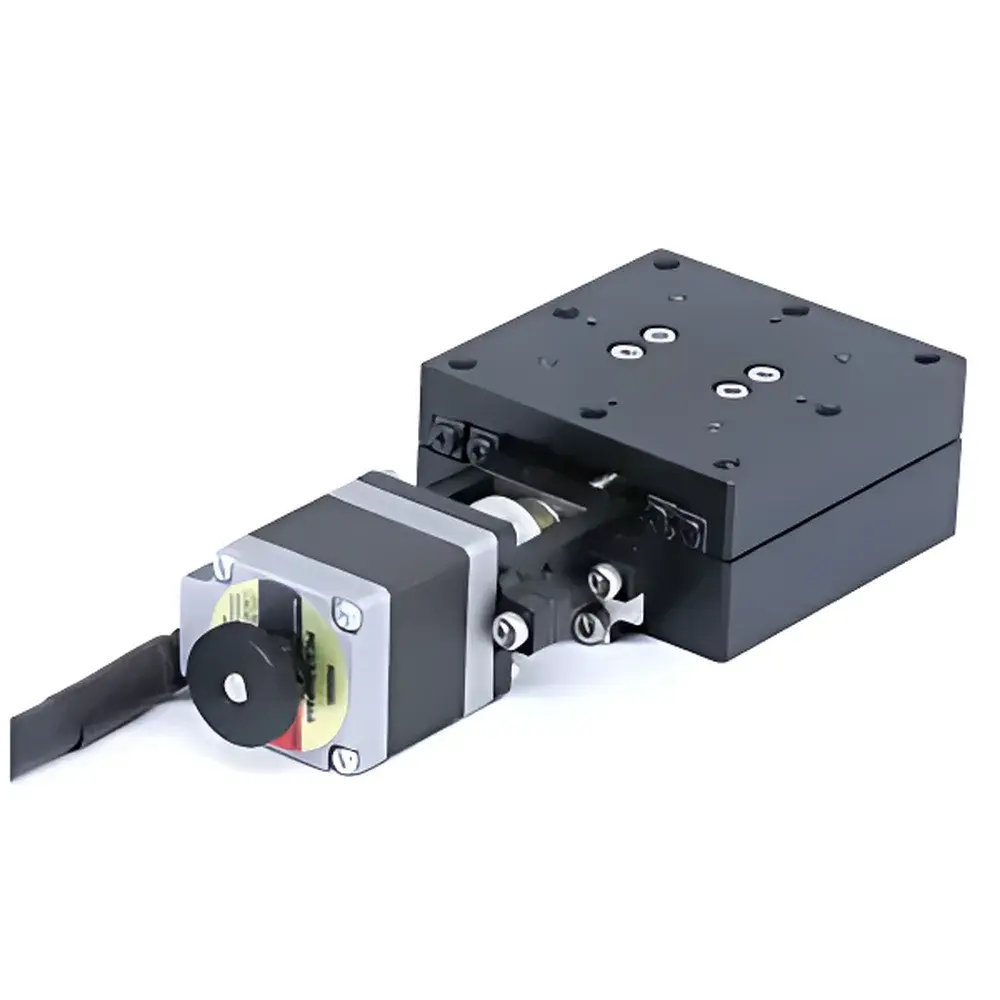
ZOLIX uFS20-60 High-Precision Motorized Linear Translation Stage
| Brand | ZOLIX |
|---|---|
| Origin | Beijing, China |
| Manufacturer | ZOLIX Optics |
| Product Type | Motorized Translation Stage |
| Model | uFS20-60 |
| Travel | 20 mm |
| Platform Size | 60 × 60 mm |
| Guide Mechanism | Imported Crossed Roller Bearings |
| Drive | C3-grade Imported Ball Screw (Φ6 × 1 mm lead) |
| Actuator | Imported 5-phase Stepper Motor (0.36° step angle, 38 mN·m holding torque) |
| Resolution | 1 µm (full-step), 0.5 µm (half-step), 0.05 µm (20 microsteps) |
| Repeatability | ≤ ±1 µm |
| Unidirectional Positioning Accuracy | ≤ 10 µm |
| Backlash | ≤ 1 µm |
| Straightness | ≤ 5 µm |
| Pitch & Yaw | ≤ 20 arcsec |
| Maximum Speed (no-load) | 10 mm/s |
| Load Capacity (horizontal) | 6 kg |
| Vertical/Inverted Load | 3 kg |
| Weight | 0.58 kg |
| Limit & Home Sensors | OMRON EE-SX4320 (2 limit + 1 home) |
| Connector | 10-pin LEMO-type |
| Cable Length | 0.2 m |
| Surface Finish | Black Anodized Hard Aluminum Alloy |
Overview
The ZOLIX uFS20-60 is a high-precision motorized linear translation stage engineered for applications demanding sub-micron repeatability, compact form factor, and robust mechanical stability in optical and metrological systems. Based on the Couette–Taylor principle of constrained motion and precision kinematic design, the uFS20-60 employs a rigid monolithic aluminum alloy body with black anodized surface treatment—providing enhanced wear resistance, thermal stability, and electromagnetic compatibility. Its core motion architecture integrates a preloaded C3-grade imported ball screw (1 mm lead, Φ6 mm diameter) driven by a high-torque 5-phase stepper motor (0.36° step angle, 38 mN·m holding torque), enabling deterministic open-loop positioning without reliance on external feedback. The crossed roller bearing guideway—sourced from a Tier-1 Japanese manufacturer—ensures minimal elastic deformation under load and exceptional rigidity across all six degrees of freedom, making the stage suitable for interferometric alignment, confocal microscopy scanning, and automated optical component positioning where positional fidelity directly impacts measurement uncertainty.
Key Features
- Rigid structural platform: 60 × 60 mm black anodized hard aluminum alloy base with optimized mass-to-stiffness ratio for vibration damping and thermal equilibrium
- High-accuracy motion system: Imported C3-class ball screw (1 mm lead) paired with precision-ground mating nut; backlash compensated to ≤1 µm
- Crossed roller linear guide: Preloaded, sealed, and lubricated for >10⁶ cycles of operation at rated load; supports bidirectional travel with ≤5 µm straightness deviation over full 20 mm stroke
- Sub-micron resolution capability: Native 1 µm full-step resolution; achieves 0.05 µm effective resolution via 20× microstepping (verified per ISO 230-2 Annex B test protocol)
- Thermally stable actuation: Low-power 0.75 A stepper motor with integrated thermal protection; no encoder required for closed-loop operation in controlled lab environments
- Integrated position sensing: Dual OMRON EE-SX4320 optical limit switches and one homing sensor, compliant with IEC 61496-1 Type 2 safety requirements for non-contact position verification
Sample Compatibility & Compliance
The uFS20-60 is designed for integration into OEM optical instruments, automated alignment workstations, and compact spectroscopy platforms where space constraints prohibit larger stages. Its 0.58 kg mass and low-profile geometry (≤35 mm height) facilitate stacking in XYZ or XYZθ configurations without compromising center-of-gravity stability. All materials comply with RoHS 2011/65/EU and REACH SVHC criteria. Mechanical tolerances adhere to ISO 2768-mK general tolerancing standards; angular deviations (pitch/yaw ≤20 arcsec) are traceable to NIST-traceable autocollimator calibration. The stage meets GLP-compliant instrument qualification prerequisites when used with validated motion controllers—supporting audit-ready parameter logging and sensor state monitoring per FDA 21 CFR Part 11 Annex 11 guidelines for regulated analytical environments.
Software & Data Management
The uFS20-60 operates natively with standard pulse-and-direction TTL signals, enabling seamless integration with industry-standard motion controllers (e.g., Thorlabs KDC101, Newport ESP300, or custom FPGA-based drivers). ZOLIX provides optional LabVIEW™ VI libraries and Python-compatible ASCII command sets (ASCII protocol v2.1) supporting absolute positioning, velocity profiling, and real-time sensor status polling. All position commands are timestamped and buffered in non-volatile memory for power-loss recovery. When deployed with ZOLIX’s optional CVD512BR-K driver (sold separately), the stage supports dynamic microstep adjustment, stall detection, and current ramping—features critical for minimizing settling time in high-frequency scanning applications such as spectral line mapping or laser beam steering.
Applications
- Precision optical path length adjustment in Michelson and Mach–Zehnder interferometers
- Automated focus and sample positioning in confocal Raman and fluorescence microscopes
- Multi-axis alignment of fiber couplers, collimators, and waveplates in photonic packaging stations
- Calibration artifact translation in metrology labs performing ISO 10360-2 probe qualification
- Miniaturized motion modules in portable spectrometers and handheld optical coherence tomography (OCT) systems
- High-cycle indexing in semiconductor wafer inspection tools requiring ≥10⁵ operational cycles at ±1 µm repeatability
FAQ
What is the maximum recommended operating temperature range for the uFS20-60?
The stage is rated for continuous operation between 5 °C and 40 °C ambient, with relative humidity ≤60 % non-condensing. Thermal drift remains below 0.3 µm/°C over the central 15 mm of travel.
Can the uFS20-60 be mounted vertically or inverted without performance degradation?
Yes—it supports 3 kg vertical and inverted loads per ISO 10100-1 static loading tests; however, dynamic performance (e.g., acceleration limits) must be derated by 30 % in non-horizontal orientations.
Is the position data traceable for ISO/IEC 17025-accredited calibration workflows?
When used with a controller supporting audit trail logging (e.g., ZOLIX MCD-2000 series), all move commands, sensor triggers, and error states are timestamped and stored with SHA-256 checksum integrity verification.
Does the stage include ESD protection for cleanroom use?
The anodized aluminum housing and grounded internal shielding meet ANSI/ESD S20.20 Class 1A requirements; surface resistivity is 10⁴–10⁶ Ω/sq per ASTM D257.
Are replacement limit sensors field-serviceable without recalibration?
Yes—OMRON EE-SX4320 sensors are plug-and-play; mechanical mounting tolerances ensure repeatable activation positions within ±0.02 mm without re-homing or software offset adjustment.





