
ZOLIX Ultrafast Spectroscopy Test System
| Brand | ZOLIX |
|---|---|
| Origin | Shanghai, China |
| Manufacturer Type | Manufacturer |
| Product Category | Domestic |
| Model | Ultrafast Spectroscopy Test System |
| Pricing | Upon Request |
Overview
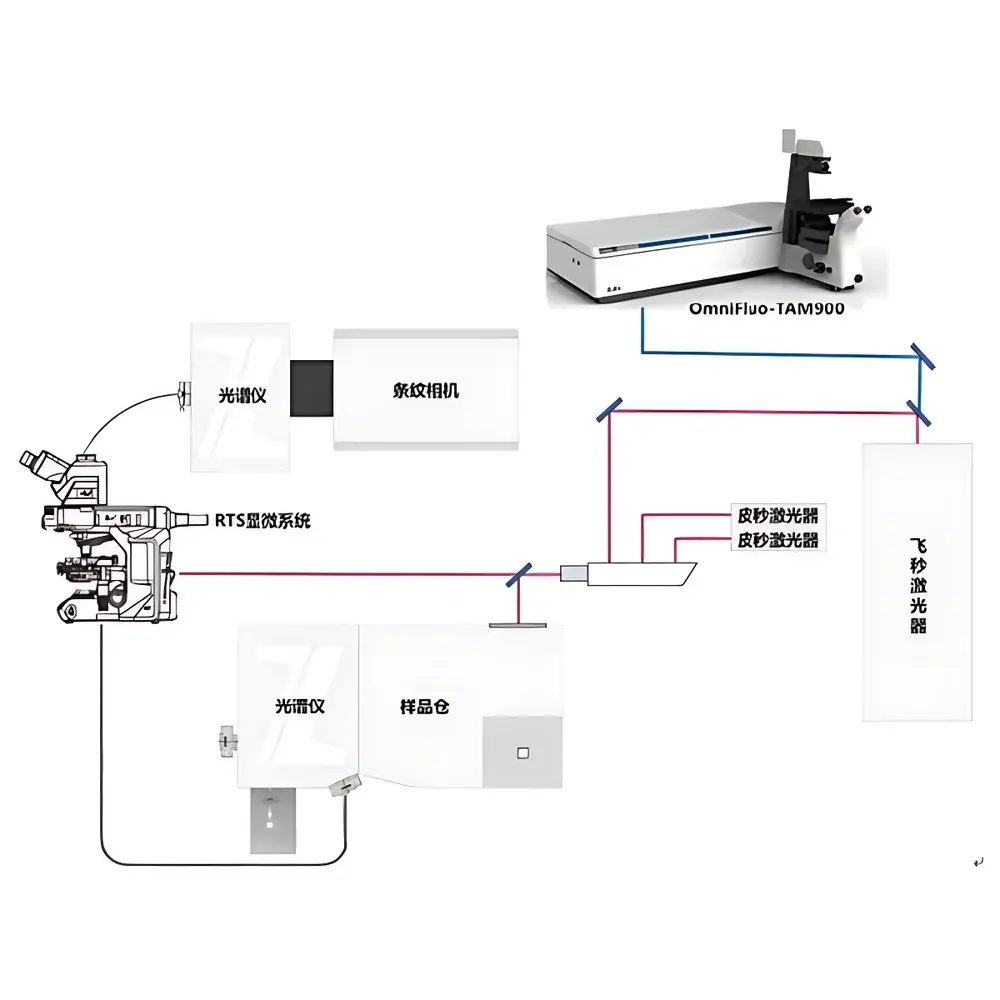
The ZOLIX Ultrafast Spectroscopy Test System is a modular, research-grade platform engineered for time-resolved optical spectroscopy at femtosecond to microsecond temporal scales. Built upon the RTS (Real-Time Spectroscopy) inverted microscope architecture, it integrates ultrafast excitation sources, time-gated detection modalities, and spatially resolved spectral acquisition to probe non-equilibrium carrier dynamics, excitonic processes, vibrational relaxation, and photoinduced reaction pathways in condensed matter and biological systems. The system operates on core physical principles including pump-probe transient absorption, time-correlated single-photon counting (TCSPC)-based fluorescence lifetime imaging (FLIM), and synchroscan-streak camera–enabled ultrafast spectral mapping. Its design enables direct observation of quantum-coherent phenomena, such as exciton dissociation, charge transfer across heterointerfaces, and spin-dependent recombination—processes critical to advancing next-generation optoelectronic materials, quantum materials, and photobiological mechanisms.
Key Features
- Modular integration of femtosecond/picosecond laser sources (e.g., Ti:sapphire oscillator + amplifier, OPA) with wavelength tunability from 200 nm to 2200 nm
- Multi-modal detection architecture: streak camera (≤5 ps temporal resolution), TCSPC-FLIM module (16 ps minimum IRF), and wide-field transient absorption imaging subsystem
- Inverted microscope base with open-top configuration—designed for seamless integration of cryogenic stages (4 K–300 K), electrical probe stations, magnetic field coils (up to ±9 T), and vacuum-compatible sample environments
- High-precision motorized XYZ stage (10 nm step resolution) enabling automated FLIM raster scanning and lifetime-mapped spectral point acquisition
- Simultaneous spatiotemporal-spectral recording: <1 μm spatial resolution (@100× objective, 405 nm excitation), <500 fs time resolution (with 100 fs pump pulses), and <0.2 nm optical resolution (1200 g/mm grating)
- Flexible excitation-detection geometry: point-pump / wide-field probe (for carrier migration tracking); wide-field pump / wide-field probe (for homogeneous carrier distribution mapping); reflection/scattering mode for opaque or layered 2D samples
Sample Compatibility & Compliance
The system supports diverse sample formats including bulk crystals, exfoliated or CVD-grown 2D materials (MoS₂, WS₂, WSe₂), perovskite thin films (MAPbI₃, CsPbBr₃), organic semiconductors (P3HT:PCBM), biomolecular assemblies (DNA origami, photosynthetic complexes), and live-cell monolayers. All optical paths comply with ISO 10110-7 (laser safety) and IEC 60825-1 standards. Data acquisition workflows adhere to GLP-compliant metadata tagging (timestamp, laser fluence, polarization state, objective ID, grating position). Optional 21 CFR Part 11–compliant audit trail logging is available for regulated R&D environments requiring traceable instrument operation records.
Software & Data Management
ZOLIX Ultrafast Control Suite (v4.2+) provides unified control of laser synchronization, delay-stage positioning, detector gating, spectrometer calibration, and microscope navigation. Raw data are stored in HDF5 format with embedded NeXus-compatible metadata schemas. Time-resolved spectral datasets support batch processing via Python-based analysis modules—including global lifetime fitting (multi-exponential decay deconvolution), principal component analysis (PCA) of transient spectra, and spatial lifetime histogram generation. Export options include TIFF stacks (for FLIM), CSV (decay curves), and MDF (multi-dimensional format) compatible with OriginLab, MATLAB, and commercial spectroscopy analysis platforms. All software binaries undergo annual third-party validation per ISO/IEC 17025 requirements for analytical instrument software verification.
Applications
- Exciton dynamics in van der Waals heterostructures: edge-state lifetimes, interlayer energy transfer, and moiré-confined carrier trapping
- Ultrafast photophysics of metal halide perovskites: ASE threshold mapping, carrier cooling kinetics, defect-mediated recombination channels
- Photoinduced charge separation at organic/inorganic interfaces: femtosecond-resolved electron injection into TiO₂ or graphene oxide
- Non-equilibrium phonon coupling in correlated oxides: transient reflectivity signatures of polaron formation and lattice distortion
- Ultrafast conformational changes in photoactive proteins (e.g., rhodopsin, LOV domains): time-resolved fluorescence anisotropy and spectral shift tracking
- Carrier diffusion profiling in lateral heterojunctions: nanoscale mapping of minority-carrier lifetime gradients using pump-probe FLIM
FAQ
What laser repetition rates are supported in synchronized acquisition modes?
The system supports full synchronization across 1 kHz–10 MHz repetition regimes, with hardware-triggered delay-line stepping and detector gate timing locked to master oscillator output.
Can the streak camera module be used for single-shot spectral acquisition?
Yes—the synchroscan mode enables single-laser-shot spectral-temporal mapping over 500 ps–100 μs windows, with programmable sweep voltage linearity calibrated to <0.1% RMS deviation.
Is vacuum compatibility available for the microscope chamber?
A UHV-compatible version (10⁻⁸ mbar base pressure) with differential pumping ports and feedthroughs for electrical/magnetic leads is offered as an optional configuration.
Does the system support polarization-resolved transient measurements?
Integrated half-wave plates, Glan-Taylor polarizers, and rotating analyzer stages enable full Stokes parameter acquisition for dichroism and anisotropy studies.
How is spectral calibration maintained across temperature and humidity variations?
An internal Hg/Ne reference lamp performs automated wavelength calibration before each measurement sequence; long-term drift is compensated using real-time grating encoder feedback (±0.005 nm stability over 8 h).




