
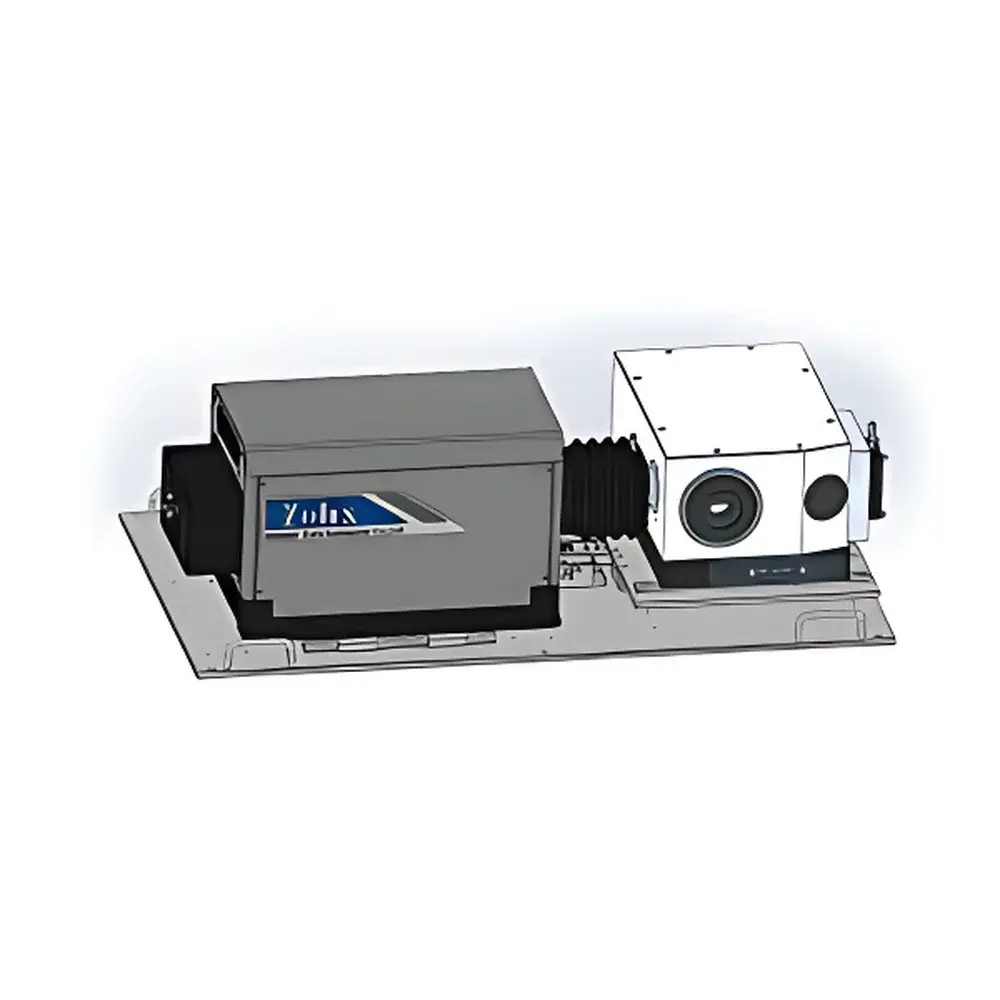
ZOLIX Ultrafast Time-Resolved Spectroscopy System
| Brand | ZOLIX |
|---|---|
| Origin | Beijing, China |
| Manufacturer Type | OEM Manufacturer |
| Product Type | Domestic |
| Model | Ultrafast Time-Resolved Spectroscopy System |
| Pricing | Upon Request |
Overview
The ZOLIX Ultrafast Time-Resolved Spectroscopy System is a turnkey, vacuum-compatible instrumentation platform engineered for sub-nanosecond to microsecond temporal resolution in spectral domain measurements. It operates on the principle of **streak camera-based time-resolved spectroscopy**, where ultrafast photonic events are converted into spatially encoded temporal information via electron-optical deflection. Incident photons are dispersed by a high-fidelity imaging spectrograph (e.g., Omni-λ series), then focused onto the photocathode of a streak tube. Photoelectrons generated at the cathode undergo acceleration and transverse electrostatic deflection synchronized with the optical event; their arrival position on the phosphor screen maps linearly to arrival time. This spatiotemporal transformation enables single-shot acquisition of transient spectra with intrinsic timing fidelity ≤5 ps and lifetime decay coverage from ≤50 ps to 100 µs. The system supports both static (steady-state) spectral acquisition and dynamic mapping of spectral evolution across time delays—critical for probing non-equilibrium carrier dynamics, exciton recombination pathways, and photoinduced charge transfer processes in advanced optoelectronic materials.
Key Features
- Sub-5 ps instrumental time resolution, validated under standard laser excitation conditions (e.g., 400 nm, 100 fs pulses)
- UV–VIS–NIR spectral coverage: 200–900 nm, configurable via grating selection and detector optimization
- High spectral resolution: <0.1 nm (FWHM) with 1200 l/mm grating, scalable down to <0.05 nm using 750 mm focal length spectrographs
- Wide single-shot spectral window: ≥200 nm at low dispersion (e.g., 150 l/mm grating), enabling simultaneous capture of broad emission or absorption bands
- Integrated cryo-cooled sCMOS or intensified CCD detection with quantum efficiency >50% across 300–800 nm
- Modular optical coupling architecture: supports fiber input, confocal microscopy integration, fluorescence sample chambers, and lens-coupled collection optics
- Fully synchronized control of delay stages, laser triggers, detector gating, and spectrograph motorization via deterministic timing engine
Sample Compatibility & Compliance
The system accommodates solid-state thin films (e.g., perovskite, 2D TMDCs), colloidal quantum dots, organic semiconductors, scintillator crystals, plasma plumes, and gas-phase radicals. Sample environments include ambient air, nitrogen-purged enclosures, liquid nitrogen cryostats (down to 77 K), and vacuum chambers (<10⁻⁵ mbar). All hardware and software modules comply with CE electromagnetic compatibility (EMC) directives and RoHS material restrictions. Data acquisition workflows support audit-trail logging aligned with GLP principles. When configured with optional FDA 21 CFR Part 11-compliant software modules (available upon request), electronic records meet regulatory requirements for traceability, user authentication, and immutable data archiving.
Software & Data Management
Control and analysis are unified within the ZOLIX Omni-Spectra suite—a Windows-based application built on Qt and Python (NumPy/SciPy). Core capabilities include real-time streak image preview, wavelength calibration using Hg/Ar lamp references, temporal axis calibration via RF-driven sweep signal, background subtraction, spectral deconvolution (including instrument response function correction), multi-exponential lifetime fitting (Levenberg–Marquardt algorithm), and transient absorption difference spectrum generation. Export formats include HDF5 (with metadata schema), ASCII, and MATLAB .mat. Batch processing pipelines support automated analysis of multi-delay datasets. The software architecture permits API-level integration with LabVIEW, MATLAB, or Python for custom experiment automation and machine learning–driven feature extraction.
Applications
- Time-resolved photoluminescence (TRPL) of perovskite thin films, with ASE lifetime quantification <20 ps
- Carrier thermalization and trapping kinetics in semiconductor heterostructures via femtosecond transient absorption
- Ultrafast chemiluminescence and bioluminescence decay profiling in catalytic and enzymatic reactions
- Plasma emission dynamics and Thomson scattering diagnostics in pulsed discharge systems
- Scintillation decay characterization of LYSO, BGO, and CsI:Tl crystals for radiation detection
- Quantum dot blinking dynamics and Auger recombination pathways
- Ultrafast Raman gain dynamics in nonlinear waveguides and photonic crystals
- Response characterization of photodetectors and optical modulators in free-space and fiber-coupled configurations
FAQ
What is the minimum measurable fluorescence lifetime with this system?
The system achieves ≤50 ps instrument response function (IRF) under optimal alignment and laser pulse conditions; effective lifetime resolution depends on signal-to-noise ratio and deconvolution fidelity.
Can the system be integrated with external cryogenic stages or electrical biasing setups?
Yes—mechanical interfaces and feedthrough-compatible mounting plates are provided for integration with closed-cycle cryostats, probe stations, and voltage/current sources.
Is synchronization with third-party femtosecond lasers supported?
Native TTL and LVDS trigger inputs accept external laser sync signals with jitter <100 ps; delay generators with 10 ps resolution are optionally available.
Does the software support batch analysis of time-series spectral data?
Yes—Omni-Spectra includes scripting-enabled batch mode for automated peak tracking, lifetime mapping, and kinetic model fitting across hundreds of delay points.
Are calibration certificates and traceable wavelength standards included?
Each delivered system ships with NIST-traceable Hg/Ar spectral calibration lamps and factory-generated resolution/linearity reports compliant with ISO 17025 guidelines.



