
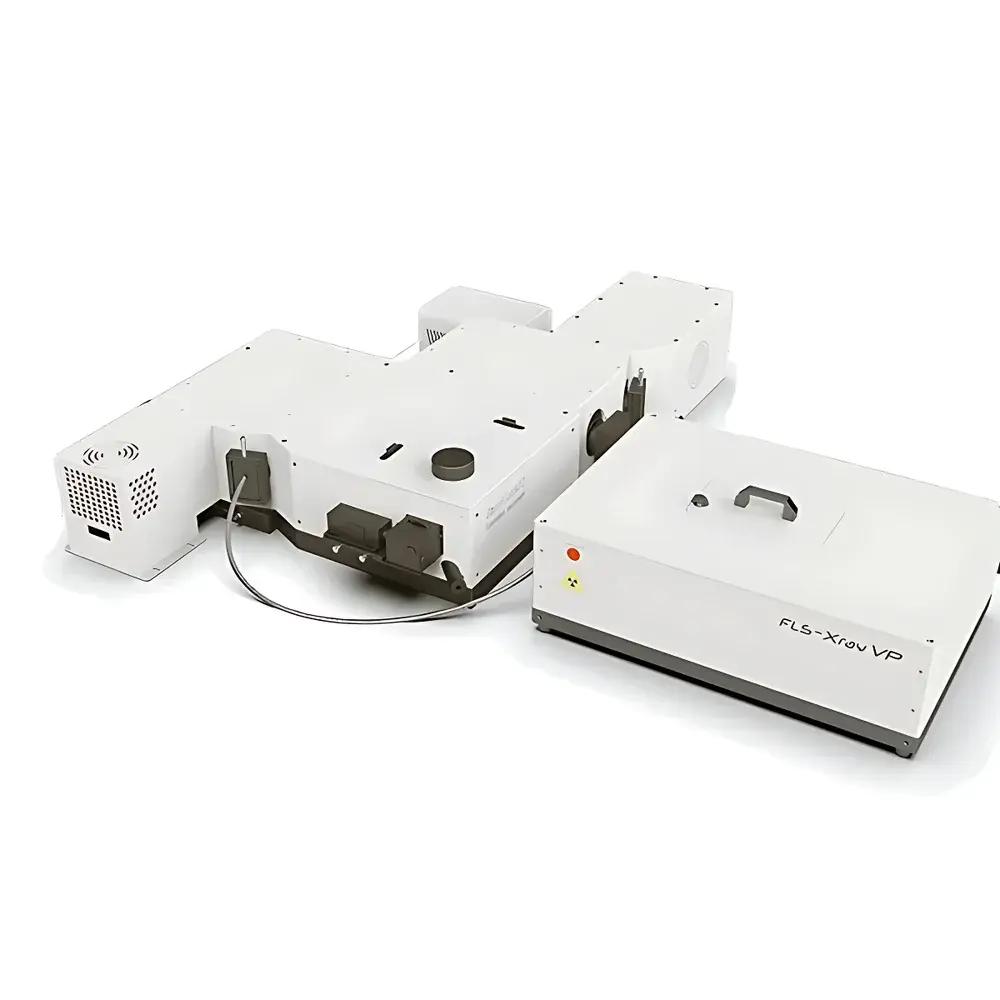
ZOLIX X-Ray Scintillation Characterization System for Spectral, Lifetime, Imaging & Light Yield Analysis
| Brand | ZOLIX |
|---|---|
| Model | X-Ray Scintillation Characterization System |
| Origin | Beijing, China |
| Manufacturer Type | OEM Producer |
| Category | Domestic |
| Price Range | USD 42,000 – 280,000 |
Overview
The ZOLIX X-Ray Scintillation Characterization System is an integrated, research-grade instrumentation platform engineered for comprehensive photophysical evaluation of scintillating materials under ionizing radiation excitation. It implements multiple complementary measurement modalities—including steady-state and time-resolved X-ray excited luminescence (XEOL), transient spectral imaging, radioluminescence lifetime mapping, and absolute light yield quantification—within a single, safety-compliant architecture. The system operates on well-established physical principles: steady-state spectroscopy relies on continuous or nanosecond-pulsed X-ray excitation (4–50 kV, up to 50 W) coupled with high-throughput grating spectrometers (200–900 nm range); time-resolved measurements employ picosecond laser-driven X-ray sources (e.g., 405 nm ps diode, <100 ps pulse width) in conjunction with time-correlated single-photon counting (TCSPC) or synchroscan streak cameras (time resolution ≤5 ps, temporal window 500 ps–100 µs); imaging leverages CMOS, single-pixel, and TFT-based active matrix detection with sub-20 lp/mm spatial resolution; and absolute light yield determination follows ISO/IEC 17025-aligned protocols using calibrated isotopic sources (e.g., 22Na, 137Cs), PMT-based signal chain, and multi-channel pulse-height analysis.
Key Features
- Modular, multi-modal design supporting concurrent or sequential acquisition of spectral, temporal, spatial, and quantitative photon yield data
- Dual X-ray excitation architecture: (a) Continuous/nanosecond-pulsed X-ray tube (0–50 kV, 0–50 W, W-anode, 200 µm Be window) and (b) Picosecond laser-pumped X-ray source (405 nm, 100 Hz–100 MHz, QE ~10% @ 400 nm, 40 kV operation)
- High-sensitivity optical detection: Back-illuminated 20 MP CMOS camera (2.4 µm pixels, -15 °C cooling, 84% QE @ 495 nm) and synchroscan streak camera (ST10) with <0.2 nm spectral resolution and 500 ps–100 µs adjustable time window
- TCSPC module with 100 Mcps maximum count rate, <10 ns dead time, 16–33,554,432 ps time bins, and USB 3.0 interface for synchronized spectral-lifetime correlation
- Full-dynamic-range light yield measurement suite: Includes 22Na/137Cs isotopic sources, lead-shielded sample chamber (compliant with GBZ115-2023), 46 mm PMT (160–650 nm), ultra-low-noise preamplifier (<60 ns rise time), spectroscopy-grade amplifier (gain 2.5–1500, <0.025% integral nonlinearity), and 2K-channel MCA with real-time dead-time correction (Gedcke-Hale method)
- Motorized XY translation stages (XY5050 or XY120120 options) with ≤1.5 µm repeatability for raster-scanned lifetime or imaging mapping
- Integrated radiation safety infrastructure: Onboard dose monitor (50 nSv/h–10 Sv/h range, ±15% accuracy), interlocked beam shutters (<10 µSv/h residual dose when closed), and full compliance with GBZ115-2023 for low-energy X-ray device shielding
Sample Compatibility & Compliance
The system accommodates powder, thin-film, bulk crystal, and solution-phase scintillator samples via standardized holders (powder cup, liquid cuvette, film stage). It supports direct-bandgap perovskite nanocrystals (e.g., CsPbBr3, FAPbBr3), classical inorganic scintillators (NaI:Tl, CsI:Tl, LaBr3:Ce, YAG:Ce), and emerging metal-halide semiconductors. All optical and X-ray pathways are fully enclosed and interlocked. Radiation shielding meets the Chinese national standard GBZ115-2023 (“Radiation Protection Standard for Low-Energy X-ray Devices”), including structural lead equivalence, distance-based exposure limits (3 m / 6 m / 30 m operational zones), and real-time ambient dose monitoring. Electrical safety conforms to IEC 61010-1. Data integrity and audit readiness support GLP/GMP workflows through timestamped metadata logging, user-access controls, and optional 21 CFR Part 11-compliant software modules.
Software & Data Management
ZOLIX ScintVision™ software provides unified control across all subsystems: X-ray source timing, spectrometer grating position, detector gate delay, TCSPC histogram accumulation, streak camera synchronization, and image acquisition. It enables simultaneous display of decay curves, spectral maps, lifetime distributions, and energy spectra. Raw data are stored in HDF5 format with embedded calibration metadata (wavelength, time-zero, gain, HV setting, dose rate). Batch processing includes exponential fitting (1–4 components), spectral deconvolution (Voigt/Gaussian), spatial lifetime mapping, and absolute photon yield calculation (photons/MeV) referenced to NIST-traceable standards. Export options include CSV, MATLAB .mat, and industry-standard CDF for third-party analysis (e.g., Origin, Igor Pro, Python SciPy). Audit trails record all parameter changes, user logins, and instrument status events.
Applications
- Development and benchmarking of halide perovskite nanocrystals for X-ray imaging and radiation dosimetry
- Structure–property correlation studies linking crystal defect density, dopant concentration, and radioluminescence quantum yield
- Time-resolved mechanistic analysis of exciton trapping, carrier recombination, and afterglow suppression in scintillators
- Performance validation of direct-conversion X-ray detectors (e.g., TFT-integrated perovskite photodiodes) under pulsed irradiation
- Calibration and cross-validation of light yield values against reference standards (e.g., NaI:Tl = 38,000 ph/MeV, LaBr3:Ce = 63,000 ph/MeV)
- Preclinical small-animal X-ray imaging system characterization and resolution testing (e.g., ANSI/HQ-39 resolution target, ≥20 lp/mm at 1 mm YAG:Ce)
- Accelerated aging and radiation damage assessment via repeated XEOL lifetime tracking
FAQ
What X-ray energies and dose rates does the system support?
Continuous excitation: 4–50 kV, 0–50 W; Nanosecond pulses: up to 150 kV, 50 ns width, 10 Hz repetition, 2.4 mR/pulse average dose rate.
Can the system measure absolute light yield in photons/MeV?
Yes—using calibrated 22Na or 137Cs sources, traceable PMT quantum efficiency, and MCA-based pulse-height spectroscopy with dead-time-corrected counting.
Is the TFT imaging module compatible with both indirect and direct X-ray conversion?
Yes—the supplied TFT sensor chips support both scintillator-coupled (indirect) and perovskite semiconductor (direct) configurations, with active area up to 32 × 32 mm and 64 × 64 pixel resolution.
How is radiation safety ensured during operation?
Compliance with GBZ115-2023 is achieved via interlocked beam shutters, real-time dose monitoring, shielded enclosure, mandatory 3/6/30 m operational zones, and automatic source cutoff upon door opening or dose threshold breach.
Does the software support automated lifetime mapping across a sample surface?
Yes—via synchronized XY stage motion, TCSPC histogram acquisition per pixel, and batch exponential fitting with spatial overlay of τ1, τ2, and amplitude-weighted mean lifetime.
Related Products





