
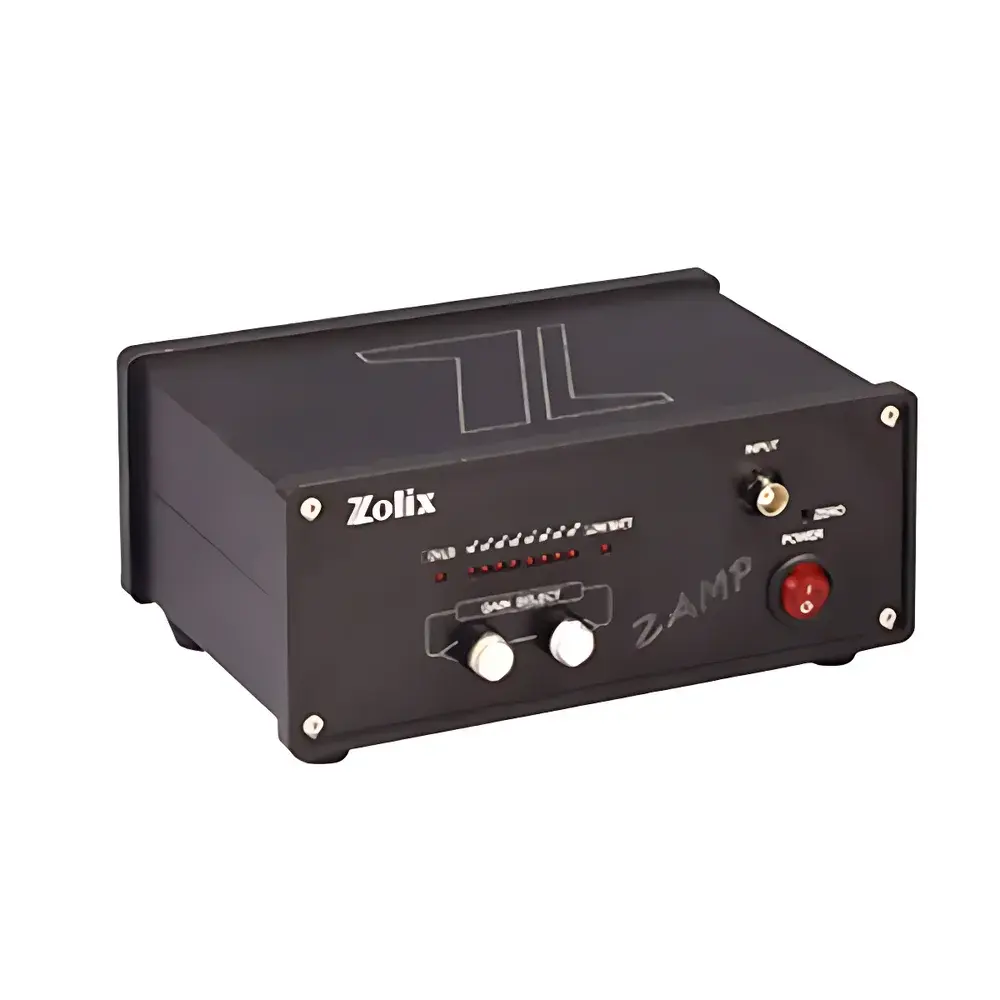
ZOLIX ZAMP Series Transimpedance Amplifier
| Brand | ZOLIX |
|---|---|
| Model | ZAMP |
| Type | Transimpedance (Current-to-Voltage) Amplifier |
| Input Impedance Range | 1 mΩ to 100 GΩ (8 decades) |
| Gain Range | 10³–10¹⁰ V/A |
| Output Noise Voltage | ≤ 0.5 mV (RMS, DC–10 kHz) |
| Input Current Range | ±5 mA |
| Output Voltage Range | ±5 V |
| Gain Accuracy | ±2% (10³–10⁸), ±5% (10⁹–10¹⁰) |
| Power Supply | Dedicated AC adapter (ZAMP-A) |
| Dimensions | 195 × 121 × 88 mm |
| Compliance | CE-marked, RoHS-compliant, designed for laboratory-grade optical signal conditioning in accordance with IEC 61326-1 (EMC for measurement equipment) |
Overview
The ZOLIX ZAMP Series Transimpedance Amplifier is a precision-engineered current-to-voltage conversion instrument designed for high-fidelity signal conditioning of weak photocurrent outputs from photodiodes, PMTs, APDs, and other low-output-current optical detectors. Operating on the principle of transimpedance amplification—where input current is converted linearly to output voltage via a feedback resistor network—the ZAMP delivers stable, low-noise gain across eight calibrated decades (10³–10¹⁰ V/A). Its ultra-low input impedance architecture (<1 mΩ typical) ensures minimal loading effect on high-impedance photodetectors, preserving signal integrity under both DC and low-frequency AC conditions. The amplifier is optimized for integration into spectroscopic systems, laser power monitoring setups, fluorescence lifetime measurement platforms, and quantum optics experiments where dynamic range, gain stability, and noise floor are critical performance determinants.
Key Features
- Eight-decade programmable gain (10³–10¹⁰ V/A) with front-panel switch selection and clear decade labeling
- Dual-power configuration: ZAMP-A supports continuous AC operation; ZAMP-B adds internal rechargeable battery option for enhanced gain accuracy and improved SNR in field or vibration-sensitive environments
- Input-referred noise voltage ≤ 0.5 mV (RMS, bandwidth 0–10 kHz), enabling reliable detection of sub-nanoampere photocurrents
- High linearity over full input range (±5 mA) with output swing limited to ±5 V into ≥10 kΩ load
- Output impedance <1 Ω ensures robust drive capability into oscilloscopes, DAQ systems, lock-in amplifiers, and digitizers
- Front-panel LED indicators for gain setting, power status, and overload warning
- Shielded BNC input/output connectors and grounded metal enclosure minimize EMI susceptibility per IEC 61000-4-3 standards
Sample Compatibility & Compliance
The ZAMP series interfaces seamlessly with a broad spectrum of optical detectors—including silicon, InGaAs, and HgCdTe (MCT) photodiodes—without requiring external biasing circuits for standard photovoltaic-mode operation. For photoconductive MCT detectors (e.g., DMCT(x)-De01 series), optional voltage-mode amplifiers (ZPA-102/ZPA-300) are available with user-configurable bias inputs. All ZOLIX amplifiers comply with CE Directive 2014/30/EU (EMC) and 2011/65/EU (RoHS), and meet IEC 61326-1 requirements for electromagnetic immunity in laboratory environments. Device calibration traceability follows ISO/IEC 17025 principles, supporting GLP-compliant documentation workflows when used in regulated optical metrology applications.
Software & Data Management
While the ZAMP operates as a stand-alone analog signal conditioner, its deterministic gain response and stable DC offset make it fully compatible with third-party data acquisition software (e.g., LabVIEW, MATLAB, Python-based PyVISA frameworks) via standard analog output routing. No proprietary drivers or firmware updates are required. When deployed in automated spectroscopy or process monitoring systems, the amplifier’s consistent transfer function enables straightforward gain compensation during post-acquisition signal reconstruction. For audit-trail compliance in QA/QC labs, users may log gain settings, power source mode (AC/battery), and ambient temperature alongside raw voltage readings—consistent with FDA 21 CFR Part 11 expectations for electronic records where applicable.
Applications
- Low-light intensity monitoring in Raman and fluorescence spectrometers
- Beam profiling and power stabilization in tunable laser systems
- Time-resolved photon counting with gated integrators or TCSPC modules
- Calibration reference chains for NIST-traceable optical power meters
- Multi-channel detector arrays in hyperspectral imaging platforms
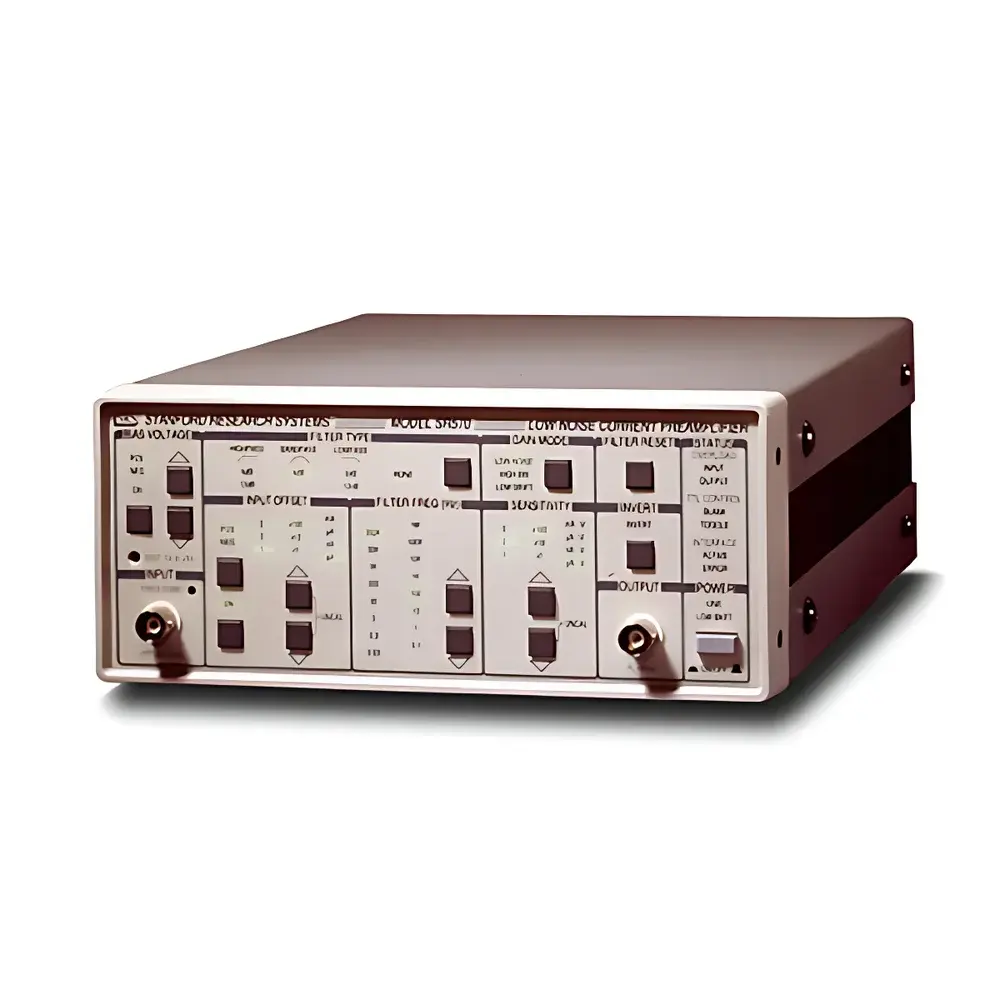
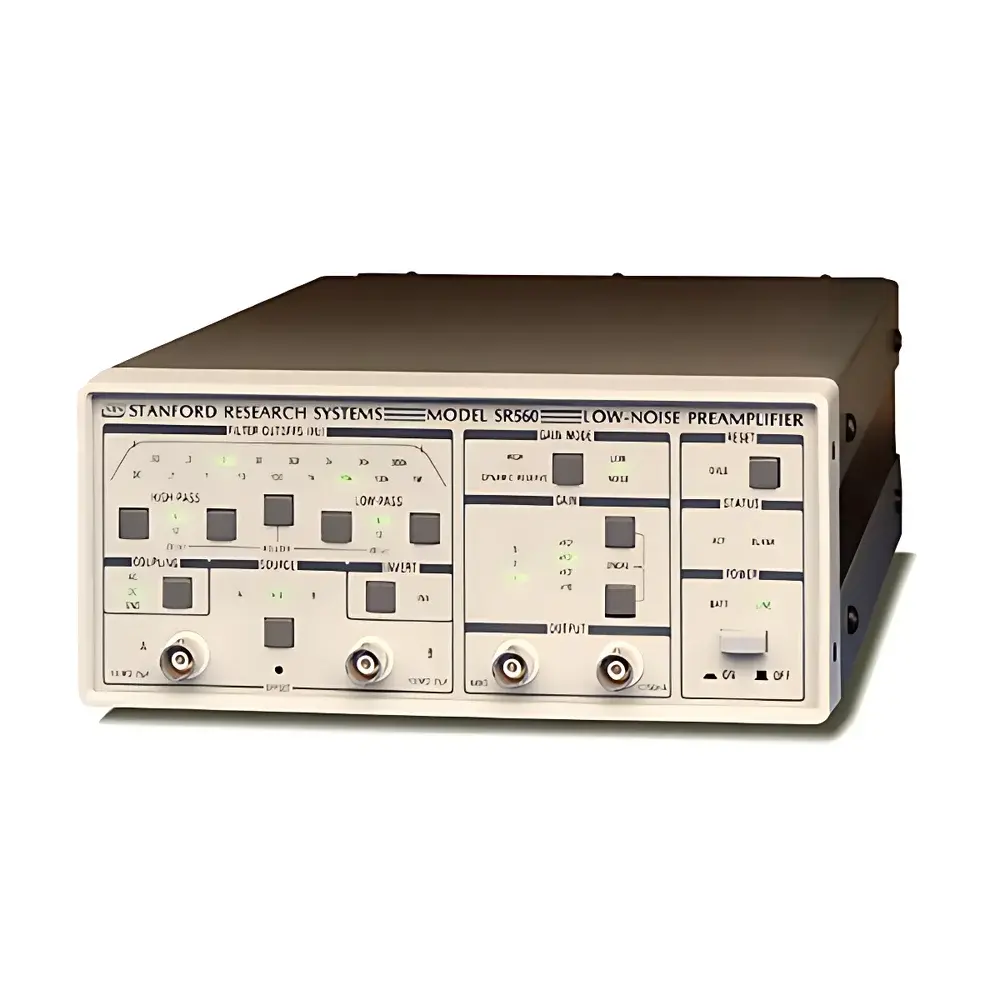
- Integration with SRS SR570 (current mode) and SR560 (voltage mode) amplifiers for hybrid signal conditioning architectures
FAQ
What is the difference between ZAMP-A and ZAMP-B?
ZAMP-A uses only an external AC adapter for continuous operation; ZAMP-B supports dual power sources—AC adapter or internal rechargeable battery—with battery operation yielding superior gain accuracy (±2% across all decades) and lower broadband noise floor.
Can ZAMP be used with photovoltaic-mode MCT detectors?
Yes, for zero-bias photovoltaic operation. For photoconductive MCT detectors requiring external bias, ZPA-102 or ZPA-300 voltage-mode amplifiers are recommended, with bias resistors selected per manufacturer datasheets.
Is remote control or digital interface supported?
No—ZAMP is an analog-only instrument with manual gain selection. For automated gain switching, users integrate it with external relay-based gain-switching modules or pair it with programmable SRS SR570 units via TTL trigger lines.
How does ZAMP compare to SRS SR570 in terms of noise performance?
SR570 achieves lower input current noise (5 fA/√Hz), making it preferable for femtoamp-level signals; ZAMP prioritizes wide dynamic range and ease of integration in OEM optical subsystems, with higher absolute input current handling (±5 mA) and simpler power management.
Does ZAMP require periodic recalibration?
Calibration drift is less than 0.05%/°C over 15–35°C ambient; annual verification against a calibrated current source (e.g., Keithley 2450) is recommended for metrology-critical applications.





