
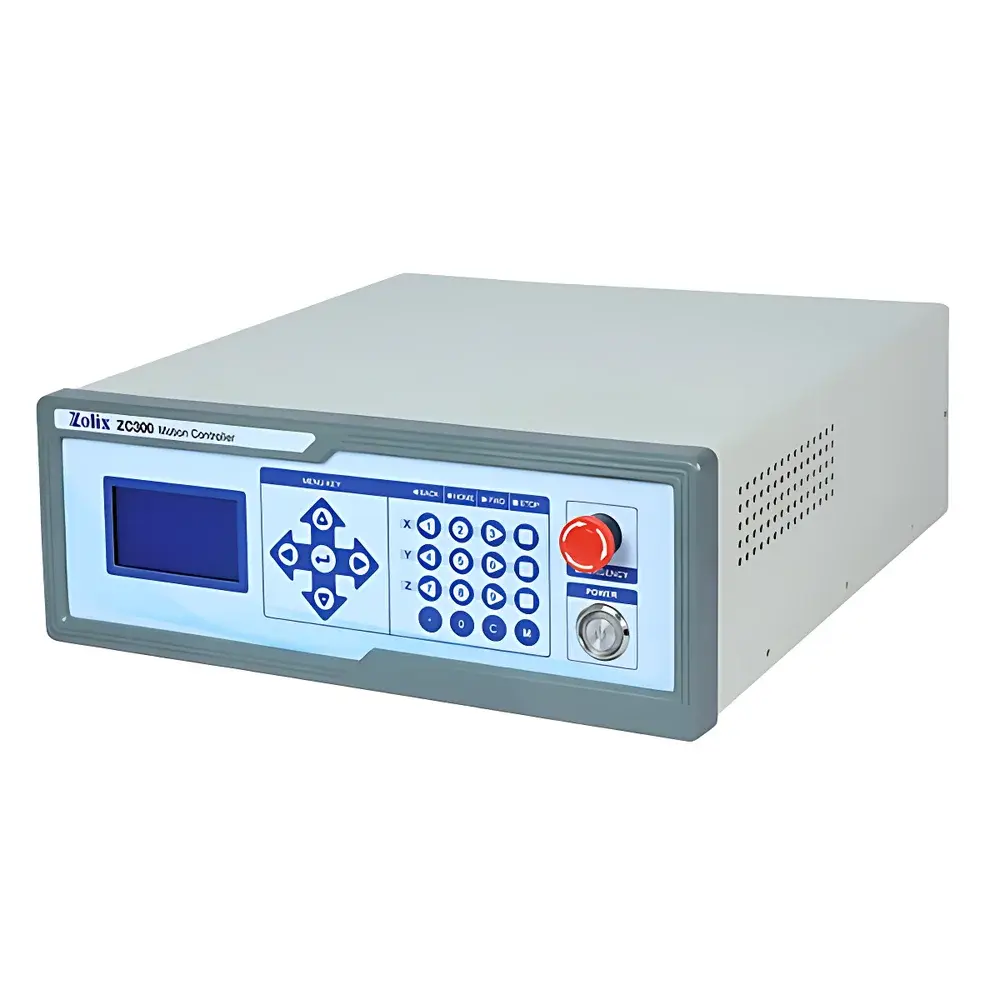
ZOLIX ZC300 Series Multi-Axis Motion Controller
| Brand | ZOLIX |
|---|---|
| Origin | Beijing, China |
| Manufacturer Type | Original Equipment Manufacturer (OEM) |
| Product Category | Motion Control Module for Optical Positioning Systems |
| Model | ZC300 |
| Axis Support | 1–3 Axes |
| Communication Protocols | Modbus RTU over RS-485, USB Virtual COM Port |
| Display | 128×64 Dot-Matrix Backlit LCD with Wide-View Angle |
| Input Power | 180–264 VAC |
| I/O Configuration | 3 Digital Inputs / 3 Digital Outputs (model-dependent) |
| Mechanical Interface | DB15 Female Connector per Axis |
| Cooling | Integrated Fan (unobstructed airflow required) |
| Compliance | CE-marked for industrial environments |
| Software Integration | Compatible with ZOLIX Motion Studio and third-party SCADA/HMI via Modbus |
Overview
The ZOLIX ZC300 Series Multi-Axis Motion Controller is an embedded, stand-alone positioning control module engineered specifically for precision optical laboratory instrumentation. Designed to interface directly with stepper or servo-driven translation stages—including motorized linear and rotary stages—the ZC300 implements point-to-point (PTP) motion control using closed-loop or open-loop architectures depending on stage feedback configuration. Its core architecture integrates high-efficiency motor drivers, real-time position tracking logic, and deterministic command execution—ensuring sub-millisecond response latency and repeatable positioning accuracy within ±0.01 mm (dependent on connected stage resolution and mechanical coupling). Unlike PC-dependent motion cards, the ZC300 operates autonomously: all motion profiles, acceleration/deceleration ramps, homing sequences, and I/O-triggered actions are stored and executed onboard. This makes it suitable for integration into ISO/IEC 17025-compliant optical alignment systems, automated spectroscopy sample changers, and laser beam steering platforms where deterministic timing and electrical noise immunity are critical.
Key Features
- Integrated dual-mode driver circuitry supporting both 2-phase bipolar stepper motors (up to 3.5 A peak) and pulse/direction servo interfaces
- Front-panel 128×64 backlit LCD with wide viewing angle for real-time axis status, coordinate display, and menu navigation—no external monitor required
- Dedicated hardware keys optimized for lab workflows: dedicated BACK/FWD/HOME/STOP buttons in coordinate view; full numeric keypad + C/M navigation in setup mode
- Emergency stop (E-Stop) circuit compliant with IEC 60204-1, triggering immediate current cutoff to all axes and latching until manual reset
- RS-485 port implementing Modbus RTU protocol (slave ID configurable), enabling daisy-chain topology for multi-controller synchronization in large-scale optical benches
- USB-B virtual COM port for firmware updates, parameter backup/restore, and direct scripting via Python/LabVIEW/VB.NET
- Onboard non-volatile memory storing up to 32 user-defined motion programs, including conditional jumps, delay timers, and input-triggered branching
Sample Compatibility & Compliance
The ZC300 is designed for seamless interoperability with ZOLIX’s full line of motorized optical translation stages (e.g., OSMS, XYS series), but maintains broad compatibility with third-party stages adhering to standard step/direction or quadrature encoder signaling. It supports common optical positioning use cases including monochromator slit adjustment, fiber coupler alignment, interferometer path-length tuning, and automated filter wheel actuation. From a regulatory standpoint, the controller conforms to EN 61326-1 (EMC for laboratory equipment) and EN 61000-6-2/-6-3 emission/immunity standards. Its power supply meets EN 61000-3-2 Class A harmonic limits. While not FDA-regulated, its deterministic behavior and audit-ready parameter logging support GLP-aligned optical metrology workflows.
Software & Data Management
ZOLIX Motion Studio—a Windows-based configuration utility—provides graphical motion profile generation, real-time oscilloscope-style axis monitoring, and CSV export of position/time logs. All configuration parameters—including microstepping resolution, acceleration profiles, limit switch polarity, and I/O mapping—are stored in EEPROM with CRC-16 validation. For enterprise integration, the Modbus register map exposes all critical variables (current position, target position, motion status, input states, error codes) for direct polling by SCADA systems or PLCs. Audit trails of parameter changes are timestamped and retained in volatile RAM during operation; persistent logging requires external host capture via USB or RS-485. No cloud connectivity or remote access capabilities are implemented—consistent with secure lab network policies.
Applications
- Automated wavelength calibration in grating-based spectrometers via precise monochromator drive control
- Synchronized multi-axis scanning in confocal microscopy stage controllers
- Beam path reconfiguration in adaptive optics testbeds using coordinated mirror mounts
- High-repetition-rate sample indexing in Raman or fluorescence microplate readers
- Thermal drift compensation loops interfacing with temperature sensors via digital inputs
- Teaching laboratories requiring robust, low-barrier motion control for undergraduate optics experiments
FAQ
Does the ZC300 support closed-loop feedback from encoders?
Yes—when configured for servo mode, it accepts quadrature A/B/Z encoder signals (5 V TTL or RS-422 differential) and performs real-time position error correction at up to 1 MHz update rate.
Can multiple ZC300 units be synchronized for coordinated motion across more than three axes?
Yes—via Modbus broadcast commands or external trigger lines (TTL-compatible), enabling master-slave configurations for up to 16 axes across four controllers.
Is firmware upgrade possible without opening the enclosure?
Yes—using the USB interface and ZOLIX Motion Studio; no JTAG or hardware programmer is required.
What is the maximum cable length supported for RS-485 communication?
Up to 1,200 meters at 9.6 kbps; termination resistors (120 Ω) are recommended for runs exceeding 300 m.
Are safety interlocks supported through the digital I/O?
Yes—inputs can be wired to light curtains or door switches to halt motion immediately; outputs can drive relays for laser shutter control or stage power enable circuits.



