
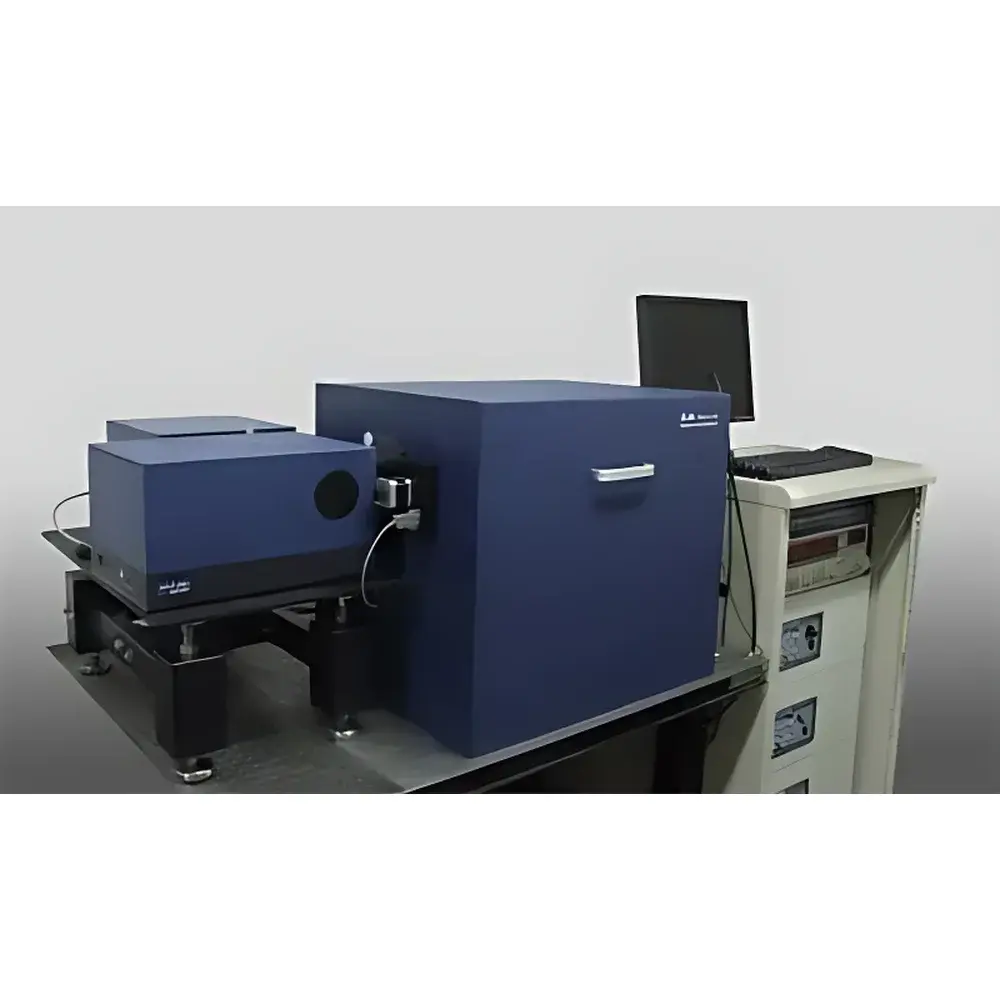
ZOLIX ZL-xx Spectral and Integrated Transmittance Measurement System for Eye Protection Devices
| Brand | ZOLIX |
|---|---|
| Model | ZL-xx |
| Origin | Beijing, China |
| Manufacturer | ZOLIX Optics Co., Ltd. |
| Spectral Range | 200–2200 nm |
| Transmittance Range | τ(λ) = 0.1–0.9 |
| Uncertainty (Vis/UVA/UVB) | U < 0.015 |
| Uncertainty (UVC/NIR) | U < 0.02 |
| Repeatability | R < 0.01 |
| Accuracy | ±2% (for optical transmittance >10%) |
| Light Sources | Automatically switched deuterium lamp and tungsten-halogen lamp |
| Sample Positioning | ±150 mm in Z/Y axes, ±90° rotation about θz, ±45° rotation about θy |
| Software | Integrated spectral acquisition, filter wheel control, transmittance calculation, parameter auto-save, and direct print export |
Overview
The ZOLIX ZL-xx Spectral and Integrated Transmittance Measurement System is a purpose-built optical characterization platform engineered for the quantitative evaluation of transmittance properties in personal eye protection devices—including safety goggles, welding helmets, face shields, and full-face respirator visors. Designed in accordance with international photobiological safety standards—including ISO 13666:2021 (Ophthalmic optics — Spectacle lenses — Requirements and test methods), EN 166:2022 (Personal eye-protection — Specifications), and ANSI Z87.1-2020 (Occupational and Educational Personal Eye and Face Protection Devices)—this system delivers traceable, high-reproducibility spectral transmittance data across the ultraviolet (UV), visible (Vis), and near-infrared (NIR) domains. Its core measurement principle relies on double-beam spectrophotometric architecture with real-time reference compensation, enabling accurate normalization of source spectral irradiance, detector responsivity, and optical path variations. The system operates under controlled ambient conditions and supports both absolute transmittance (τ(λ)) and wavelength-integrated transmittance values—such as UV-A (315–400 nm), UV-B (280–315 nm), UV-C (200–280 nm), visible (380–780 nm), and NIR (780–2200 nm)—as required by regulatory compliance testing protocols.
Key Features
- Full-spectrum coverage from 200 nm to 2200 nm, spanning deep UV through extended NIR—enabling comprehensive photobiological hazard assessment per ICNIRP and ACGIH guidelines.
- Dual-source illumination system featuring automatic switching between deuterium lamp (UV) and tungsten-halogen lamp (Vis–NIR), ensuring optimal signal-to-noise ratio and spectral continuity without manual intervention.
- Precision mechanical sample stage with motorized Z- and Y-axis translation (±150 mm each) and dual-axis angular adjustment (±90° about θz, ±45° about θy), guaranteeing reproducible alignment of curved or asymmetric lens geometries onto the optical axis.
- Calibration-traceable transmittance measurement with combined standard uncertainty <0.015 for Vis, UVA, and UVB bands and <0.02 for UVC and NIR bands—validated against NIST-traceable neutral density filters and certified reference materials.
- High repeatability (R 10%) achieved via thermally stabilized optics, low-stray-light monochromator design, and real-time dark-current subtraction.
- Fully integrated software suite supporting automated wavelength scanning, filter wheel synchronization, spectral smoothing, integration band definition, and batch reporting compliant with GLP documentation requirements.
Sample Compatibility & Compliance
The ZL-xx system accommodates plano and prescription-grade eye protection devices with refractive powers ranging from −4 m⁻¹ to +4 m⁻¹, including polycarbonate, CR-39, Trivex, and photochromic lenses. Its non-contact, collimated beam geometry eliminates edge diffraction artifacts common in wide-angle or thick-lens measurements. All hardware and software components comply with IEC 61000-4 electromagnetic compatibility standards and meet mechanical safety requirements outlined in EN 61010-1. Data integrity safeguards—including audit trail logging, user access levels, and electronic signature support—are implemented to satisfy FDA 21 CFR Part 11 and EU Annex 11 expectations for regulated laboratories conducting certification testing.
Software & Data Management
The proprietary ZOLIX SpectraControl™ software provides an intuitive GUI for instrument control, spectral acquisition, and post-processing. It enables customizable integration band definitions (e.g., Erythemal Action Spectrum weighting, Blue Light Hazard function), automatic pass/fail flagging against EN 170 or EN 172 thresholds, and export of CSV, XML, and PDF reports with embedded metadata (operator ID, timestamp, calibration certificate ID, environmental conditions). All measurement parameters—including slit width, scan speed, averaging cycles, and filter selection—are automatically saved with each dataset. Raw spectral files adhere to JCAMP-DX v6 format for long-term archival and third-party interoperability.
Applications
- Regulatory conformance testing for CE marking, ANSI Z87.1 certification, and CSA Z94.3 approval.
- R&D validation of UV-blocking performance in anti-blue light, laser protective, and arc-flash-rated eyewear.
- Quality control of lens coatings, tint uniformity, and aging-induced transmittance drift under accelerated UV exposure.
- Photobiological safety assessment per IEC 62471 for LED-based safety glasses used in industrial lighting environments.
- Reference measurement in national metrology institutes supporting interlaboratory comparison studies.
FAQ
Does the system support automated compliance reporting per EN 166?
Yes—the software includes preconfigured templates aligned with EN 166 Annexes B and C, generating structured output for optical density, luminous transmittance, and spectral filtering classes.
Can it measure curved or wraparound lenses?
Yes—its adjustable multi-axis sample stage ensures precise centering and normal incidence alignment even for complex freeform geometries.
Is NIST-traceable calibration provided with the system?
A full calibration certificate traceable to NIST SRM 2036 (neutral density filters) and NIST SRM 2032 (spectral irradiance standards) is supplied at time of delivery.
What are the environmental operating requirements?
The system is rated for operation at 15–30 °C, relative humidity ≤70% non-condensing, and requires vibration-isolated benchtop placement with stable AC power (220 V ±5%, 50/60 Hz).
Is remote operation supported?
Yes—TCP/IP-enabled instrument control allows integration into centralized lab management systems and supports unattended overnight measurement sequences via scheduled scripts.






