
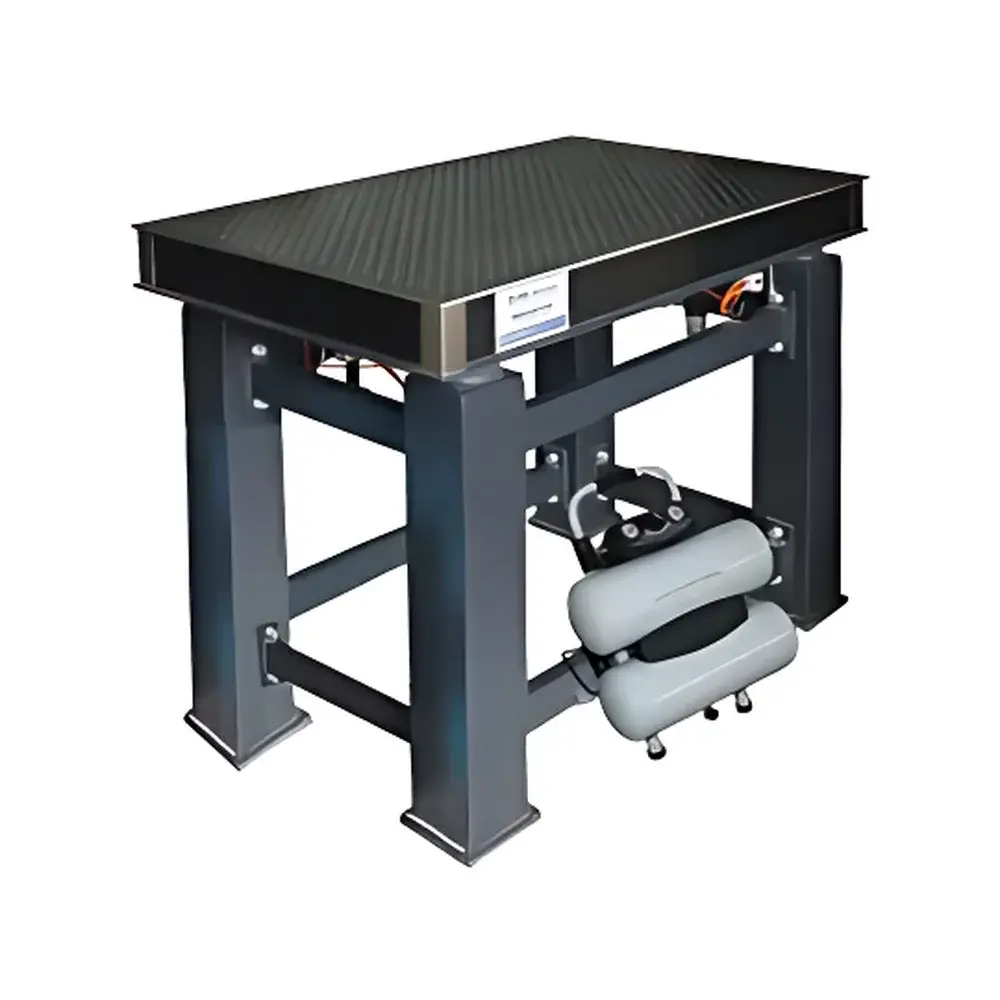
ZOLIX ZLT Series Pneumatic Air-Floating Optical Vibration Isolation Table
| Brand | ZOLIX |
|---|---|
| Origin | Beijing, China |
| Manufacturer | ZOLIX (Zolix Instruments Co., Ltd.) |
| Model | ZLT Series |
| Platform Thickness Options | 100 mm / 200 mm / 300 mm |
| Natural Frequency | < 3–4.5 Hz |
| Surface Flatness | 0.02–0.05 mm per 600 mm × 600 mm |
| Mounting Hole Pattern | M6 threaded holes on 25 mm × 25 mm grid |
| Total Height | 800 mm (adjustable ±20–30 mm) |
| Support Configuration | 4-leg or 6-leg pneumatic isolation system with dual-chamber air chambers and imported leveling valves |
| Included | Oil-free silent air compressor (operating pressure: 3–7 kgf/cm²), precision leveling valves, damping pads, stainless-steel corner guards, and integrated height-adjustment mechanism |
Overview
The ZOLIX ZLT Series Pneumatic Air-Floating Optical Vibration Isolation Table is an engineered solution for high-stability optical experimentation in environments where sub-Hz mechanical noise compromises measurement fidelity. Based on passive pneumatic isolation principles—leveraging compressible gas within elastomeric air bladders to decouple the rigid optical surface from floor-borne vibrations—the ZLT platform achieves a natural frequency below 3–4.5 Hz across all standard configurations. This performance range places it within the accepted operational envelope for isolating low-frequency disturbances common in urban laboratories, shared facility spaces, and near HVAC or mechanical infrastructure. The table’s structural architecture integrates three functional layers: a precision-ground ferromagnetic stainless-steel top plate (4–6 mm thick), a high-modulus steel honeycomb core arranged in orthogonal rib geometry, and a carbon-steel base plate (4–6 mm thick, black powder-coated). This tri-layer sandwich construction delivers exceptional bending stiffness (>2.5 × 10⁶ N·m²/m² typical), minimizing dynamic deflection under static and transient loads while preserving long-term dimensional stability.
Key Features
- Tri-layer monolithic platform design: Top plate of magnetic stainless steel (AISI 430 equivalent), orthogonally reinforced steel honeycomb core, and structural carbon-steel base—optimized for rigidity-to-mass ratio and thermal homogeneity.
- Precision surface finish: Top plate ground to flatness of 0.02–0.05 mm over 600 mm × 600 mm area—exceeding ISO 10360-2 Class 1 tolerances for optical reference surfaces.
- Standardized M6 tapped array on 25 mm × 25 mm pitch—compatible with internationally recognized optomechanical components (e.g., Thorlabs, Newport, Standa).
- Dual-chamber pneumatic isolation system with six high-reliability imported air bladders (four-leg models use four; six-leg models use six), enabling uniform load distribution and rapid self-leveling response (< 30 s typical stabilization time after load change).
- Three high-sensitivity imported leveling valves with sub-arcminute angular resolution—integrated into a kinematic support interface that eliminates binding during height adjustment.
- Integrated height-adjustment mechanism with ±20–30 mm travel range—designed for fine-tuning relative to adjacent instrumentation without compromising isolation integrity.
- Included oil-free, low-noise air compressor (3–7 kgf/cm² operating range) with built-in moisture separator and pressure regulator—compliant with ISO 8573-1 Class 3 particulate and Class 4 humidity specifications.
Sample Compatibility & Compliance
The ZLT Series accommodates a broad spectrum of optical payloads—from compact interferometers and laser cavities to multi-axis translation stages, spectroscopic beamlines, and quantum optics setups requiring micro-radian pointing stability. Its load capacity ranges from 400 kg (100 mm thickness) to 800 kg (200–300 mm variants), supporting both static and quasi-dynamic loading profiles typical of alignment-intensive applications. All structural materials meet RoHS Directive 2011/65/EU requirements. Surface treatments—including black powder coating on base plates and passivated stainless-steel top plates—conform to ASTM B117 salt-spray resistance standards (>96 h). While not certified to ISO 14001 or ISO 9001 as a standalone product, ZOLIX manufacturing facilities operate under documented quality management systems aligned with ISO 9001:2015 principles. Platform geometry and mounting compatibility are consistent with ANSI/ISO 10360-2 and DIN 8580 standards for metrological-grade work surfaces.
Software & Data Management
The ZLT Series operates as a purely mechanical, analog isolation system—requiring no embedded firmware, control software, or digital interfaces. This architecture ensures immunity to electromagnetic interference (EMI), eliminates cybersecurity concerns, and guarantees deterministic behavior across decades of service life. Pressure monitoring and manual calibration are performed using included analog gauges and mechanical bubble levels. For users integrating the platform into GLP/GMP-regulated workflows, documentation packages include material certifications (mill test reports for stainless and carbon steels), compressor performance curves, and factory-assembled leveling validation records. Traceable calibration of leveling valves and pressure regulators can be performed per ISO/IEC 17025-accredited third-party protocols upon request.
Applications
- Laser interferometry and gravitational wave prototype testing where sub-nanometer path-length stability is required.
- Confocal and super-resolution microscopy setups sensitive to vertical drift and lateral jitter.
- Ultrafast laser pulse compression and dispersion compensation systems demanding long-term beam-pointing repeatability.
- Atomic physics experiments involving magneto-optical traps (MOTs) and optical lattices.
- Optical coherence tomography (OCT) and swept-source system alignment in clinical R&D labs.
- Calibration of coordinate measuring machines (CMMs) and laser trackers in metrology laboratories.
- Thin-film characterization via ellipsometry or reflectometry under vibration-limited conditions.
FAQ
What is the recommended compressed air supply specification for continuous operation?
A clean, dry, oil-free air source delivering 3–7 kgf/cm² (43–100 psi) at ≥10 L/min flow rate is required. Use of the included compressor is strongly advised to ensure contaminant control and pressure stability.
Can the ZLT platform be integrated with active vibration cancellation systems?
Yes—its rigid, low-resonance mechanical interface serves as an ideal passive foundation for hybrid active-passive isolation stacks (e.g., stacked with inertial feedback actuators compliant with IEEE 1158 standards).
Is the M6 thread pattern compatible with ISO metric and UNC hardware?
The M6 × 1.0 threaded holes accept both ISO metric fasteners and UNC #8–32 adapters via standard bushings; no re-tapping is necessary.
How does temperature variation affect platform performance?
Thermal expansion coefficients are matched between stainless-steel top and carbon-steel base (≈10–12 µm/m·K), limiting differential growth to <1 µm over 10 °C ambient shifts—well within optical alignment tolerances.
What maintenance intervals are recommended for the pneumatic system?
Inspect air bladders and leveling valves annually; replace O-rings every 5 years or after 10,000 operational cycles. Compressor filters require replacement every 12 months under normal lab usage.




