
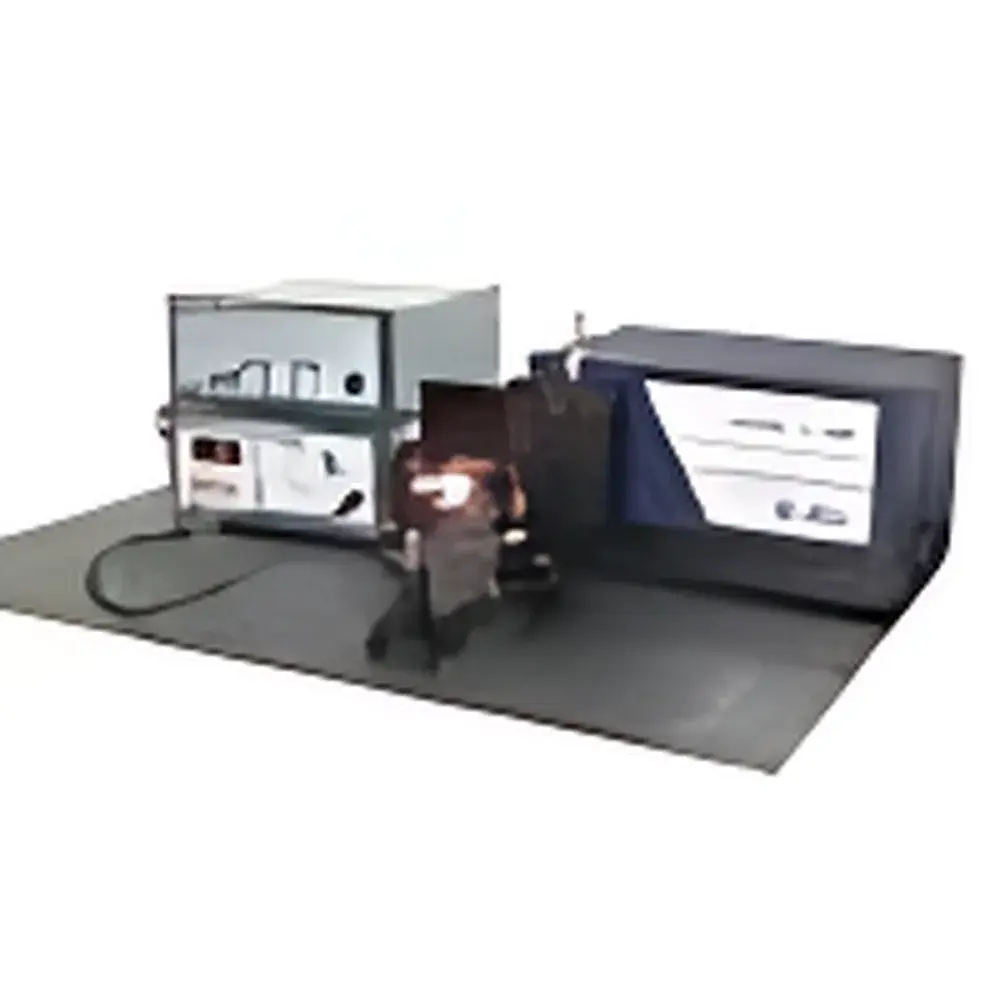
ZOLIX ZLX-ES Series Emission Spectroscopy and Light Source Spectral Measurement System
| Brand | ZOLIX |
|---|---|
| Model | ZLX-ES Series |
| Origin | Beijing, China |
| Manufacturer Type | Original Equipment Manufacturer (OEM) |
| Product Origin | Domestic (China) |
| Pricing | Upon Request |
Overview
The ZOLIX ZLX-ES Series Emission Spectroscopy and Light Source Spectral Measurement System is a modular, research-grade optical instrumentation platform engineered for quantitative spectral characterization of emissive devices and radiation sources. It operates on the principle of dispersive spectroscopy—utilizing high-fidelity monochromators to spatially separate incident photons by wavelength, followed by calibrated photodetection and traceable radiometric conversion. The system supports absolute spectral irradiance (W·nm⁻¹·sr⁻¹·m⁻²), spectral radiant flux (W·nm⁻¹), luminous flux (lm), chromaticity coordinates (CIE 1931 x,y or u′,v′), correlated color temperature (CCT), and color rendering index (CRI/Ra) calculations—all derived from first-principles radiometric calibration traceable to NIM (National Institute of Metrology, China) standards. Designed for laboratory-based photometric and radiometric validation, it serves as a foundational tool in LED product development, lamp certification, plasma diagnostics, atomic emission analysis, and solid-state lighting R&D.
Key Features
- Modular architecture supporting interchangeable monochromator options: Omni-λ150 (entry-level broadband resolution), Omni-λ300/500/750 (high-resolution configurations with <0.1 nm FWHM capability at 500 nm, depending on grating and slit settings)
- Dual-output monochromator configuration available for simultaneous UV–VIS and NIR detection (e.g., 200–400 nm Si CCD + 900–1700 nm InGaAs detector), eliminating mechanical re-alignment between spectral ranges
- Integrated SD filter wheel for automatic suppression of higher-order diffraction artifacts—critical for broadband emitters spanning 200–2500 nm
- Thermoelectrically cooled back-illuminated CCD and extended-range InGaAs detectors ensure low-noise, high-dynamic-range acquisition (up to 10⁵:1 SNR under optimized integration)
- Motorized entrance/exit slits with micron-level reproducibility, enabling precise control of spectral bandwidth (0.05–10 nm) and throughput trade-offs
- Fully programmable via ZOLIX SpectraSoft™ software with IEEE 1394 (FireWire) and USB 3.0 interfaces; compatible with LabVIEW™, Python (PyVISA), and MATLAB® APIs for automated test sequences
Sample Compatibility & Compliance
The ZLX-ES system accommodates diverse emissive samples including incandescent filaments, fluorescent discharge lamps, phosphor-converted and monochromatic LEDs, OLED panels, laser diodes (CW/pulsed), low-pressure sodium and mercury vapor lamps, ICP and glow-discharge plasmas, and arc sources. Sample mounting is facilitated via adjustable XYZ stages with optional integrating spheres (e.g., Labsphere ISF-2000 series) for total flux measurement per CIE S 023/E:2015 and IES LM-79-19. Radiometric calibration adheres to ISO/IEC 17025 requirements when performed using NIST-traceable standard lamps (e.g., FEL-type tungsten halogen standards). System documentation supports GLP-compliant audit trails, and raw spectral data files comply with ASTM E308-23 spectral data exchange format conventions.
Software & Data Management
SpectraSoft™ provides a validated, version-controlled environment for instrument control, real-time spectral preview, multi-curve overlay, and ISO/CIE-compliant photometric post-processing. All acquired spectra are stored in HDF5 format with embedded metadata (wavelength calibration coefficients, detector gain settings, integration time, ambient temperature, calibration date, and operator ID). Software includes built-in modules for CIE 1931 chromaticity mapping, TM-30-20 color fidelity analysis, flicker metrics (IEEE 1789-2015), and spectral power distribution (SPD) normalization. Audit logs record every parameter change and data export action, satisfying FDA 21 CFR Part 11 requirements for electronic records when deployed in regulated lighting QA/QC environments.
Applications
- LED binning and lifetime lumen depreciation studies (IES LM-80/LM-84)
- Color consistency verification across manufacturing lots per ENERGY STAR® and DLC specifications
- Plasma emission line identification and intensity quantification in analytical chemistry and fusion diagnostics
- UV curing lamp spectral output validation for photopolymerization process control
- Characterization of quantum dot and perovskite light emitters in next-generation display R&D
- Calibration transfer between production-line spectroradiometers and reference-grade metrology labs
FAQ
Is the ZLX-ES system compliant with international photometric standards?
Yes—it supports measurement protocols aligned with CIE S 023/E:2015, IES LM-79-19, ISO/CIE 11664 (colorimetry), and ASTM E308-23 for spectral data handling.
Can the system measure pulsed light sources such as flash LEDs or laser pulses?
Yes, when configured with gated detection mode and synchronized external trigger input (TTL-compatible), it captures time-resolved spectral profiles with microsecond-level timing resolution.
What calibration certificates are provided with the system?
Each delivery includes a factory radiometric calibration report referencing NIM-traceable standard lamps, plus optional ISO/IEC 17025-accredited calibration upon request.
Does the software support automated compliance reporting for ENERGY STAR or DLC submissions?
SpectraSoft™ exports structured XML and CSV reports compatible with ENERGY STAR’s LM-79 submission portal and DLC’s QPL database ingestion schema.
Is remote operation and monitoring supported?
Yes—via secure SSH-enabled network interface and RESTful API endpoints, enabling integration into centralized lab management systems and Industry 4.0 data pipelines.



