
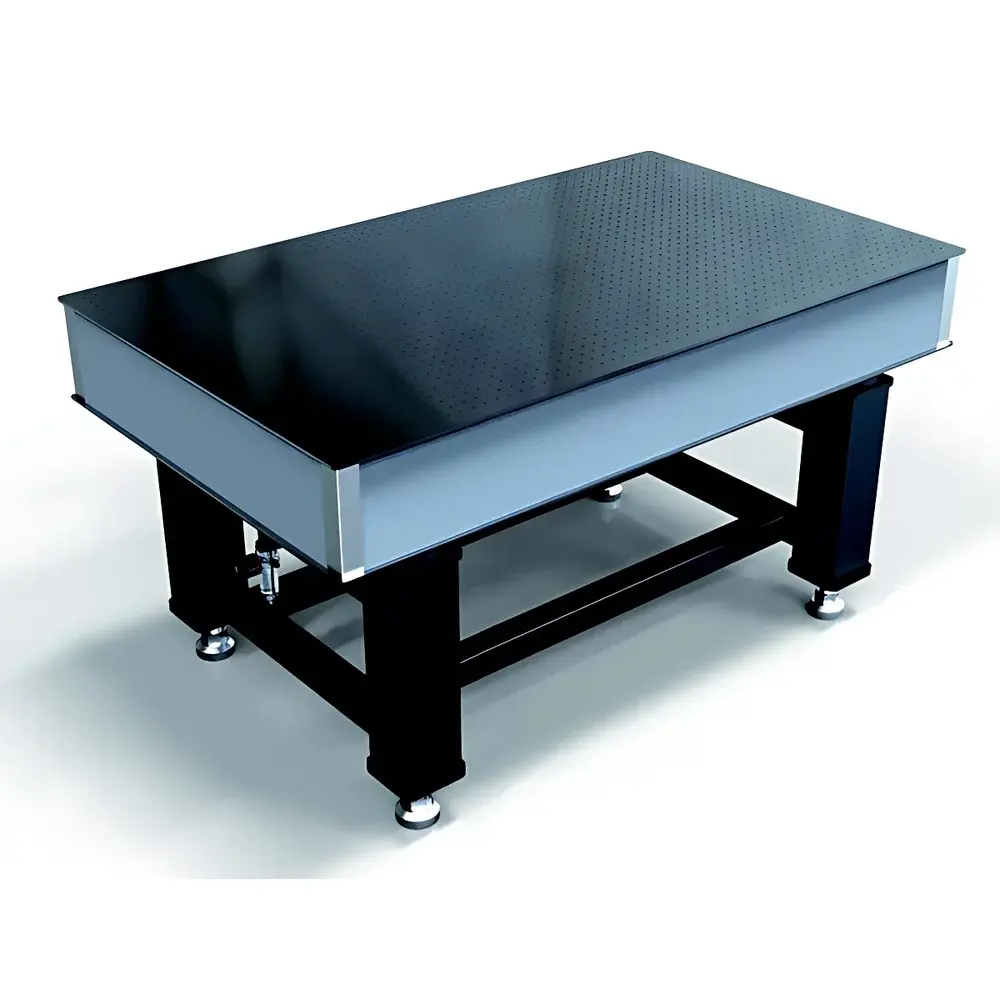
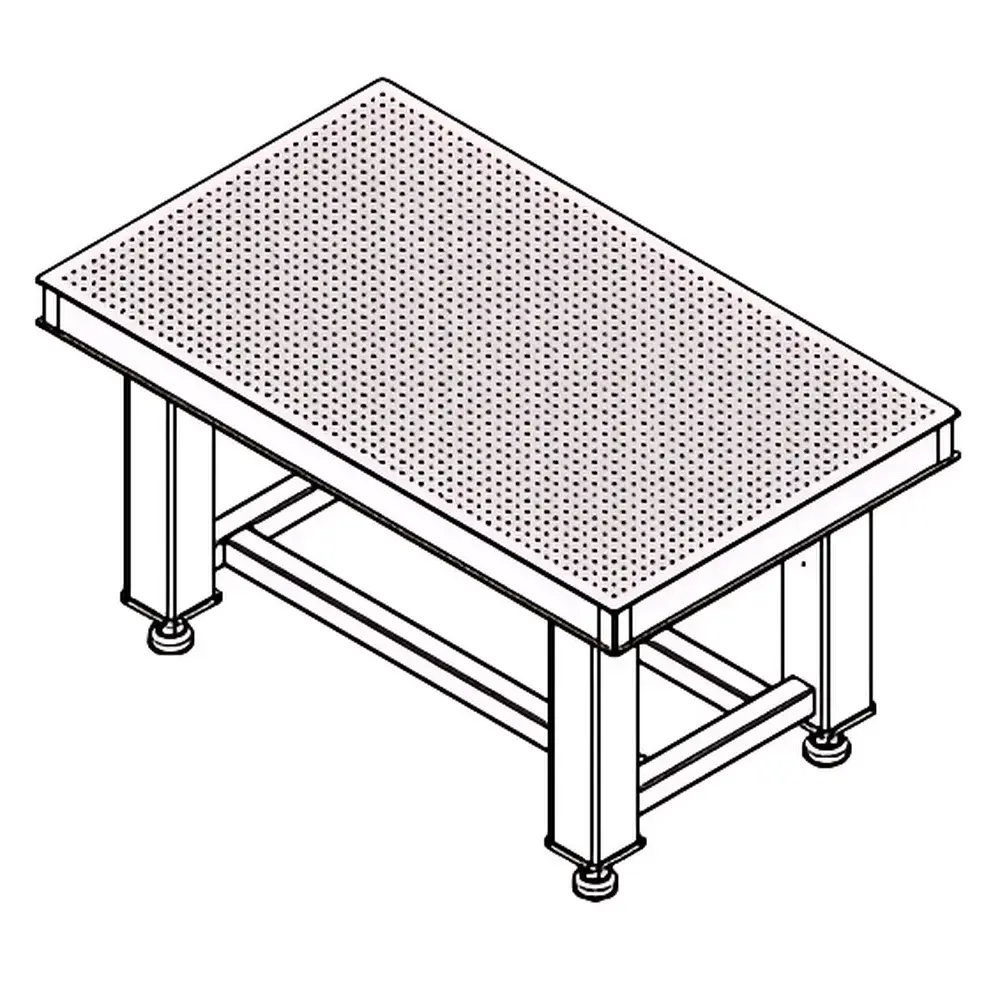
ZOLIX ZTB Series Semi-Diaphragm Air-Floating Optical Table
| Brand | ZOLIX |
|---|---|
| Origin | Beijing, China |
| Manufacturer Type | Direct Manufacturer |
| Product Line | ZTB Series |
| Platform Thickness Options | 50 / 100 / 150 / 200 mm |
| Surface Material | SUS410 Ferromagnetic Stainless Steel |
| Structural Design | Three-Layer Honeycomb Core with Full-Welded Construction |
| Surface Flatness | 0.1 mm per 600 mm × 600 mm |
| Mounting Pattern | M6 Threaded Holes on 25 mm × 25 mm Grid |
| Inherent Frequency Range | <1.5–3 Hz (load-dependent) |
| Air Spring Type | Semi-Diaphragm Dual-Chamber Pneumatic Isolator |
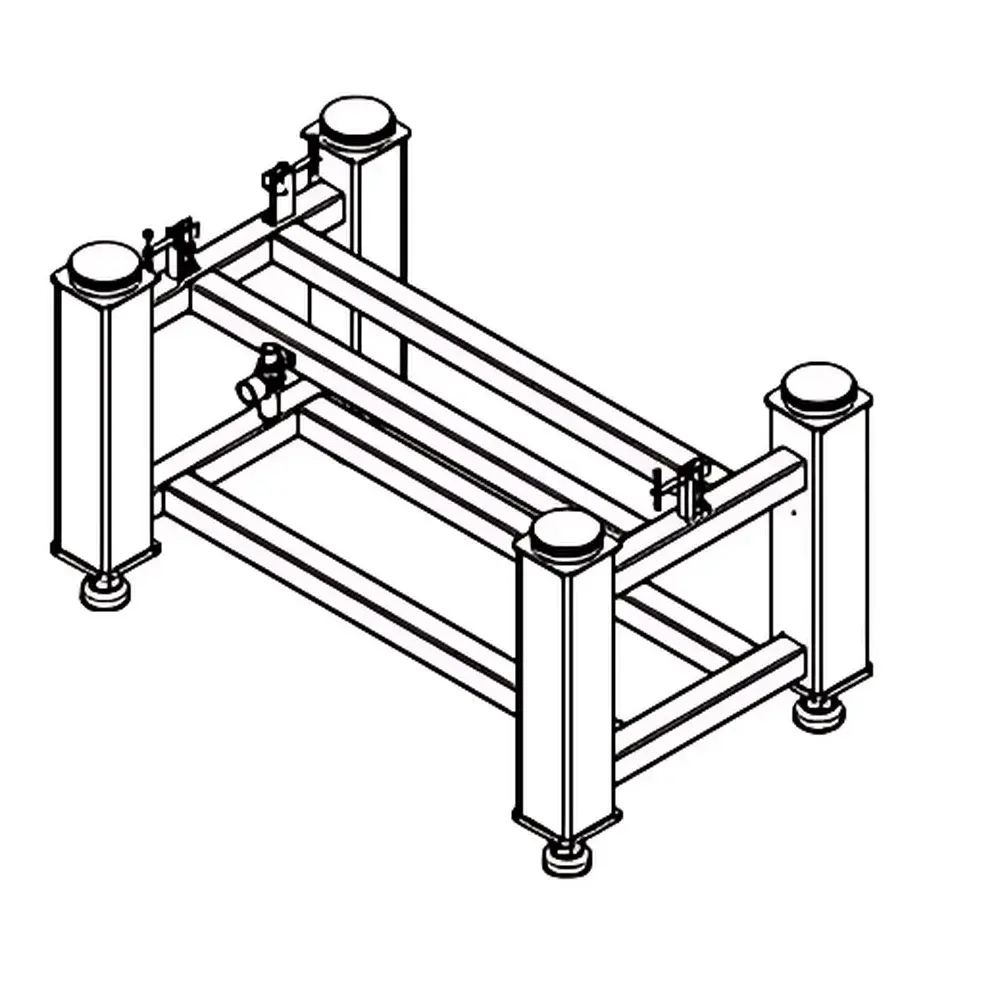
| Support Frame | Fully Welded Four-Point (or Six-Point for ≥3 m) Structural Base |
| Height Adjustment | Dual-Stage (Base Legs + Top-Level Leveling Valves) |
| Standard Air Supply | Silent Oil-Free Compressor (3–7 kg/cm² Operating Pressure) |
| Side Cladding | Gray Aluminum-Plastic Composite Panel with Stainless Steel Corner Reinforcement |
| Total System Height | 800 mm (±10 to +15 mm Adjustable) |
| Compliance | Designed for ISO 10816-1 Vibration Sensitivity Class A and ASTM E1772 Laboratory Floor Vibration Mitigation Requirements |
Overview
The ZOLIX ZTB Series Semi-Diaphragm Air-Floating Optical Table is an engineered solution for high-stability optical and precision metrology applications requiring sub-hertz vibration isolation. Utilizing a semi-diaphragm pneumatic isolator architecture—comprising dual-chamber air springs with integrated damping pads—the platform achieves inherent resonant frequencies consistently below 1.5–3 Hz across operational load ranges (typically 50–300 kg/m²). This performance envelope meets the stringent mechanical stability requirements of interferometry, laser cavity alignment, quantum optics experiments, and nanoscale imaging systems where floor-borne vibrations (e.g., from HVAC, footfall, or building resonance) must be attenuated by >90% above 5 Hz. The table’s structural integrity originates from its monolithic three-layer honeycomb core: upper and lower skins of 4–6 mm SUS410 ferromagnetic stainless steel, bonded via full-penetration welding—not adhesive—to a rigid steel lattice grid. This eliminates delamination risks common in bonded-core alternatives and ensures long-term dimensional stability under thermal cycling and mechanical loading.
Key Features
- Fully welded, four-point (or six-point for ≥3 m span) structural base frame with dual-stage height adjustment: coarse leveling at each support leg base and fine horizontal correction via three high-sensitivity imported leveling valves mounted at the top interface.
- SUS410 ferromagnetic stainless steel top surface (4–6 mm thick), offering superior corrosion resistance and magnetic compatibility with translation stages, motorized mounts, and vacuum-compatible accessories.
- Precision-ground tabletop surface with flatness of ≤0.1 mm over any 600 mm × 600 mm area—verified per ISO 10360-2 geometric tolerance protocols—ensuring repeatable optical path alignment across large-area setups.
- M6 threaded mounting holes on a strict 25 mm × 25 mm orthogonal grid, enabling deterministic placement of kinematic mounts, cage systems, and automated positioning stages without interpolation or adapter plates.
- Integrated silent oil-free air compressor (standard), delivering regulated pressure between 3–7 kg/cm²; automatic pressure balancing circuit maintains consistent lift force and minimizes settling time (<30 seconds post-load change).
- Side cladding composed of structural carbon steel inner layer and gray aluminum-plastic composite outer panel, with stainless steel corner guards—optimized for both electromagnetic shielding integrity and cleanroom-compliant aesthetics.
Sample Compatibility & Compliance
The ZTB Series accommodates optical components ranging from compact diode lasers and fiber couplers to multi-axis nanopositioning stages and vacuum chambers up to 150 kg. Its ferromagnetic surface supports direct magnetic base attachment, while the M6 grid enables modular integration with Thorlabs, Newport, and Standa-compatible hardware. From a regulatory standpoint, the platform’s vibration transmissibility profile aligns with ISO 10816-1 Category A (laboratory instrumentation) and ASTM E1772 Annex A2 for low-frequency ground motion mitigation. The welded construction and absence of organic adhesives ensure compliance with ISO 14644-1 Class 5 cleanroom material outgassing limits when specified with optional black epoxy-coated underside. No volatile organic compounds (VOCs) are introduced during manufacturing, supporting GLP-aligned environmental monitoring protocols.
Software & Data Management
While the ZTB Series operates as a passive mechanical isolation system (no embedded electronics or firmware), its performance integration into automated labs is facilitated through compatibility with third-party active vibration cancellation systems (e.g., TMC Micro-g or Kinetic Systems Q-STAB). Optional analog pressure monitoring ports allow connection to PLC-based air supply management systems for predictive maintenance logging (e.g., pressure decay rate trending over 30-day intervals). All mechanical specifications—including flatness maps, modal analysis reports, and load-deflection curves—are supplied in PDF and CSV formats compliant with 21 CFR Part 11 audit trail requirements upon request, supporting FDA-regulated R&D documentation workflows.
Applications
- Laser interferometry and gravitational wave detector prototype benches requiring <5 nm RMS displacement noise floor.
- Confocal and super-resolution microscopy platforms where stage-induced drift must remain <10 nm/hour over 8-hour acquisitions.
- Quantum computing testbeds integrating cryogenic optical interfaces and microwave delivery waveguides.
- Optical coherence tomography (OCT) system development demanding stable reference arm pathlength stability (<λ/20 over 24 h).
- Calibration laboratories performing ISO/IEC 17025-accredited measurements of beam pointing stability and wavefront error.
- Industrial metrology cells integrating vision-guided robotic alignment with sub-micron repeatability.
FAQ
What is the maximum recommended payload per square meter?
For optimal isolation performance (inherent frequency <2 Hz), payloads should not exceed 250 kg/m². At full rated thickness (200 mm), static deflection remains <1.2 µm under uniform 300 kg/m² loading—verified per ASTM E2568 bending modulus testing.
Can the ZTB platform be integrated with active vibration cancellation systems?
Yes. The rigid, non-resonant base frame and standardized M6 grid provide mechanical anchoring points for TMC, Herzan, or Accurion active isolators. Interface dimensions and bolt patterns conform to ISO 2768-mK general tolerances.
Is the SUS410 surface compatible with ultra-high vacuum (UHV) environments?
SUS410 is UHV-compatible up to 1×10⁻⁹ mbar when electropolished and baked at 150°C for 24 hours. Optional vacuum-grade surface passivation and bake-out certification are available upon order.
Does the platform require compressed air conditioning (dryer/filtration)?
A coalescing filter (0.01 µm rating) and desiccant dryer are recommended for continuous operation in humid climates to prevent condensation in secondary air chambers. Standard compressor output meets ISO 8573-1 Class 3:4:4 requirements.
How is flatness verified and documented for QA purposes?
Each platform undergoes coordinate measuring machine (CMM) verification using a Leica Absolute Tracker AT960-MR. Raw point-cloud data and GD&T deviation reports (per ASME Y14.5) are archived and provided with serial-number traceability.






