
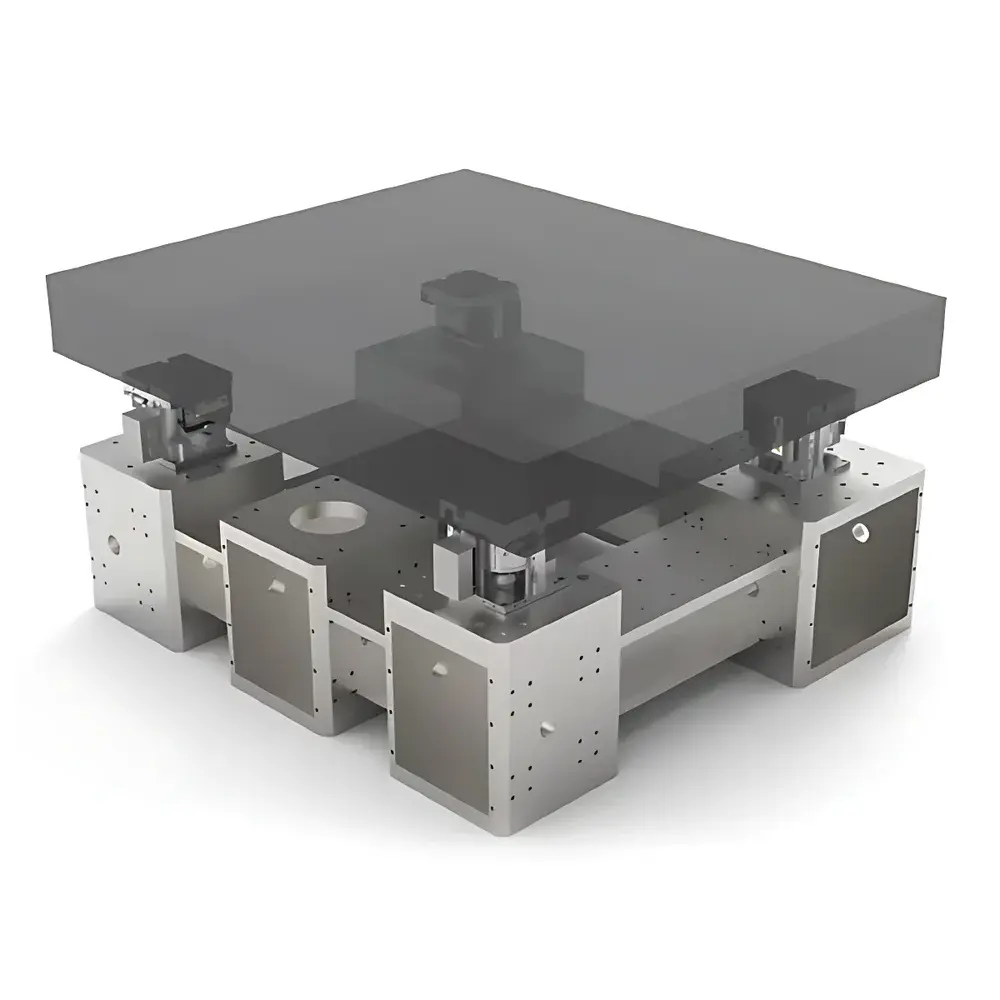
ZOLIX ZVI-FT Series Active Air-Floating Vibration Isolation Platform
| Brand | ZOLIX |
|---|---|
| Origin | Beijing, China |
| Manufacturer Type | Direct Manufacturer |
| Product Origin | Domestic (China) |
| Model | ZVI-FT Series |
| Pricing | Available Upon Request |
| Active Isolation Bandwidth | 0.8–150 Hz |
| Platform Stability | ≤ ±8 µm |
| Vibration Transmissibility | ≤ −10 dB @ 2 Hz, ≤ −25 dB @ 5 Hz, ≤ −35 dB @ 10 Hz, ≤ −40 dB @ 20 Hz |
| Horizontal Actuator Peak Thrust | Up to 1280 N per leg |
| Max System Power Consumption | 1500 W |
| Surface Flatness (NTBP) | 0.02–0.05 mm / 600 mm × 600 mm |
| Surface Flatness (NTBK) | 0.1 mm / 600 mm × 600 mm |
| Granite Surface Grade Options | Grade 0, Grade 1, Grade 2, Grade 3 (per GB/T 20428–2006) |
| Platform Thickness Options | 100 mm, 200 mm, 300 mm |
| Mounting Hole Diameter & Pitch | Customizable |
| Standard Single-Leg Load Capacity | 1800 kg |
| Platform Dimensions | Multiple standard footprints available (custom sizes supported) |
Overview
The ZOLIX ZVI-FT Series Active Air-Floating Vibration Isolation Platform is an engineered solution for ultra-stable optical and precision metrology environments where sub-micron positional stability and broadband vibration attenuation are critical. Built upon a six-degree-of-freedom (6-DOF) active isolation architecture, the platform combines pneumatic air spring support with real-time inertial sensing and high-bandwidth electromagnetic actuation to suppress both ground-borne and structure-borne disturbances across a continuous frequency range from 0.8 Hz to 150 Hz. Unlike passive platforms limited by mechanical resonance and low-frequency roll-off, the ZVI-FT dynamically counteracts motion in all translational and rotational axes—X, Y, Z, pitch, yaw, and roll—enabling stable operation for interferometric systems, scanning probe microscopes, nanoimprint lithography tools, and quantum optics experiments requiring VC-G class or better floor vibration performance.
Key Features
- Six-axis active feedback control system with proprietary real-time digital signal processing (DSP) firmware, fully developed in-house by ZOLIX engineering teams.
- High-force horizontal actuators delivering up to 1280 N peak thrust per leg—optimized for damping low-frequency building sway and heavy equipment-induced resonances.
- Integrated air suspension with precision-regulated air springs, ensuring consistent preload and thermal drift compensation over extended operational cycles.
- Modular granite tabletop options compliant with GB/T 20428–2006: Grade 0 (highest flatness and dimensional stability), Grade 1, Grade 2, and Grade 3—each certified and traceable to national metrology standards.
- Customizable mechanical interface: mounting hole diameter, pitch, and spatial layout configurable to match OEM instrument footprints or bespoke optical breadboard layouts.
- Robust power architecture supporting up to 1500 W total system draw, with redundant safety monitoring for pressure, current, temperature, and position error limits.
Sample Compatibility & Compliance
The ZVI-FT platform accommodates payloads ranging from 700 kg to 7500 kg, making it suitable for full-scale optical tables, multi-axis motion stages, electron microscopy chambers, and semiconductor inspection tools. Its structural design meets ISO 14644-1 Class 5 cleanroom compatibility requirements when specified with sealed actuators and non-outgassing surface treatments. All control electronics conform to IEC 61000-6-2 (immunity) and IEC 61000-6-4 (emission) standards. The platform’s mechanical interface and load rating documentation support integration into FDA-regulated instrumentation environments where mechanical stability is part of the validation protocol (e.g., ASTM E2554 for interferometric measurement uncertainty). Calibration reports include traceable verification of transmissibility curves and static stability metrics per ISO 20816-1.
Software & Data Management
ZOLIX provides the ZVI-Control Suite—a Windows-based application enabling real-time monitoring, parameter tuning, and diagnostic logging. The software supports dual-mode operation: automatic adaptive mode (self-tuning PID gains based on payload inertia and floor spectral content) and manual expert mode (full access to loop gain, filter cutoffs, and axis coupling coefficients). All configuration changes are timestamped and logged with user ID and system state metadata—supporting GLP/GMP audit trails. Export formats include CSV, HDF5, and MATLAB .mat; raw sensor data streams (acceleration, displacement, actuator current) are accessible via TCP/IP socket interface for integration with LabVIEW, Python, or custom SCADA systems. Firmware updates are delivered via signed binary packages with SHA-256 hash verification to ensure integrity and traceability.
Applications
- High-resolution laser interferometry and gravitational wave detector test benches requiring VC-G floor vibration compliance.
- Atomic force microscopy (AFM) and scanning tunneling microscopy (STM) systems demanding <10 nm RMS vertical stability over 100 s acquisition windows.
- Photolithography alignment stations and maskless direct-write systems where stage positioning repeatability must remain unaffected by HVAC-induced floor vibrations.
- Quantum computing hardware setups—including trapped-ion traps and superconducting qubit cryostats—where microseismic noise below 5 Hz degrades coherence times.
- Calibration laboratories performing ISO/IEC 17025-accredited dimensional metrology using coordinate measuring machines (CMMs) and laser trackers.
FAQ
What is the lowest frequency at which active vibration cancellation begins?
The ZVI-FT achieves closed-loop control onset at 0.8 Hz, verified by swept-sine transmissibility testing per ISO 10816-1 Annex B.
Can the platform be integrated with existing building management systems (BMS)?
Yes—digital I/O and Modbus TCP interfaces are available as optional modules for status reporting and emergency shutdown coordination.
Is granite surface certification included with delivery?
Each Grade 0–3 granite top ships with a factory-issued flatness certificate referencing GB/T 20428–2006, including measurement grid coordinates and deviation maps.
How is system-level calibration performed after installation?
On-site commissioning includes laser tracker–based geometric verification, accelerometer-based transmissibility mapping, and load-dependent stability profiling under representative operating conditions.
Does the platform support redundant power input for mission-critical applications?
Dual 208–240 VAC inputs with automatic switchover are available as an engineering option, meeting IEC 62040-3 Tier III resilience requirements.




