
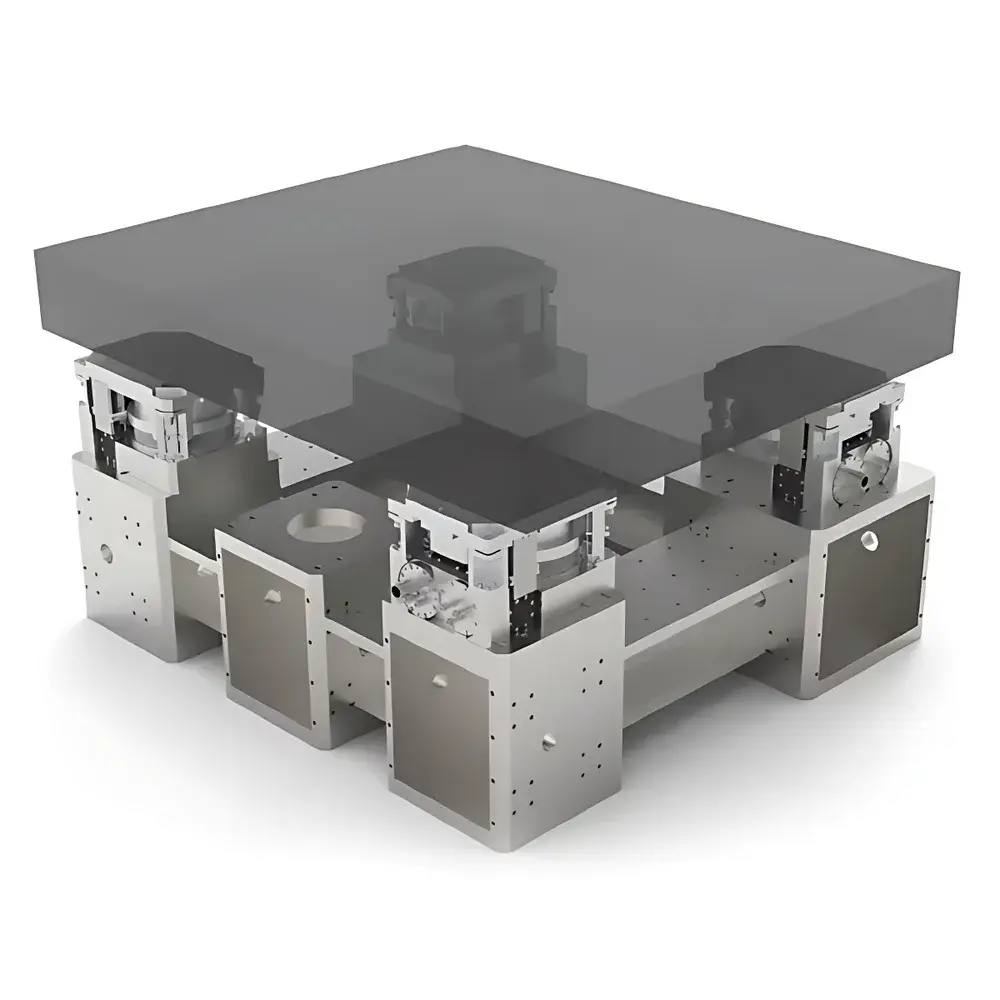
ZOLIX ZVI-FV Series Air-Bearing Parallel Negative-Stiffness Active Vibration Isolation Platform
| Brand | ZOLIX |
|---|---|
| Origin | Beijing, China |
| Manufacturer Type | Original Equipment Manufacturer (OEM) |
| Product Origin | Domestic (China) |
| Model | ZVI-FV Series |
| Pricing | Upon Request |
| Active Isolation Bandwidth | 0.5–150 Hz |
| Table Stability | ≤ ±5 µm |
| Transmissibility | ≤ –20 dB @ 2 Hz, ≤ –35 dB @ 5 Hz, ≤ –45 dB @ 10 Hz |
| Horizontal Actuator Peak Force | 160 N |
| Max. System Power Consumption | 700 W |
| Table Flatness (NTBP) | 0.02–0.05 mm / 600 mm × 600 mm |
| Table Flatness (NTBK) | 0.1 mm / 600 mm × 600 mm |
| Granite Table Grade Options | Grade 0, 1, 2, or 3 per GB/T 20428–2006 |
| Table Thickness Options | 100 mm, 200 mm, or 300 mm |
| Mounting Hole Diameter & Pitch | Customizable |
| Standard Single-Leg Load Capacity | 1600 kg |
| Max. Supported Payload | 4600–6200 kg |
| Dimensions (L×W×H) Variants | e.g., 3000 mm × 1200 mm × 350/400 mm |
| Single-Leg Weight | 35 kg |
Overview
The ZOLIX ZVI-FV Series is a high-performance, six-degree-of-freedom (6-DOF) active vibration isolation platform engineered for ultra-stable optical and precision metrology applications. It integrates pneumatic air-bearing support with a parallel architecture combining mechanical positive-stiffness elements and magnetically actuated negative-stiffness mechanisms—specifically, an inverted-pendulum-based passive negative-stiffness stage operating in parallel with actively controlled electromagnetic actuators. This hybrid design achieves sub-Hz isolation onset (down to 0.5 Hz), enabling effective suppression of low-frequency ground-borne disturbances including building sway, HVAC-induced vibrations, and traffic-induced seismic noise. Unlike conventional passive platforms or single-axis active systems, the ZVI-FV delivers true multi-axis force feedback control across all translational and rotational degrees of freedom, making it suitable for demanding setups such as laser interferometry, electron microscopy, nano-imprint lithography, and quantum optics experiments where nanometer-scale positional stability is non-negotiable.
Key Features
- Hybrid isolation architecture: Air-spring suspension combined with magnetically driven negative-stiffness inverted pendulums and parallel electromagnetic actuators for broadband suppression.
- True 6-DOF real-time active control with closed-loop force feedback, covering X/Y/Z translation and pitch/yaw/roll rotation.
- Sub-Hz active bandwidth initiation at 0.5 Hz, extending to 150 Hz—optimized for both microseismic and mid-frequency mechanical noise sources.
- Fully domestically developed core control system with real-time DSP-based processing, ensuring deterministic latency and synchronization across all channels.
- Modular granite tabletop options compliant with GB/T 20428–2006: Grade 0 (highest flatness tolerance), Grade 1, Grade 2, or Grade 3—selected based on application-specific stability requirements.
- Customizable mounting interface: Hole diameter, pitch, and spatial layout configurable to match OEM instrument footprints or bespoke optical breadboard layouts.
- Scalable mechanical design supporting payloads from 100 kg up to 6200 kg, with standardized leg configurations rated for 1600 kg per isolator.
Sample Compatibility & Compliance
The ZVI-FV platform accommodates a broad range of high-value optical and analytical instruments—including scanning probe microscopes (SPM), atomic force microscopes (AFM), confocal laser scanning microscopes (CLSM), optical coherence tomography (OCT) systems, and ultrafast laser amplifiers—without requiring structural modification. Its low-transmissibility performance (< –45 dB at 10 Hz) meets stringent environmental requirements for ISO Class 5 cleanroom installations and GLP-compliant metrology labs. While not certified to ISO 10816 or ASTM E1776 per se (as those standards pertain to machinery vibration assessment rather than isolation performance), the platform’s transmissibility curves and stability metrics align with best-practice specifications referenced in ISO 20486 (vibration isolation for precision equipment) and are routinely validated against internal test protocols traceable to national metrology institutes. All electrical subsystems comply with IEC 61000-6-3 (EMC emission limits) and IEC 61000-6-2 (immunity requirements).
Software & Data Management
The ZVI-FV operates via ZOLIX’s proprietary real-time control software suite, accessible through a Windows-based GUI with optional remote API (TCP/IP + Modbus TCP). The system logs full 6-channel sensor data (acceleration, displacement, actuator current) at ≥1 kHz sampling rate with timestamped, lossless binary storage. Audit trails include configuration history, calibration timestamps, and user login events—supporting basic 21 CFR Part 11 compliance for regulated environments when deployed with domain-authenticated network access and write-protected storage. Firmware updates are digitally signed and installed via secure bootloader; configuration files are exportable in CSV and HDF5 formats for third-party analysis in MATLAB, Python (SciPy), or LabVIEW. No cloud connectivity is embedded by default—ensuring data sovereignty and compatibility with air-gapped laboratory networks.
Applications
- Stabilization of transmission electron microscopes (TEM) and scanning transmission electron microscopes (STEM) requiring <10 pm RMS table motion.
- Interferometric gravitational wave detector prototype benches and optical cavity alignment stations.
- Ultrafast pump-probe spectroscopy setups where timing jitter must remain below 10 fs over 24-hour acquisition windows.
- Photolithography mask alignment systems and nanoimprint stamping platforms sensitive to sub-micron drift.
- Quantum computing testbeds involving trapped-ion or superconducting qubit arrays requiring cryogenic-stage decoupling from floor vibrations.
- Calibration laboratories performing primary standard comparisons under ISO/IEC 17025-accredited conditions.
FAQ
What is the lowest frequency at which active isolation becomes effective?
Active control engages continuously from 0.5 Hz upward; below this threshold, passive air-spring isolation dominates, providing >90% attenuation above ~2 Hz.
Can the platform be integrated into a cleanroom environment?
Yes—the system uses oil-free air bearings and sealed electromagnetic actuators; all materials meet ISO 14644-1 Class 5 outgassing requirements when specified with optional stainless-steel fasteners and epoxy-coated base plates.
Is third-party calibration documentation available?
ZOLIX provides factory calibration certificates for accelerometer sensitivity, actuator force constants, and table flatness verification per GB/T 20428–2006; NIST-traceable recalibration services are available upon request.
Does the system support integration with existing lab automation frameworks?
Yes—via open TCP/IP commands and Modbus TCP register mapping, enabling synchronization with PLC-controlled environmental systems, vacuum sequencers, or motion controllers.
What maintenance is required during routine operation?
Annual inspection of air filter elements and compressed air quality (ISO 8573-1 Class 2:2:2 recommended); no scheduled lubrication or actuator replacement is required within the first 10 years under normal lab conditions.




