
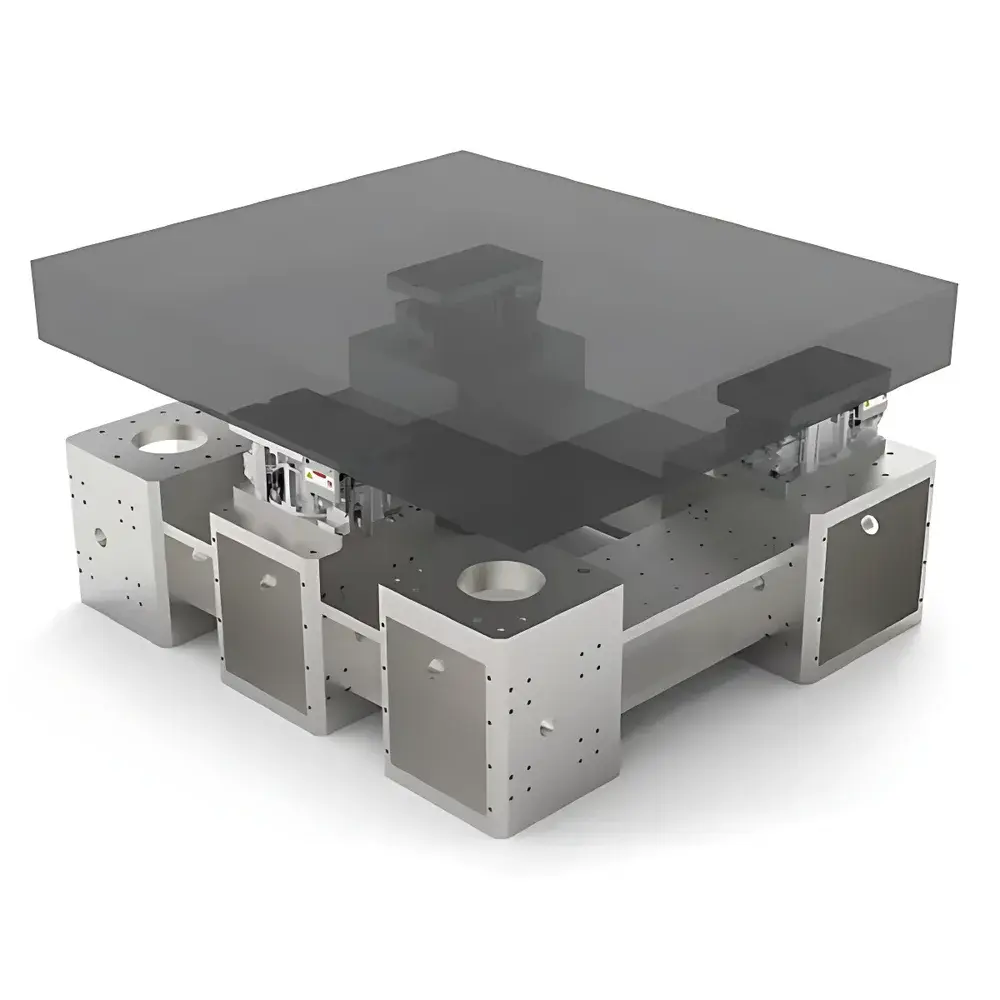
ZOLIX ZVI-ST Series Steel-Spring Active Vibration Isolation Platform
| Brand | ZOLIX |
|---|---|
| Origin | Beijing, China |
| Manufacturer Type | Direct Manufacturer |
| Product Origin | Domestic (China) |
| Model | ZVI-ST Series |
| Pricing | Upon Request |
| Active Isolation Bandwidth | 1–150 Hz |
| Platform Stability | ≤ ±10 µm |
| Vibration Transmission Loss | ≤ –3 dB @ 2 Hz, ≤ –12 dB @ 5 Hz, ≤ –25 dB @ 10 Hz |
| Horizontal Actuator Peak Thrust | Up to 1280 N (system), 270 N (per actuator) |
| Max System Power Consumption | 400 W |
| Surface Flatness (NTBP) | 0.02–0.05 mm / 600 mm × 600 mm |
| Surface Flatness (NTBK) | 0.1 mm / 600 mm × 600 mm |
| Granite Surface Grade Options | Grade 0, 1, 2, or 3 per GB/T 20428–2006 |
| Platform Thickness Options | 100 / 200 / 300 mm |
| Mounting Hole Pattern | Customizable diameter & pitch, including non-standard positioning |
| Max Load per Isolator Leg | 500 kg |
| Standard Dimensions (L×W×H, mm) | Multiple configurations from 1500×1000×800 to 3000×1200×900 |
Overview
The ZOLIX ZVI-ST Series Steel-Spring Active Vibration Isolation Platform is an engineered solution for ultra-stable optical and precision metrology environments where sub-micron positional stability is critical. Unlike pneumatic passive systems, the ZVI-ST platform integrates high-stiffness steel coil springs with six-degree-of-freedom (6-DOF) electromagnetic active feedback control—eliminating dependency on compressed air while delivering broadband isolation performance from 1 Hz upward. Its hybrid architecture combines the low-frequency robustness of mechanical spring suspension with real-time inertial sensing and closed-loop actuation, enabling dynamic compensation of ground-borne vibrations, acoustic excitation, and facility-induced disturbances. Designed specifically for laser interferometry, nanoscale imaging (e.g., AFM, SEM sample stages), quantum optics experiments, and high-resolution spectroscopy setups, the platform meets stringent requirements for long-duration coherence and spatial repeatability in both academic and industrial R&D laboratories.
Key Features
- Steel-spring primary suspension: Provides inherent mechanical stability, zero gas consumption, and immunity to pressure fluctuations or air-line contamination—ideal for cleanrooms and vacuum-adjacent installations.
- Full 6-DOF active control: Independent electromagnetic actuators on each support leg suppress translational (X/Y/Z) and rotational (pitch/yaw/roll) modes across 1–150 Hz bandwidth.
- Domestically developed control firmware and FPGA-based real-time processing unit ensure deterministic latency (< 100 µs loop time) and field-upgradable algorithms without third-party licensing constraints.
- Modular granite tabletop options conforming to GB/T 20428–2006: Grade 0 (highest precision, ≤0.02 mm flatness deviation over 600 mm) through Grade 3 for cost-optimized applications.
- Configurable mounting interface: Standard M6 threaded holes on 25 mm grid; custom hole patterns—including non-uniform spacing, oversized apertures, or recessed fixtures—are supported per customer mechanical drawings.
- Scalable load capacity: Configurations accommodate payloads from 100 kg to 1900 kg, with individual isolator legs rated for up to 500 kg static load and 1280 N peak horizontal thrust at system level.
Sample Compatibility & Compliance
The ZVI-ST platform is compatible with standard optical breadboards, custom-machined aluminum or stainless-steel top plates, and certified optical-grade granite surfaces. Its structural design accommodates integration with environmental enclosures, acoustic hoods, and magnetic shielding cages without compromising dynamic performance. From a regulatory standpoint, the system’s deterministic control architecture supports audit-ready documentation for GLP and GMP-aligned laboratories. While not intrinsically certified to ISO 14644 (cleanroom) or ISO 2631 (human vibration), its measured transmission loss profiles comply with typical requirements for Class 1000 cleanroom optical assembly (per SEMI F21-0202) and satisfy vibration criteria for ISO 22475-1 compliant geotechnical instrumentation setups. All electronics meet CE EMC Directive 2014/30/EU and RoHS 2011/65/EU standards.
Software & Data Management
The platform operates via ZOLIX’s proprietary VIBRO-CORE™ control software, deployed on Windows-based host PCs with USB 3.0 or Ethernet (TCP/IP) interface. The software provides real-time spectral monitoring (FFT-based), time-domain waveform logging (up to 10 kHz sampling), and configurable alarm thresholds for displacement, velocity, and actuator saturation events. All operational parameters—including gain matrices, filter coefficients, and sensor calibration offsets—are stored with timestamped version control. Audit trails record user login sessions, configuration changes, and firmware updates—enabling full traceability in regulated environments. Data export supports CSV, HDF5, and MATLAB .mat formats; API access (C/C++, Python SDK) permits integration into LabVIEW, Python-based automation pipelines, or enterprise MES platforms requiring 21 CFR Part 11-compliant electronic signatures (when paired with validated identity management infrastructure).
Applications
- Laser-based metrology systems requiring 1-hour acquisition windows (e.g., gravitational wave detector prototype alignment, optical clock stabilization).
- Atomic force microscopy (AFM) and scanning tunneling microscopy (STM) installations where thermal drift and floor vibration limit lateral resolution below 0.5 nm.
- Quantum computing testbeds involving trapped-ion or superconducting qubit manipulation, where microseismic noise degrades gate fidelity.
- High-magnification photolithography mask inspection stations operating at λ/10 wavefront tolerance.
- Calibration laboratories performing ISO/IEC 17025-accredited measurements of displacement transducers, accelerometers, and laser interferometers.
- Industrial inline inspection cells integrating vision-guided robotics with micron-level pose repeatability requirements.
FAQ
Does the ZVI-ST platform require compressed air or external vacuum sources?
No. It operates exclusively on AC power (100–240 VAC, 50/60 Hz) and uses steel springs for passive low-frequency support—eliminating air compressors, dryers, and associated maintenance.
Can the control system be integrated into a centralized building management system (BMS)?
Yes. Modbus TCP and OPC UA protocol support is available as an optional firmware module, enabling status reporting, fault alerts, and remote enable/disable commands via standard industrial networks.
What is the recommended maintenance schedule for long-term stability?
No scheduled mechanical maintenance is required. Annual verification of sensor bias offsets and actuator linearity (using built-in self-test routines) is advised; full recalibration is performed only after physical impact or relocation.
Is the granite surface certified to international metrology standards?
Granite tops are supplied with individual calibration certificates traceable to CNAS-accredited labs (equivalent to ISO/IEC 17025), including surface flatness, parallelism, and hardness test reports per GB/T 20428–2006.
How does the system handle sudden transient shocks, such as door slams or elevator operation?
The 6-DOF controller detects shock-induced acceleration spikes within 2 ms and applies counteracting forces via high-bandwidth electromagnetic actuators—limiting residual platform displacement to <5 µm for impulses under 0.5 g peak acceleration.





