
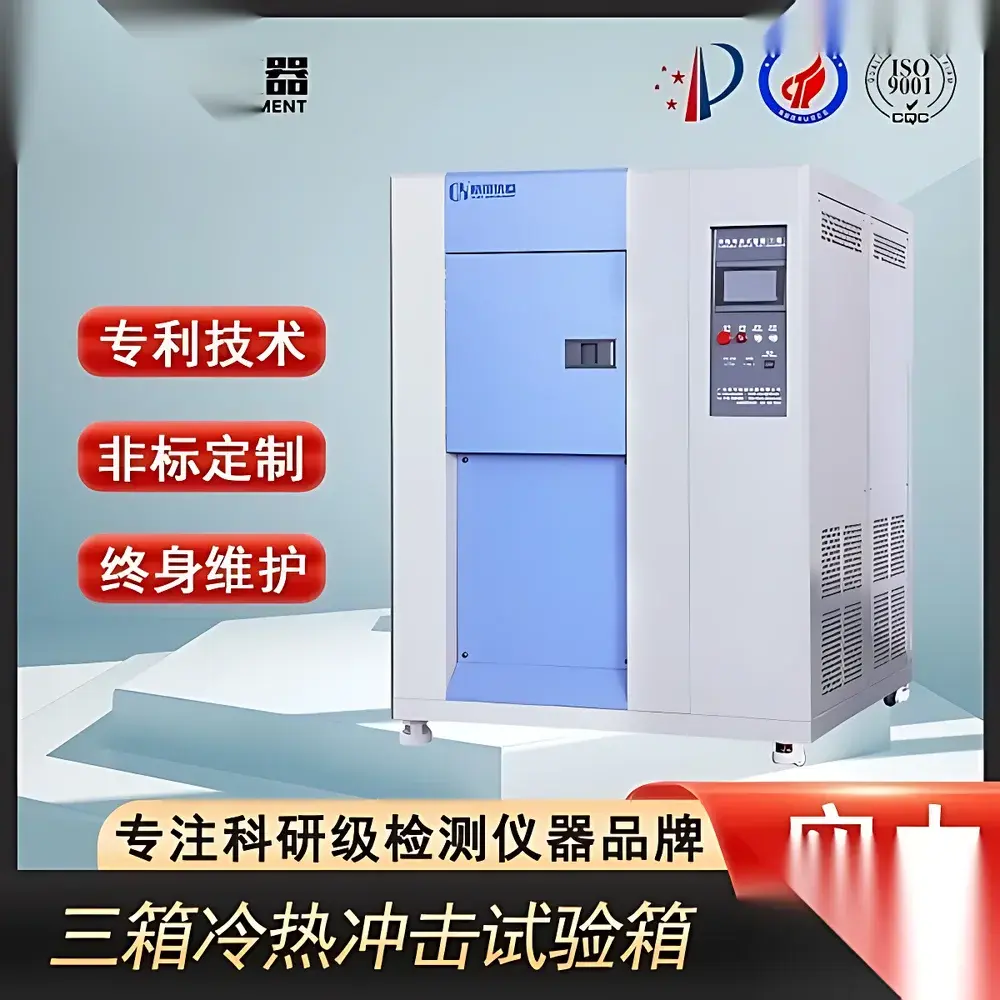
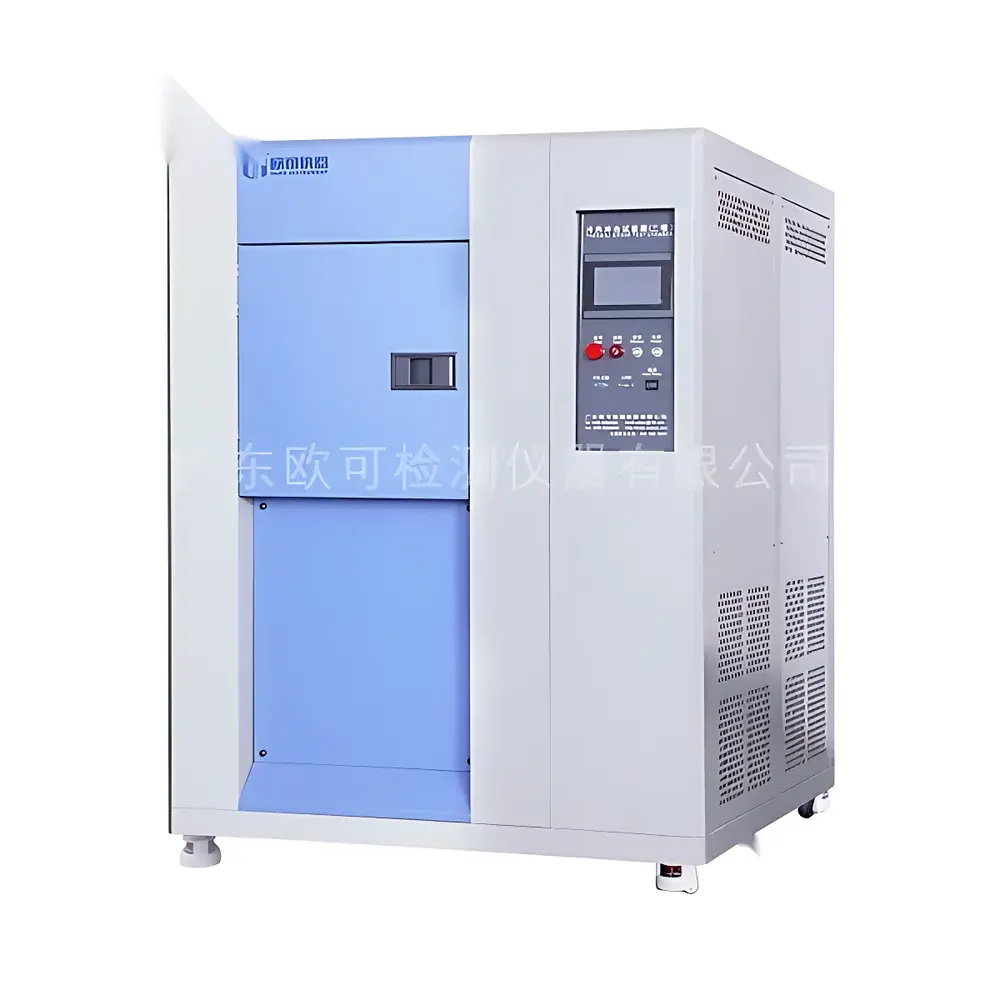
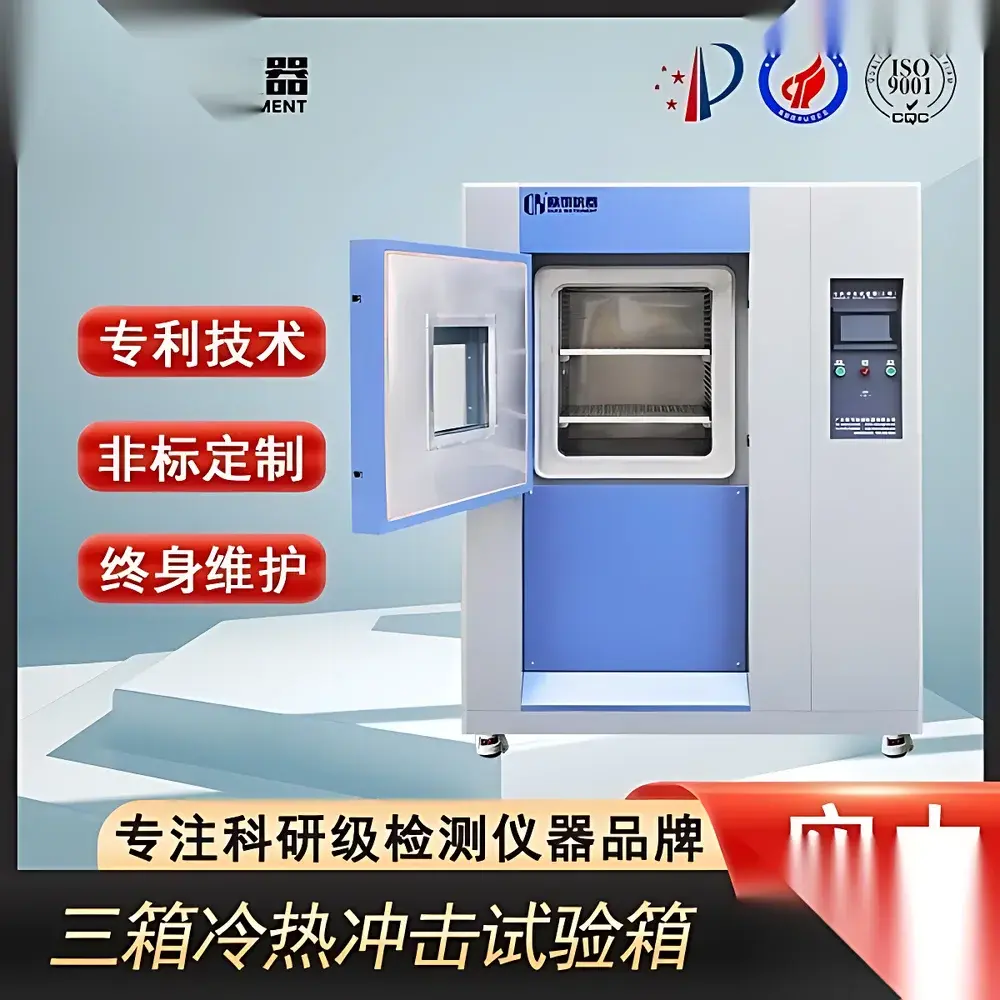
Three-Zone Thermal Shock Test Chamber
| Key Features | Three-zone design (high-temperature chamber, low-temperature chamber, test chamber) |
|---|---|
| Programmable memory | 100 test profiles, up to 9999 cycles, max 999 h 59 min per segment |
| Data logging | paperless real-time curve display and archival |
| Compliance | MIL-STD-202, IEC 60068-2-14, JIS C 60068-2-14 |
| Optional | LN₂ rapid-cooling module, RS-485/RS-232C communication interface, external temperature data logger |
| Safety | PLC-controlled fault detection, automatic emergency shutdown on power fluctuation, dual thermal overprotection |
Overview
The Three-Zone Thermal Shock Test Chamber is an engineered environmental stress screening (ESS) platform designed for accelerated reliability validation of electronic components, aerospace subsystems, automotive ECUs, LED modules, printed circuit boards (PCBs), battery cells, and advanced composite materials. Unlike two-zone mechanical shuttle systems, this chamber employs a static test zone with independent high- and low-temperature reservoirs—enabling true zero-movement thermal shock exposure. It operates on the principle of rapid air-stream switching between thermally isolated chambers, delivering controlled, repeatable thermal transients without subjecting specimens to mechanical acceleration or positional disturbance. This architecture ensures high reproducibility in evaluating material integrity under extreme ΔT conditions—specifically targeting failure mechanisms such as interfacial delamination, solder joint fatigue, coefficient-of-thermal-expansion (CTE) mismatch cracking, and dielectric degradation.
Key Features
- Three-chamber architecture: Dedicated high-temperature zone (up to +150 °C), low-temperature zone (down to −70 °C), and stationary test chamber—eliminating mechanical actuator wear and vibration-induced artifacts.
- Ultra-fast thermal transition: Air-path switching achieves specimen temperature transfer in ≤10 seconds, meeting stringent requirements of MIL-STD-202G Method 107, IEC 60068-2-14, and JIS C 60068-2-14.
- Rapid thermal recovery: Post-transition stabilization within ≤5 seconds ensures precise dwell-time control and minimizes thermal lag during cyclic profiling.
- Dual-stage refrigeration system: Optimized HFC-404A/HFC-23 cascade configuration delivers stable sub-zero operation with enhanced energy efficiency and reduced environmental impact versus legacy CFC/R-502 systems.
- Intelligent control interface: Japanese-manufactured 302×240-dot color LCD touchscreen controller supports both English and Chinese navigation, real-time graphical trend monitoring, and intuitive program editing.
- Robust programmability: Stores up to 100 independent test sequences; each sequence supports up to 9999 cycles with individual segment durations configurable to 1 minute resolution (max 999 h 59 min).
- Integrated safety logic: PLC-based fault management continuously monitors compressor discharge pressure, chamber door interlocks, overtemperature sensors, and mains voltage stability—triggering immediate shutdown and audible/visual alarms upon deviation.
Sample Compatibility & Compliance
This chamber accommodates test specimens up to 500 mm × 500 mm × 500 mm (W×D×H) with standard internal volume options of 150 L, 300 L, and 500 L. Its non-contact air impingement method preserves dimensional integrity of fragile assemblies—including wafer-level packages, MEMS devices, and thin-film photovoltaic substrates. The system complies with ISO/IEC 17025 calibration traceability requirements when operated with NIST-traceable reference probes. It supports full audit readiness for GLP and GMP environments through optional 21 CFR Part 11-compliant software modules that enforce user authentication, electronic signatures, and immutable audit trails for all parameter changes and test executions.
Software & Data Management
The embedded controller provides native paperless data acquisition with timestamped CSV export capability. Optional PC-based software (supplied on secure USB drive) enables remote monitoring via RS-232C or RS-485 interfaces, synchronized multi-chamber coordination, and automated report generation compliant with ASTM E171 and IEC 60747-16 documentation standards. All recorded thermal profiles include metadata such as operator ID, calibration certificate number, ambient lab conditions, and version-stamped firmware identifiers—ensuring full traceability across product development lifecycles.
Applications
- Qualification testing of EV battery modules per UN ECE R100 and GB/T 31467.3 thermal abuse protocols.
- Solder joint reliability assessment of automotive ADAS controllers under JEDEC JESD22-A104E cycling profiles.
- Qualification of space-grade optoelectronics per ECSS-Q-ST-70-08C thermal vacuum shock specifications.
- Material screening of polymer encapsulants and underfill adhesives used in fan-out wafer-level packaging (FOWLP).
- Process validation of conformal coating adhesion strength following IPC-CC-830B accelerated aging schedules.
FAQ
What distinguishes the three-zone architecture from conventional two-zone shuttle systems?
The three-zone design eliminates mechanical movement of the test specimen—reducing risk of vibration-induced damage and enabling higher fidelity correlation with field failure modes observed in statically mounted electronics.
Can the chamber be integrated into an existing factory MES or LIMS environment?
Yes—via optional RS-485 Modbus RTU or Ethernet/IP gateway modules, supporting seamless data exchange with Siemens SIMATIC, Rockwell FactoryTalk, or LabVantage platforms.
Is calibration certification included with shipment?
A factory-issued as-found/as-left calibration report (traceable to NPL/PTB standards) is provided; on-site UKAS-accredited calibration services are available upon request.
What maintenance intervals are recommended for long-term operational stability?
Compressor oil analysis every 2,000 operating hours; refrigerant leak inspection quarterly; heat exchanger cleaning semiannually; controller firmware updates aligned with vendor release cycles.



