
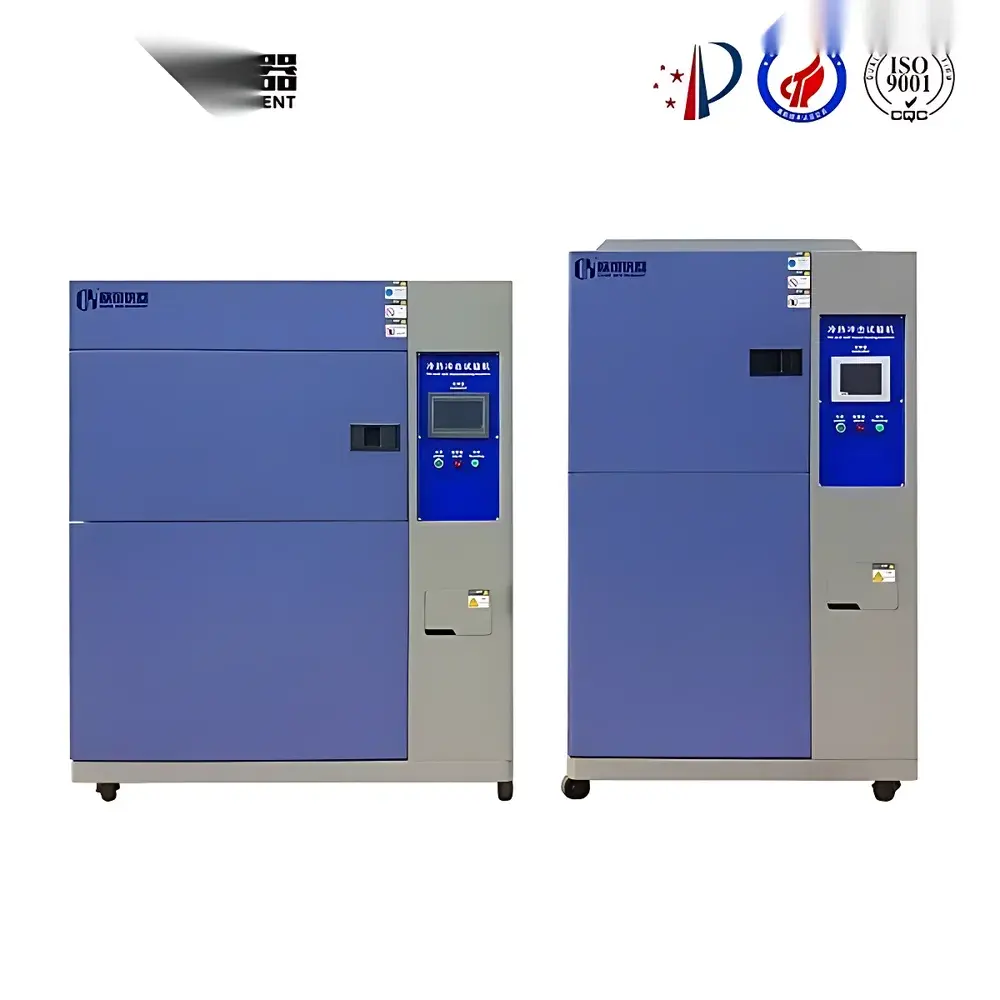
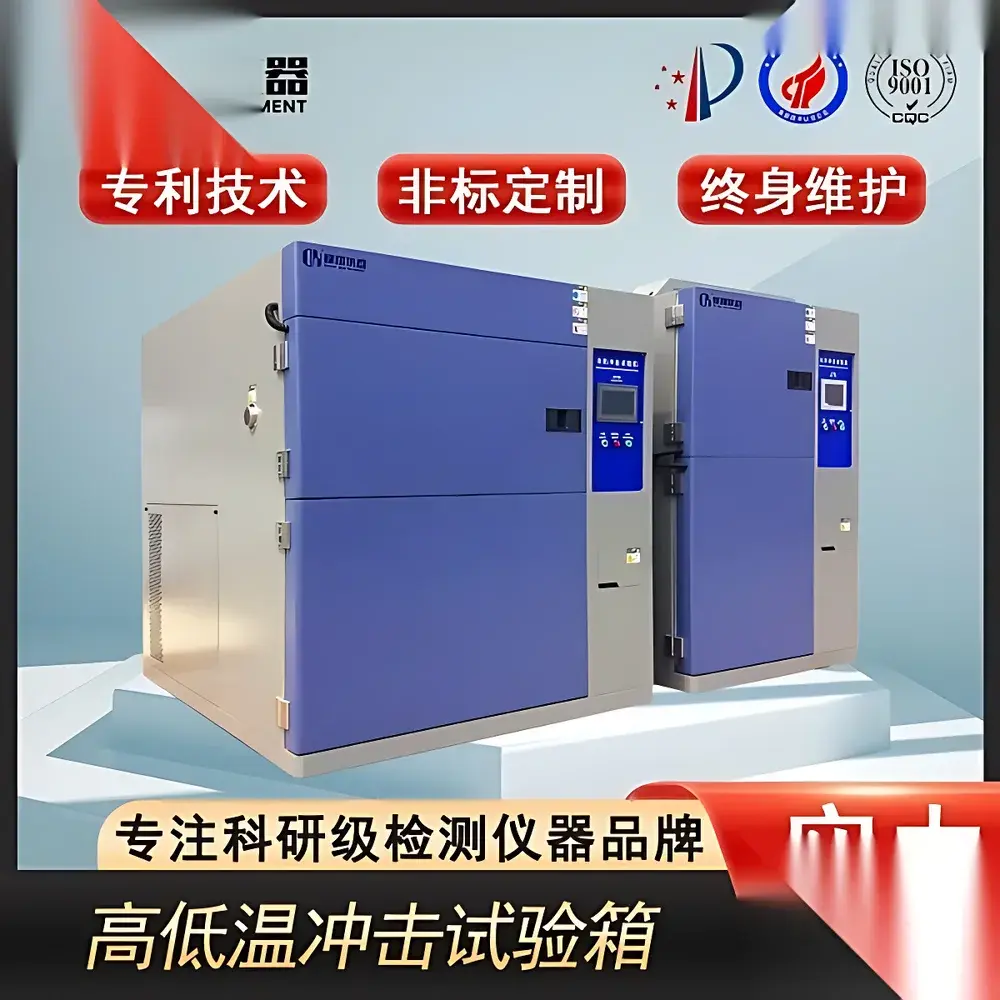
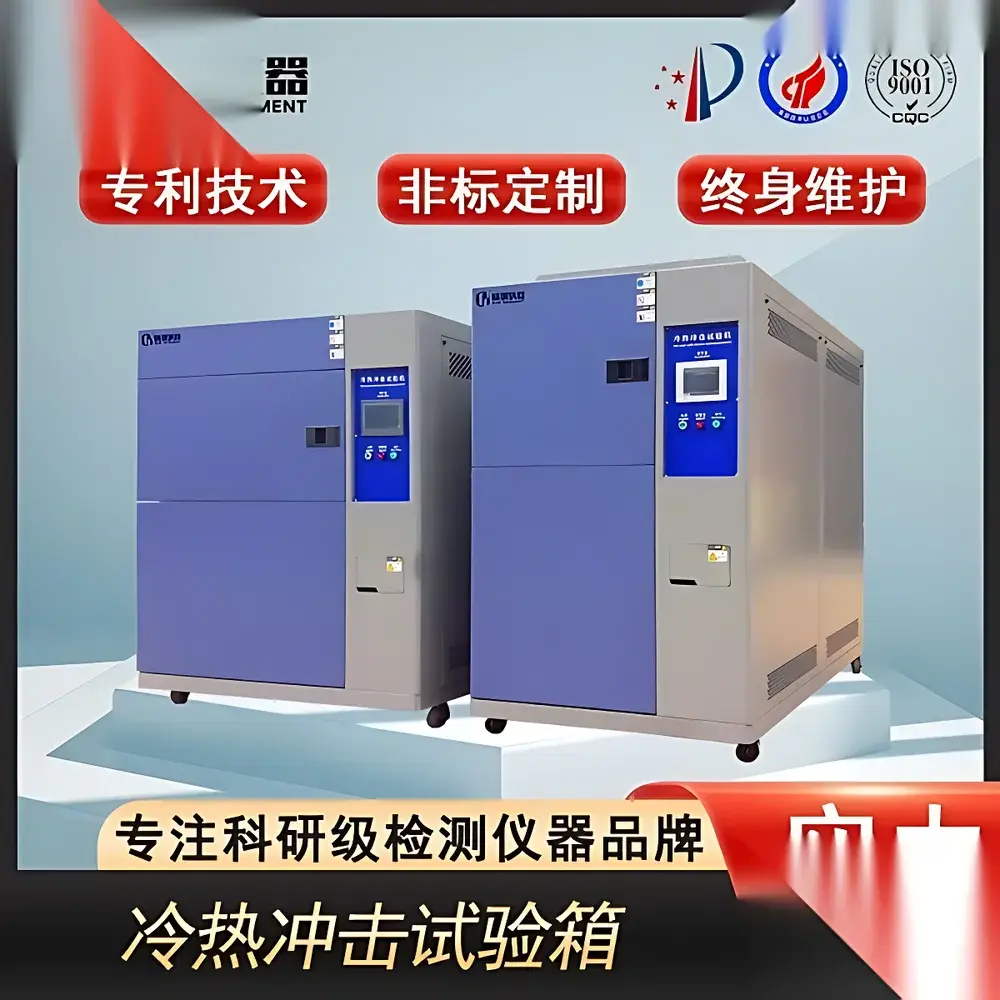
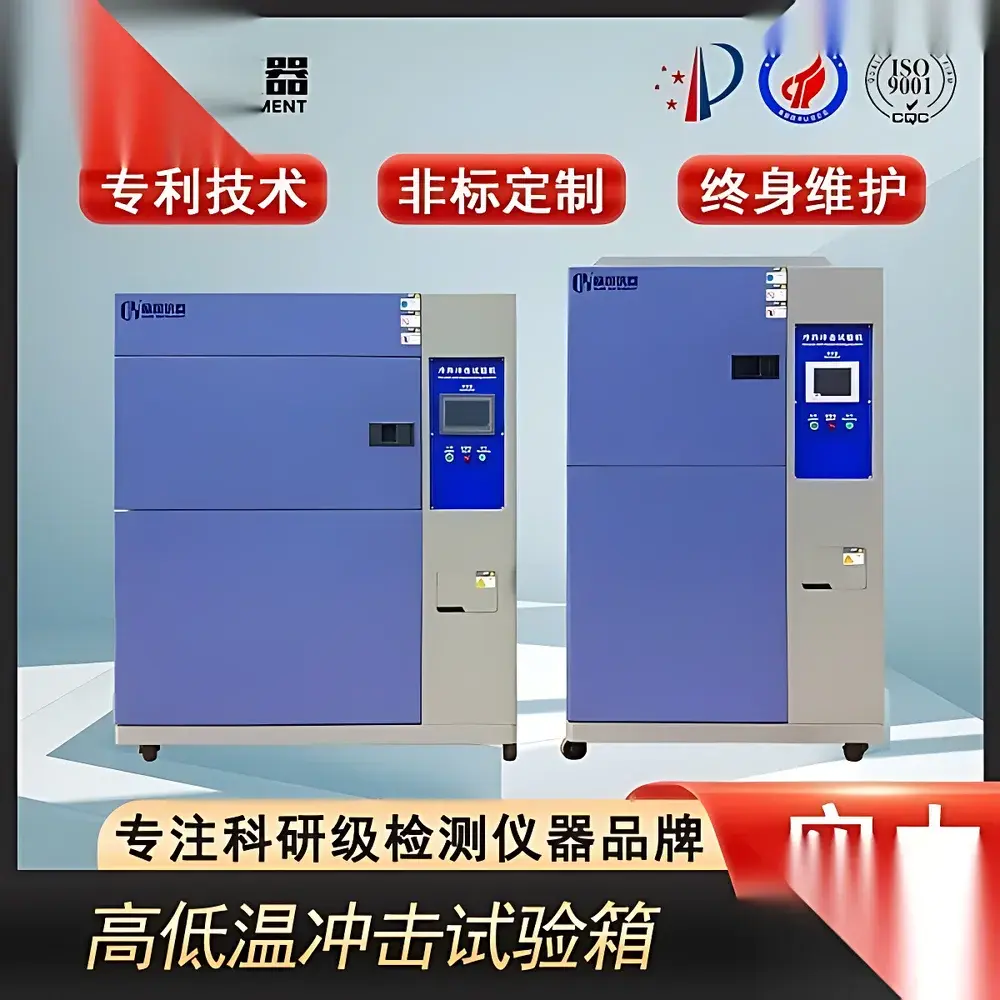
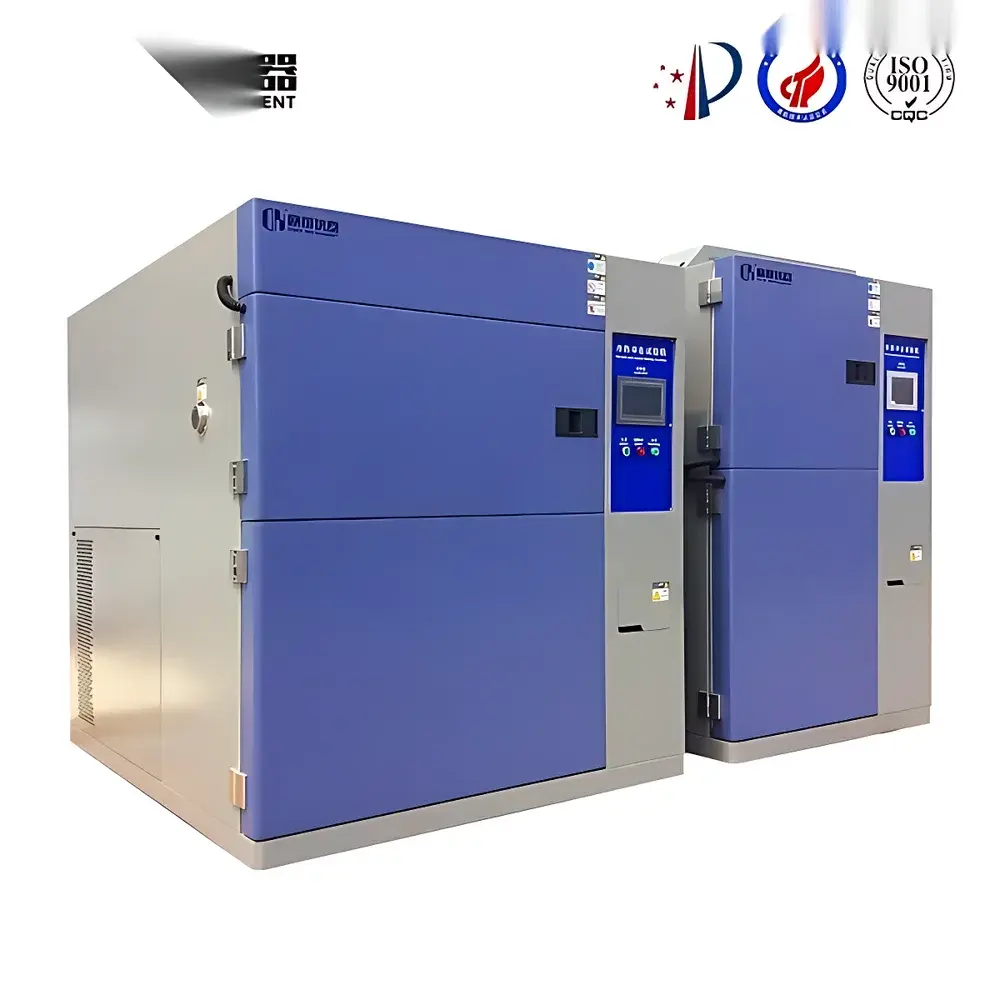
Three-Zone Thermal Shock Test Chamber
| Brand | Other Brands |
|---|---|
| Origin | Imported |
| Manufacturer Type | Authorized Distributor |
| Price | USD 11,200 (FOB) |
| Temperature Range | High Zone: +150°C to +200°C |
| Low Zone | -70°C to -40°C |
| Test Zone | -65°C to +180°C |
| Transition Time (5% Recovery) | ≤15 s (Typical, per IEC 60068-2-14) |
| Cycle Count | Up to 9999 Cycles |
| Soak Time per Zone | Adjustable 1–9999 min |
| Cooling System | Dual-Stage Cascade Refrigeration (Air-Cooled or Water-Cooled Options) |
| Control Interface | 7″ Full-Color TFT LCD Touchscreen with Bilingual (English/Chinese) GUI |
| Data Logging | Optional External Recorder or PC-Connected USB/RS485 Interface |
| Compliance | IEC 60068-2-14 (Test N), MIL-STD-810H Method 503.5, GJB 150.5A-2009, GB/T 2423.22–2012, ASTM D6279–20 |
Overview
The Three-Zone Thermal Shock Test Chamber is an engineered environmental stress screening (ESS) system designed for rapid, high-fidelity thermal cycling of electronic components, aerospace hardware, automotive modules, and polymeric materials. Unlike single- or dual-chamber configurations, this tri-zone architecture physically isolates the high-temperature zone, low-temperature zone, and test chamber—eliminating thermal inertia and enabling sub-15-second transition times between extreme temperature extremes. The system operates on the principle of *air-mass transfer*, where conditioned air from pre-stabilized hot and cold reservoirs is pneumatically routed into the test zone via high-speed damper-controlled ducts. This methodology ensures precise, repeatable thermal shock profiles without subjecting specimens to mechanical handling or positional disturbance during transitions—critical for evaluating solder joint integrity, coating adhesion, sealant performance, and interfacial delamination under accelerated aging conditions.
Key Features
- Tri-zone segregated architecture with independent PID-controlled heating and refrigeration circuits for each compartment—ensuring stable soak temperatures ±0.5°C uniformity (per IEC 60068-3-5)
- High-speed pneumatic air-switching mechanism with stainless-steel insulated ductwork and leak-tight dampers, achieving ≤15 s transition time (5% recovery criterion) between −65°C and +180°C
- 7-inch full-color TFT touchscreen interface with intuitive English/Chinese bilingual navigation, real-time trend graphing, and user-configurable profile templates
- Dual-stage cascade refrigeration system using environmentally compliant R404A/R23 mixed refrigerants; available in air-cooled (standard) or water-cooled (high-ambient option) configurations
- Programmable cycle logic supporting automatic sequential shock (hot→cold→test), manual selective zone activation, two-zone or three-zone shock modes, and customizable dwell durations (1–9999 minutes per zone)
- Integrated safety architecture including over-temperature cut-off, refrigerant pressure monitoring, door interlock, and alarm logging with timestamped event history
Sample Compatibility & Compliance
The chamber accommodates standard test specimens up to 500 mm × 500 mm × 500 mm (W×D×H) with a maximum payload of 30 kg. It supports both bare PCB assemblies and fully packaged modules—including BGAs, QFNs, MEMS sensors, and hermetically sealed connectors—without requiring fixture modification. All operational parameters and calibration traceability comply with international qualification standards: IEC 60068-2-14 (Test N), MIL-STD-810H Method 503.5, GJB 150.5A-2009 (China’s military standard for temperature shock), GB/T 2423.22–2012 (national standard for temperature change testing), and ASTM D6279–20 (standard practice for thermal shock evaluation of polymer coatings). The system meets GLP-aligned documentation requirements when paired with optional data acquisition software, supporting audit-ready records for ISO 9001, IATF 16949, and AS9100 certified laboratories.
Software & Data Management
While the embedded controller manages all real-time execution, optional PC-based software (sold separately) enables full remote supervision, automated report generation (PDF/CSV), and long-term trending analysis. The software supports 21 CFR Part 11-compliant user access control, electronic signatures, and immutable audit trails—including parameter changes, alarm events, and calibration interventions. Raw temperature data from all three zones is sampled at 1 Hz resolution and stored with millisecond-level timestamping. Export formats include .csv for statistical process control (SPC) integration and .xml for LIMS interoperability. Calibration certificates are traceable to NIST or CNAS-accredited labs, with recommended annual verification per ISO/IEC 17025 guidelines.
Applications
- Qualification testing of avionics control units subjected to rapid altitude-induced thermal transients
- Evaluation of die-attach reliability in power semiconductor packages under repeated thermal mismatch stress
- Validation of conformal coating durability on printed circuit boards exposed to automotive under-hood thermal cycles
- Accelerated life testing of lithium-ion battery modules for electric vehicle applications
- Material compatibility assessment of elastomeric seals used in cryogenic instrumentation housings
- Process window definition for reflow soldering line optimization and failure mode identification
FAQ
What is the difference between two-zone and three-zone thermal shock testing?
Two-zone systems alternate the test specimen between hot and cold chambers via mechanical transfer—introducing handling-induced variables and longer transition times. Three-zone systems maintain constant temperature reservoirs and move only conditioned air, enabling faster, more repeatable shocks with zero specimen displacement.
Can this chamber meet MIL-STD-810H requirements?
Yes—the chamber satisfies Method 503.5 (Temperature Shock) when configured with specified soak times, transition rates, and cycle counts per the test plan. Documentation includes compliance statements aligned with DoD acquisition guidance.
Is external data logging mandatory for quality audits?
No—but for ISO 13485 or IATF 16949 environments, externally recorded, time-stamped, and user-verified data is strongly recommended to satisfy evidence retention and traceability clauses.
What refrigerant is used, and does it comply with F-Gas regulations?
The system uses R404A (high-temp stage) and R23 (low-temp stage)—both classified as HFCs. While not exempt, they are permitted under current EU F-Gas Regulation (EU) No 517/2014 for laboratory equipment with closed-loop operation and certified leak rates <0.5%/year.
How often should temperature uniformity mapping be performed?
Per ISO/IEC 17025 and ASTM E74, quarterly mapping is recommended for routine use; additional mapping is required after major maintenance, relocation, or any deviation exceeding ±1.0°C from baseline uniformity specifications.
Related Products



