
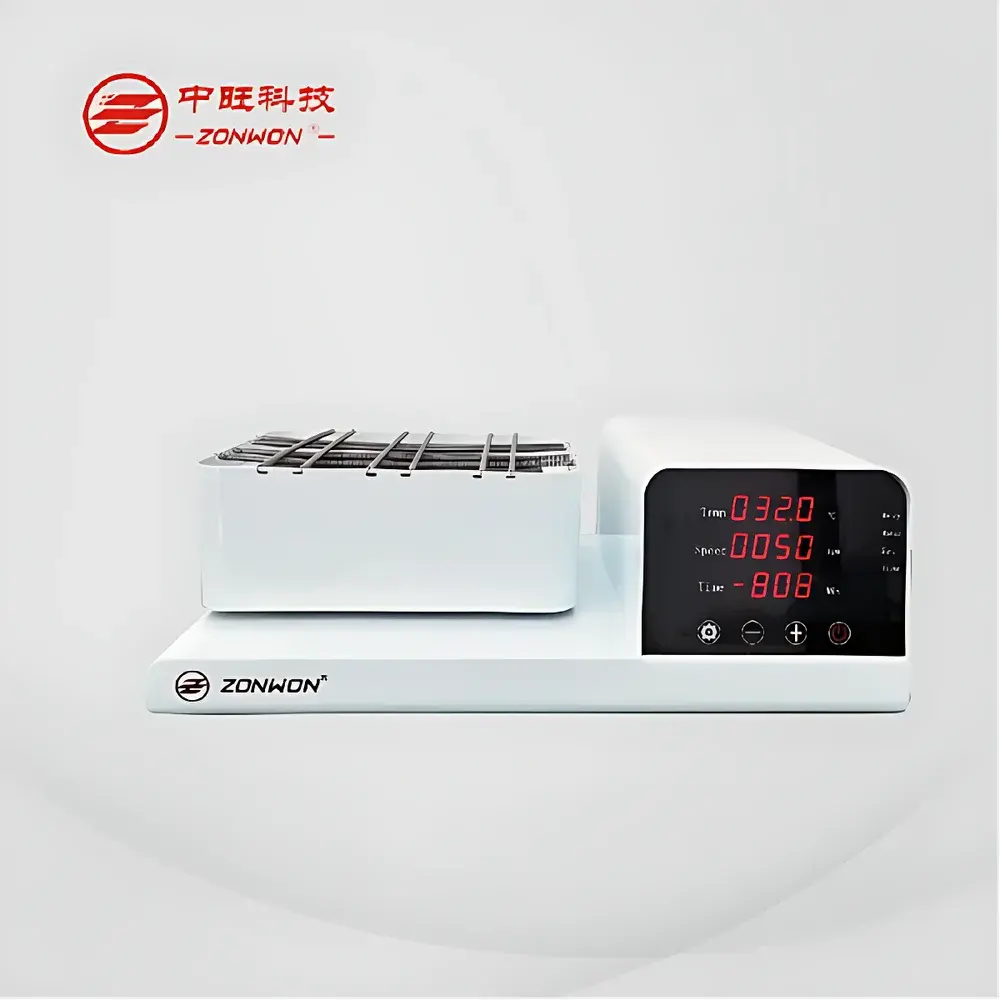
ZONWON PV6 Orbital Shaking Constant-Temperature Sample Dissolution Unit
| Brand | ZONWON |
|---|---|
| Origin | Zhejiang, China |
| Manufacturer Type | Direct Manufacturer |
| Country of Origin | China |
| Model | PV6 |
| Operating Mode | Adjustable Speed |
| Rotational Speed Range | 10–120 rpm |
| Shaking Motion | Orbital Oscillation |
| Block Material | Solid Metal (Aluminum Alloy) |
| Number of Sample Wells | 6 |
| Compatible Vessel Sizes | 50 mL conical or round-bottom vials |
| Temperature Range | Ambient to 200 °C |
| Temperature Accuracy | ±1 °C |
| Power Supply | 220 V / 50 Hz / 2 kW |
| Dimensions (L×W×H) | 425 × 260 × 165 mm |
Overview
The ZONWON PV6 Orbital Shaking Constant-Temperature Sample Dissolution Unit is an engineered solution for controlled, low-shear thermal dissolution of polymeric and thermoplastic materials in analytical and quality control laboratories. It operates on the principle of orbital shaking—generating gentle, circular motion that minimizes mechanical degradation while ensuring uniform heat transfer across multiple samples. Unlike vortexing or linear agitation, orbital oscillation preserves macromolecular integrity during dissolution, making it especially suitable for high-molecular-weight polymers such as polyethylene (PE), polypropylene (PP), and polyvinyl chloride (PVC). The unit integrates a solid metal heating block with precisely machined wells, enabling stable temperature maintenance and minimal inter-well thermal deviation—critical for reproducible rheological or viscometric sample preparation prior to testing per ISO 1628, ASTM D1243, or GB/T 1632.3.
Key Features
- Governed orbital shaking mechanism with continuously adjustable speed (10–120 rpm) to accommodate diverse polymer solubility kinetics and solvent volatility profiles.
- Monolithic aluminum alloy heating block—CNC-machined for dimensional consistency and thermal homogeneity; each well features optimized depth to ensure liquid level remains below the top surface, eliminating convective air interference during heating.
- Spring-loaded vial retention system prevents dislodgement under dynamic conditions, supporting safe operation with 50 mL conical or standard round-bottom dissolution vessels.
- Integrated digital PID temperature controller delivers ±1 °C accuracy across the full operating range (ambient to 200 °C), validated using traceable NIST-calibrated probes.
- Programmable timer function enables unattended, repeatable dissolution cycles—essential for GLP-compliant batch processing and method standardization.
- Low-noise brushless motor drive and passive thermal insulation reduce operational disturbance and long-term drift, contributing to >99.7% uptime in continuous QC environments.
Sample Compatibility & Compliance
The PV6 is routinely deployed in polymer characterization workflows requiring adherence to national and international standards including GB/T 1632.3 (determination of viscosity-number of PVC resins), GB/T 3401 (polyvinyl chloride resins—specifications), and GB/T 5761 (suspension PVC resins). Its design supports compatibility with common organic solvents (e.g., cyclohexanone, tetrahydrofuran, chlorobenzene) used in polymer dissolution protocols. All thermal and mechanical parameters are documented in accordance with ISO/IEC 17025 requirements for equipment qualification. The unit’s construction meets IP20 environmental protection rating and complies with IEC 61010-1 for laboratory electrical safety.
Software & Data Management
While the PV6 operates via embedded hardware controls (no external PC dependency), its temperature and timing parameters are fully configurable and retain settings after power cycling. For integration into regulated environments, optional RS-485 serial output (with Modbus RTU protocol support) enables connection to centralized LIMS or SCADA systems for audit-trail generation. When paired with compliant data loggers, the unit satisfies FDA 21 CFR Part 11 requirements for electronic records—provided user-defined SOPs govern calibration frequency, parameter verification, and access control.
Applications
- Preparation of homogeneous polymer solutions for intrinsic viscosity measurement (e.g., Ubbelohde viscometry per ISO 1628-1).
- Dissolution of thermoplastic resin pellets prior to melt flow index (MFI) or capillary rheometry testing (ASTM D1238, ISO 1133).
- Controlled solvent swelling studies for cross-linked polymer networks and elastomers.
- Standardized sample conditioning for Fourier-transform infrared (FTIR) spectroscopy and differential scanning calorimetry (DSC) analysis.
- QC release testing of PVC suspension resins in accordance with GB/T 5761 specifications.
FAQ
What types of vessels are compatible with the PV6?
Standard 50 mL conical flasks (e.g., Kimax, Pyrex) and round-bottom glass vials with outer diameters between 28–32 mm fit securely within the spring-retained wells.
Can the PV6 be used with volatile solvents above 100 °C?
Yes—provided appropriate fume hood ventilation and sealed vessel caps are employed; the unit’s metal block design ensures minimal radiant heat loss and stable bath-like thermal environment.
Is temperature uniformity verified across all six wells?
Yes—per factory qualification, inter-well temperature variation is ≤±0.8 °C at 150 °C, confirmed using six-channel calibrated thermocouples placed at geometric centers of each well.
Does the PV6 support GMP/GLP documentation packages?
A complete IQ/OQ documentation kit—including test protocols, acceptance criteria, and raw data templates—is available upon request for validation in regulated pharmaceutical or polymer manufacturing facilities.
What maintenance is required for long-term reliability?
Annual verification of temperature sensor calibration and visual inspection of spring tension and block surface integrity are recommended; no lubrication or consumable replacement is required.



