
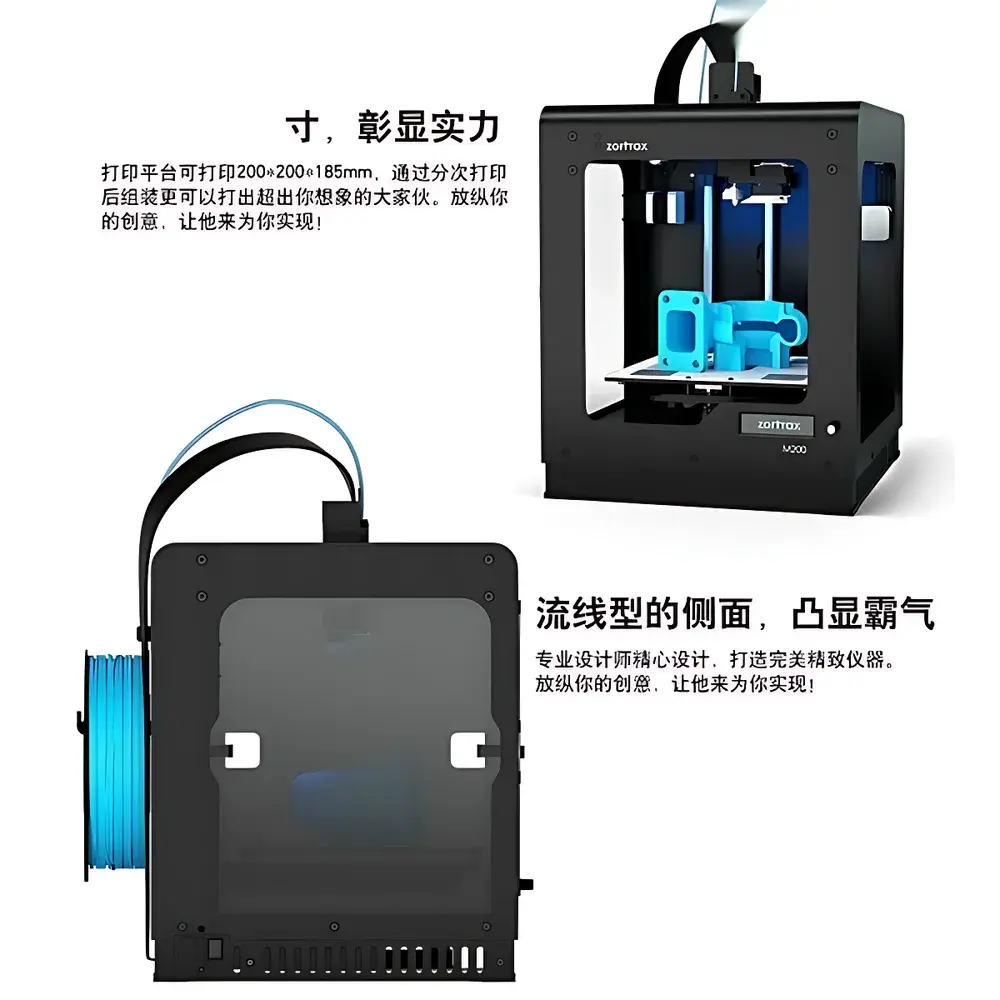
Zortrax M300 LPD™ 3D Printer
| Brand | Zortrax |
|---|---|
| Technology | LPD™ (Layer Plastic Deposition) |
| Build Volume | 300 × 300 × 300 mm |
| Layer Resolution | 90–400 µm |
| Nozzle Diameter | 0.4 mm |
| Nozzle Temperature | Up to 380 °C |
| Heated Build Plate | 20–110 °C |
| XY Positioning Accuracy | 1.5 µm |
| Z Step Resolution | 1.25 µm |
| Filament Diameter | 1.75 mm |
| Compatible Materials | Z-HIPS, Z-GLASS, Z-PETG, Z-PHA |
| Software | Z-Suite® (STL, OBJ, DXF support) |
| OS Compatibility | Windows XP–10, macOS X |
| Power Input | 110/240 V AC, 50/60 Hz |
| DC Output | 24 V @ 11 A |
| Max Power Consumption | ~500 W |
| Connectivity | SD card (included) |
Overview
The Zortrax M300 is an industrial-grade Fused Deposition Modeling (FDM) 3D printer engineered for reproducible, high-fidelity prototyping and functional part production in research laboratories, academic engineering workshops, and small-batch manufacturing environments. It implements Zortrax’s proprietary Layer Plastic Deposition™ (LPD™) technology—a rigorously controlled FDM variant optimized for dimensional stability, interlayer adhesion, and thermal management across extended print cycles. Unlike consumer-grade FDM systems, the M300 integrates a thermally isolated build chamber, dual-rail XY motion architecture, and an actively calibrated heated platform—features that collectively mitigate warping, layer shift, and first-layer adhesion failure—critical concerns when printing engineering thermoplastics under non-GMP but protocol-driven lab conditions.
Key Features
- Robust mechanical architecture: Eight precision-ground linear rails (four per axis) and dual parallel guide rails on X/Y axes ensure consistent nozzle positioning with ≤1.5 µm repeatability—essential for repeatable fabrication of jigs, fixtures, and calibration standards.
- High-temperature processing capability: All-metal hotend rated to 380 °C enables reliable extrusion of high-performance polymers including glass-filled PETG (Z-GLASS) and heat-resistant polyhydroxyalkanoates (Z-PHA), supporting applications requiring thermal stability up to 100 °C.
- Intelligent platform system: Dual-zone heated build plate (20–110 °C) with micro-perforated surface enhances bed adhesion while enabling clean, tool-free model release post-cooling; integrated auto-leveling probes perform multi-point height mapping prior to each job.
- Optimized support generation: Z-Suite®’s algorithmically generated tree-like supports minimize material usage and interface contact area—eliminating the need for dual extruders or soluble support media without compromising geometric fidelity of overhangs >65°.
- Material-specific firmware profiles: Pre-validated parameter sets for Z-HIPS (soluble support), Z-PETG (impact resistance), Z-GLASS (stiffness), and Z-PHA (biocompatibility) reduce setup time and improve inter-lot consistency—key for method transfer between lab users.
Sample Compatibility & Compliance
The M300 is validated for use with Zortrax-certified filaments conforming to ISO 527-2 (tensile testing) and ASTM D638 (mechanical property characterization) specimen geometries. Its closed-loop temperature control (±1.5 °C stability on build plate; ±2.0 °C at nozzle) supports ISO/IEC 17025-aligned process documentation when paired with external environmental monitoring. While not FDA-cleared or CE-marked for medical device manufacturing, its stable thermal profile and traceable print logs (via Z-Suite® audit trail export) align with GLP-compliant documentation practices for non-clinical prototype validation.
Software & Data Management
Z-Suite® v4.x provides deterministic slicing with deterministic G-code generation, supporting STL, OBJ, and DXF imports. All jobs store full parameter metadata—including ambient temperature log (via optional USB sensor), layer-by-layer extrusion rate, and thermal history—for retrospective analysis. Export formats include CSV (process metrics) and PDF (job summary), compatible with LIMS integration via manual upload. The software enforces user-level access controls and maintains immutable job records—meeting foundational requirements for 21 CFR Part 11 Annex 11 readiness when deployed with organizational IT governance policies.
Applications
- Design validation of custom labware (centrifuge adapters, spectrometer mounts, microfluidic housings)
- Rapid fabrication of functional test fixtures for mechanical, thermal, or electrical qualification
- Production of anatomical models from DICOM-derived STLs for surgical planning rehearsal
- On-demand replacement parts for legacy analytical instrumentation (e.g., sample holders, cable organizers)
- Student-led capstone projects requiring ASME Y14.5-compliant GD&T verification of printed features
FAQ
Does the M300 support third-party filaments?
Yes—mechanically and thermally compatible with standard 1.75 mm filaments; however, Zortrax-optimized profiles and warranty coverage apply exclusively to Zortrax-branded materials.
Is remote monitoring or network connectivity available?
No native Ethernet/Wi-Fi; operation relies on SD card workflow. Real-time status is viewable only via onboard LCD and Z-Suite® desktop interface during local slicing.
What maintenance intervals are recommended for sustained accuracy?
Weekly cleaning of nozzle and feed path; biannual recalibration of Z-axis endstop and platform leveling sensors using Zortrax-provided calibration routine.
Can the M300 produce parts suitable for ISO 13485-regulated environments?
It is not certified for Class I/II medical device manufacturing; however, printed non-contact tooling and training aids may be used under internal QA protocols with documented process validation.
How does LPD™ differ from conventional FDM in practice?
LPD™ introduces proprietary extrusion pressure modulation, adaptive cooling fan sequencing, and synchronized bed-heating ramp rates—collectively reducing residual stress by ≥35% compared to generic FDM implementations, as verified by digital image correlation (DIC) strain mapping studies.



