
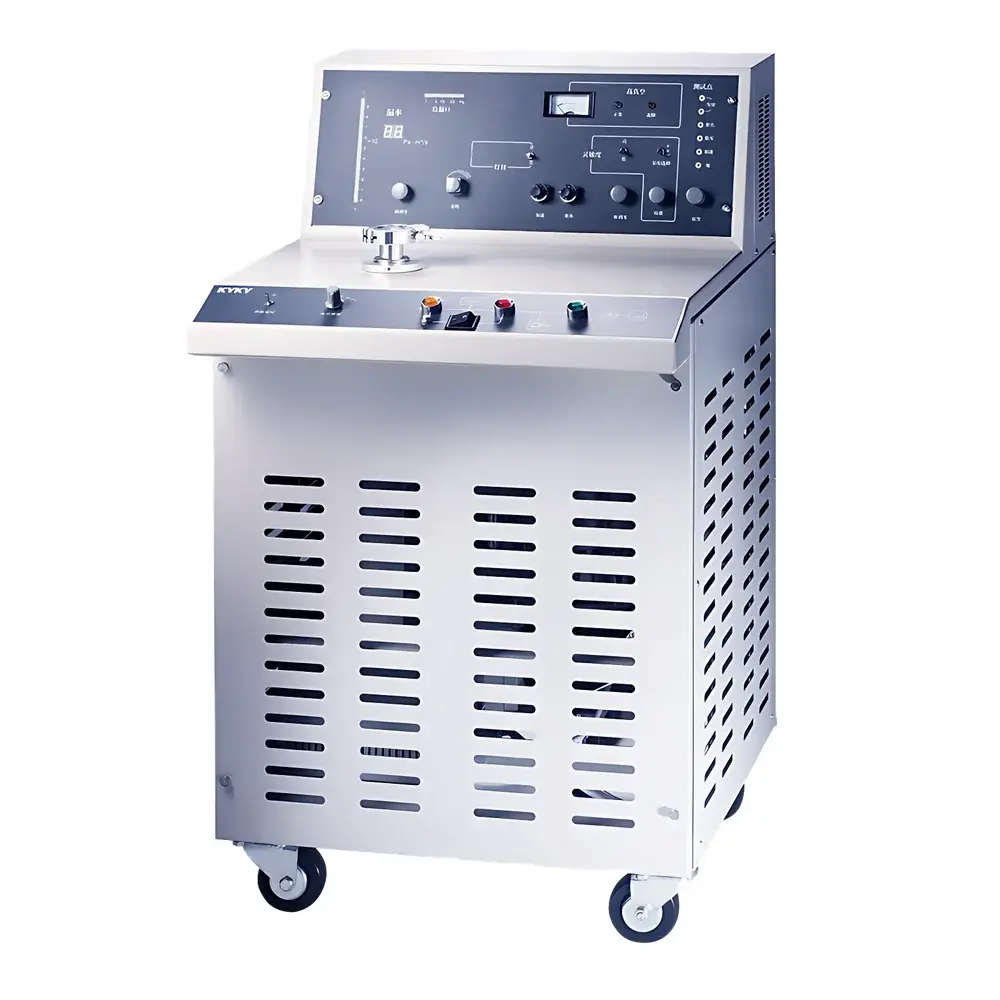
ZQJ-230D Helium Mass Spectrometer Leak Detector
| Origin | Beijing, China |
|---|---|
| Manufacturer Type | Authorized Distributor |
| Origin Category | Domestic (PRC) |
| Model | ZQJ-230D |
| Price Range | USD 7,000 – 14,000 |
| Minimum Detectable Leak Rate | <5×10⁻¹¹ Pa·m³/s |
| Leak Measurement Range | 5×10⁻¹¹ – 9.8×10⁻⁵ Pa·m³/s |
| Maximum Inlet Pressure at Test Port | 20 Pa |
| Response Time | ≤3 s |
| Pump-Down Start-up Time | <8 min |
| Power Supply | 220 VAC ±10%, 50 Hz, 16 A |
| Operating Ambient Temperature | 5–35 °C, Relative Humidity ≤80% |
| Dimensions (L×W×H) | 540×600×950 mm |
| Weight | 82 kg |
Overview
The ZQJ-230D Helium Mass Spectrometer Leak Detector is a high-sensitivity, benchtop-integrated leak detection system engineered for precision vacuum integrity verification across industrial and research environments. It operates on the principle of reverse diffusion helium mass spectrometry — a configuration where helium tracer gas introduced externally diffuses *into* the evacuated test chamber through leaks and is subsequently ionized, separated by mass-to-charge ratio (m/z = 4), and quantified by a high-gain electron multiplier detector. This architecture enables reliable detection under elevated background pressures (up to 20 Pa at the test port), eliminating the need for ultra-high vacuum pre-conditioning prior to leak scanning. The instrument integrates a dual-stage vacuum system comprising a turbo-molecular pump (TMP) backed by an oil-sealed rotary vane mechanical pump, delivering rapid pump-down (<8 min from atmosphere to operational base pressure) and stable high-vacuum operation (<1×10⁻⁴ Pa typical base pressure). Its core measurement capability — a minimum detectable leak rate of <5×10⁻¹¹ Pa·m³/s — meets the sensitivity requirements for critical applications in aerospace component validation, cryogenic system certification, and semiconductor vacuum chamber qualification.
Key Features
- Reverse diffusion helium MS architecture enabling leak testing at up to 20 Pa inlet pressure — ideal for pressurized or rough-vacuum subsystems.
- Integrated vacuum train with high-speed turbo-molecular pump and robust mechanical backing pump — optimized for fast start-up and long-term stability.
- PLC-based automated control system supporting two primary operational modes: vacuum-mode (vacuum chamber evacuation + sniffing) and sniffer-mode (helium spray + active suction).
- Dedicated electromechanical valve manifold for fully sequenced pre-evacuation, leak measurement, and venting — minimizing operator intervention and procedural error.
- Real-time analog-style display using a 50-segment LED bar graph coupled with digital decade scaling — providing intuitive, logarithmic visualization of leak rate across 11 orders of magnitude (5×10⁻¹¹ to 9.8×10⁻⁵ Pa·m³/s).
- Full structural enclosure fabricated from welded steel — rated for vibration resistance (IEC 60068-2-6) and mechanical shock tolerance (IEC 60068-2-27), suitable for factory floor deployment.
- Automatic vacuum interlock protection: TMP shutdown triggered if foreline pressure exceeds safe threshold or if cooling water flow fails (if water-cooled option installed).
Sample Compatibility & Compliance
The ZQJ-230D supports both internal (vacuum chamber) and external (sniffer probe) helium introduction methods, accommodating diverse geometries including sealed enclosures, welded joints, flanged connections, and microfluidic manifolds. It complies with fundamental vacuum metrology practices aligned with ISO 20484:2017 (Leak detection — Vocabulary and definitions) and ASTM E493-22 (Standard Practice for Leaks Using Helium as a Tracer Gas). While not certified to EN 1330-8 or ISO 10648-2 for formal calibration traceability, its performance envelope satisfies the technical requirements referenced in ASME BPVC Section V, Article 10 (Leak Testing) and EU Pressure Equipment Directive (PED 2014/68/EU) Annex I, §2.10 for tightness verification of Class I–III systems. All electronic controls adhere to EMC Directive 2014/30/EU and Low Voltage Directive 2014/35/EU.
Software & Data Management
The ZQJ-230D operates via embedded PLC firmware with no external PC dependency; however, optional RS-232 or USB-to-serial interface enables integration into centralized QA/QC data acquisition platforms. When connected, it transmits timestamped leak rate values, pump status flags, and valve sequence logs in ASCII format — compatible with LabVIEW, MATLAB, or custom SCADA systems. Audit trail functionality includes automatic logging of all mode transitions and alarm events (e.g., overpressure, TMP stall), supporting GLP-compliant documentation per FDA 21 CFR Part 11 when paired with validated third-party software. No proprietary software license or cloud service is required for basic operation or data export.
Applications
- Vacuum system commissioning and maintenance in semiconductor fabrication tools (e.g., PVD/CVD chambers, ion implanters).
- Hermeticity validation of cryogenic components including superconducting magnet housings, LNG heat exchangers, and dilution refrigerators.
- Leak screening of high-reliability electronic packages (MEMS sensors, RF modules, hermetic relays) per MIL-STD-883 Method 1014.
- Quality assurance in energy infrastructure manufacturing — nuclear fuel rod cladding, fusion reactor first-wall panels, hydrogen compression vessels.
- R&D vacuum diagnostics in university and national laboratory settings, particularly for ultrahigh vacuum (UHV) system characterization and getter pump performance assessment.
- Valve and actuator factory acceptance testing (FAT) per ISO 5208 leakage classification standards (Class A–D).
FAQ
What helium purity is recommended for optimal sensitivity?
Use ≥99.999% pure helium (Grade 5.0) to minimize background nitrogen and argon interference that may elevate baseline noise above 1×10⁻¹¹ Pa·m³/s.
Can the ZQJ-230D be used for quantitative leak localization?
Yes — when operated in sniffer mode with a calibrated helium probe, it provides semi-quantitative spatial resolution down to ~5 mm under controlled laminar flow conditions; full quantification requires correlation with ASTM E2654 standard practice.
Is the turbo-molecular pump oil-free?
The standard configuration uses a bearing-lubricated TMP; an optional dry-bearing or magnetic-bearing TMP variant is available upon request for oil-free operation in ultra-clean environments.
Does the instrument support automated pass/fail reporting?
Not natively — pass/fail logic must be implemented externally via PLC or host software using the serial output stream; no built-in recipe-based judgment engine is included.
What maintenance intervals are specified for the vacuum system?
Mechanical pump oil change every 500 operating hours; TMP rotor inspection and cleaning every 5,000 hours; mass filter calibration recommended annually using certified helium reference leaks traceable to NIST SRM 2197.







