
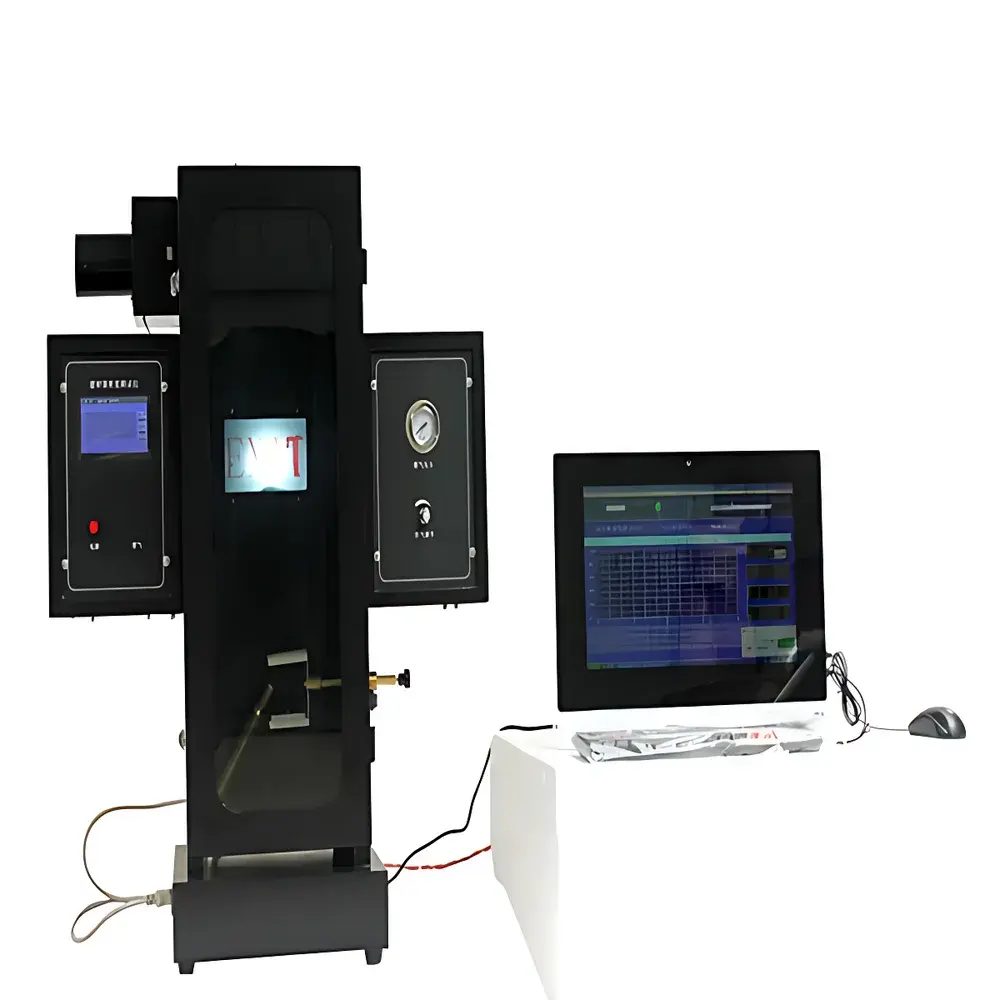
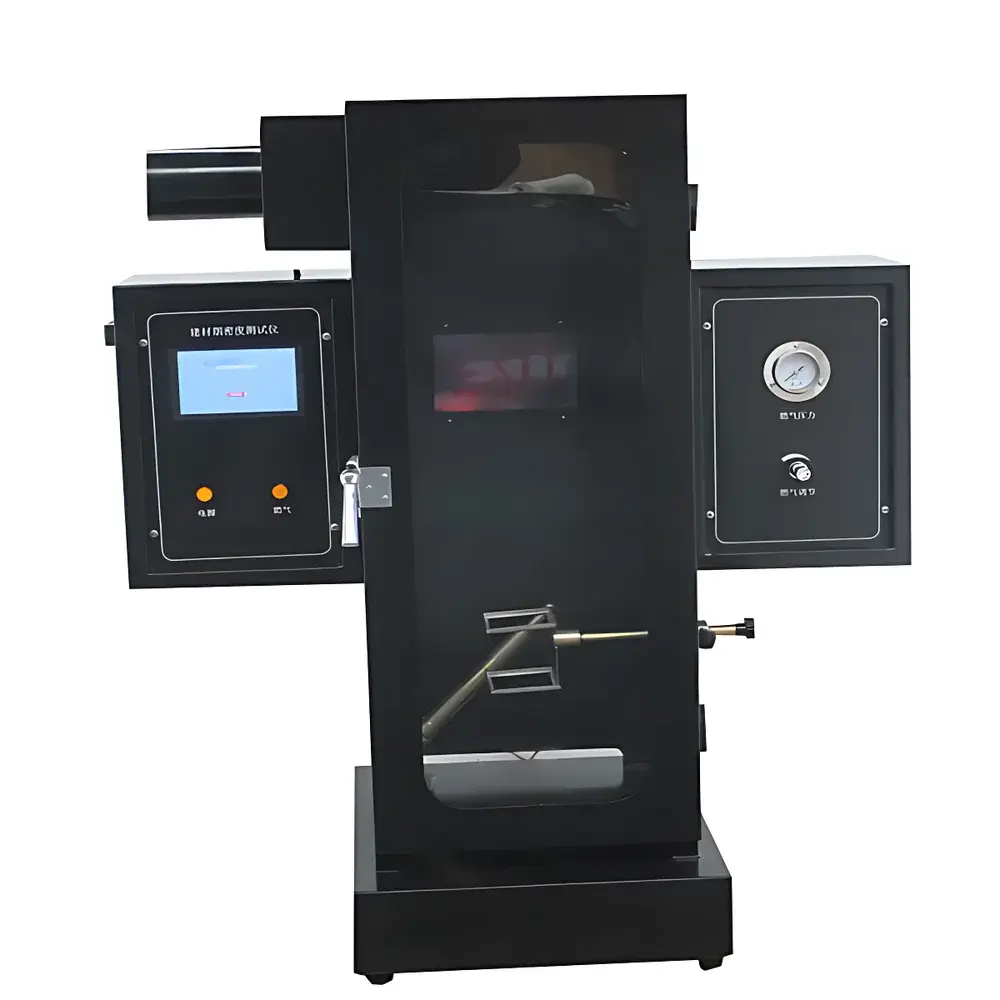
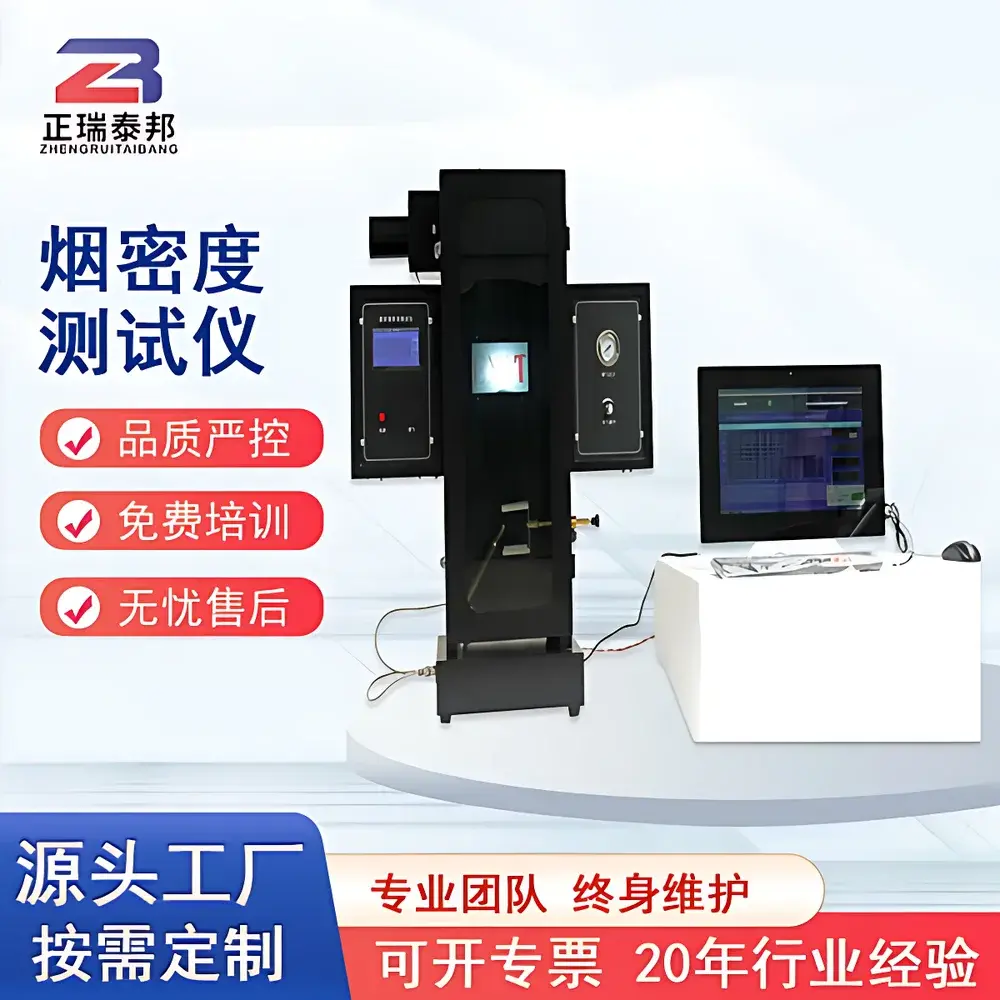
ZRTB JCY-3 Building Material Smoke Density Chamber
| Brand | ZRTB |
|---|---|
| Origin | Jiangsu, China |
| Manufacturer Type | Manufacturer |
| Model | JCY-3 |
| Price | USD 1,500 (approx.) |
| Compliance | GB/T 8627–2007, ASTM D2843 |
| Dimensions (L×W×H) | 740 × 500 × 900 mm |
| Weight | ~50 kg |
| Power Supply | 220 V ±10%, 50 Hz, 100 W |
| Operating Temp. | 0–40 °C |
| Relative Humidity | ≤85% RH |
| Gas Source | 95% propane (user-supplied) |
| Burner Pressure (main) | 276 kPa (adjustable) |
| Burner Pressure (pilot) | 210 ±5 kPa |
| Flame Application Time | 4 min |
| Light Source | 15 W, 6 V incandescent lamp |
| Photodetector | Silicon photovoltaic cell |
| Optical Measurement Range | 0–100% transmittance |
| Accuracy | ±3% |
| Calibration | Triple NIST-traceable neutral density filters (±3% verification error) |
| Control Interface | 5″ TFT touchscreen (800×480), RS232, FPGA-driven real-time display |
| Automation | Auto-ignition, auto-timing, auto-exhaust control, staged linear photometric correction |
| Enclosure Requirement | Fume hood installation mandatory |
| Airflow Constraint | No forced convection during test |
Overview
The ZRTB JCY-3 Building Material Smoke Density Chamber is a precision-engineered instrument designed to quantify the optical smoke obscuration generated during the controlled combustion or thermal decomposition of construction materials. It operates on the principle of photometric transmittance measurement, in accordance with the standardized radiant exposure and static chamber methodology defined in GB/T 8627–2007 and ASTM D2843. During testing, a specimen is exposed to a calibrated Bunsen burner flame under specified gas pressure and duration; the resulting smoke plume accumulates within a sealed, geometrically defined smoke chamber. A collimated light beam passes horizontally through the chamber, and attenuation of light intensity—measured continuously by a silicon photovoltaic detector—is converted into real-time transmittance values. The system computes both the Maximum Specific Extinction (MSD) and Smoke Development Rate (SDR), expressed as percentage transmittance loss relative to baseline air clarity. This quantitative smoke density output serves as a critical input for fire hazard assessment, material classification (e.g., Class B1/C in Chinese building codes), and regulatory compliance documentation.
Key Features
- Dual independent control architecture: Integrated 5-inch industrial touchscreen (800×480 resolution) and PC-based software interface—both fully synchronized and interchangeable without hardware reconfiguration.
- Network-enabled multi-station operation: Supports concurrent access from multiple client PCs over local area network (LAN); ideal for shared laboratory environments requiring centralized data logging and remote supervision.
- Automated burner positioning system: Precision stepper-motor-driven rotation of main and auxiliary burners ensures repeatable angular alignment (45° to chamber axis) and consistent flame impingement geometry per GB/T 8627–2007 Clause 6.2.
- Hardware-accelerated real-time display: FPGA + ARM Cortex-M3 co-processor architecture enables zero-latency screen refresh (<10 ms), deterministic timing for photometric sampling, and fail-safe display continuity—even during transient power fluctuations.
- Staged photometric linearity correction: Built-in three-point calibration using NIST-traceable neutral density filters (OD 0.3, 0.6, 1.0) compensates for nonlinearity across the full 0–100% transmittance range, improving measurement fidelity beyond ±3% accuracy specification.
- Integrated safety-critical automation: Fully sequenced operation includes automatic ignition, flame-on timing (exactly 240 s ±1 s), exhaust activation post-test, and gas shutoff interlock—reducing operator dependency and procedural variability.
Sample Compatibility & Compliance
The JCY-3 accommodates standard rectangular specimens measuring 25.4 mm × 25.4 mm × thickness up to 25 mm, mounted vertically in the designated holder per ASTM D2843 Annex A1. It supports rigid, semi-rigid, and flexible sheet materials including insulation foams, PVC wall coverings, cable jacketing, ceiling tiles, and coated wood composites. All mechanical, optical, and thermal subsystems conform to the dimensional tolerances, airflow constraints, and photometric validation requirements stipulated in GB/T 8627–2007 Sections 4–7 and ASTM D2843 Section 7. The chamber’s internal volume (≈0.33 m³), aspect ratio (1:1:1.2), and blackened interior surfaces meet reflectance limits (<5%) required for valid extinction coefficient derivation. As a Class I laboratory instrument, it is intended for installation exclusively within certified fume hoods meeting EN 14175 or ANSI/AIHA Z9.5 ventilation standards to ensure operator safety and environmental containment during pyrolysis gas release.
Software & Data Management
The proprietary control software provides ISO/IEC 17025-aligned data integrity features: full audit trail with timestamped user actions (login/logout, parameter changes, test initiation), electronic signature capability, and immutable raw-data export in CSV and XML formats. All photometric curves—including instantaneous transmittance, first derivative (smoke generation rate), and integrated MSD/SDR—are stored with metadata (specimen ID, ambient T/RH, gas pressure logs, filter calibration timestamps). The system supports 21 CFR Part 11-compliant configuration when deployed in GLP/GMP-regulated facilities—enabling role-based access control, electronic record retention ≥15 years, and cryptographic hash verification of archived datasets. Exported reports include automatic annotation of pass/fail status against GB 8624–2012 smoke density thresholds (e.g., SDR ≤ 75 for Class B1).
Applications
- Fire performance certification of structural and decorative building products per GB 8624, EN 13501–1, and UL 723.
- Comparative smoke toxicity screening during R&D of low-smoke halogen-free cables and intumescent coatings.
- Quality assurance testing in manufacturing lines producing fire-retardant plywood, mineral wool boards, and phenolic foam insulation.
- Academic research on smoke particle morphology and soot yield correlation using synchronized gravimetric and optical analysis.
- Regulatory submission support for CE marking, CCC certification, and NFPA 285 wall assembly evaluations.
FAQ
What standards does the JCY-3 explicitly validate against?
The instrument is configured and verified to meet all physical, optical, and procedural requirements of GB/T 8627–2007 and ASTM D2843. Certificate of Conformance includes traceable verification of burner geometry, photometric linearity, and chamber reflectance.
Is propane the only acceptable fuel source?
Per Clause 6.3 of ASTM D2843, 95% minimum purity propane is the reference fuel. Natural gas (with equivalent Wobbe index and laminar flame speed) may be substituted only after full recalibration and interlaboratory validation.
Can test data be exported for third-party statistical analysis?
Yes—raw time-series transmittance data (10 Hz sampling), computed MSD/SDR values, and environmental logs export directly to CSV with ISO 8601 timestamps and SI unit annotations, compatible with JMP, Minitab, and Python Pandas workflows.
Does the system support unattended overnight testing?
No. Per GB/T 8627–2007 Section 8.4, each test cycle must be supervised due to mandatory 15-minute cooldown intervals between runs and real-time visual confirmation of flame stability and smoke dispersion behavior.
What maintenance is required to sustain ±3% photometric accuracy?
Quarterly verification using supplied ND filters; annual recalibration of pressure transducers and thermocouples by accredited metrology lab (ISO/IEC 17025 certificate required); biannual cleaning of optical windows with spectroscopic-grade methanol and lint-free wipes.



