
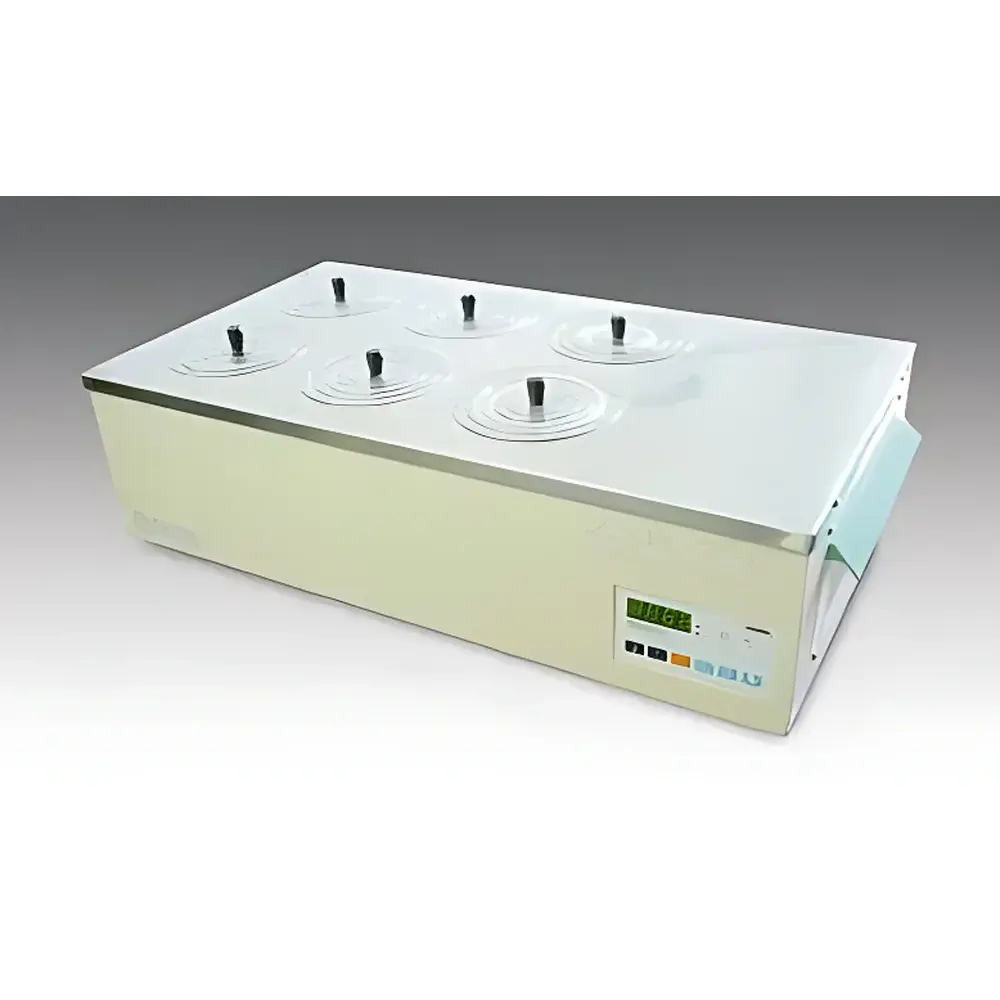
ZSBB-728 Constant-Temperature Water Bath Shaker
| Origin | Shanghai, China |
|---|---|
| Manufacturer Type | Authorized Distributor |
| Origin Category | Domestic (China) |
| Model | ZSBB-728 |
| Quotation | Upon Request |
| Temperature Range | Ambient to 100 °C |
| Temperature Control Accuracy | ±0.1 °C |
| Chamber Volume | 32 L |
| Interior Dimensions (W×D×H) | 640 × 320 × 160 mm |
| External Dimensions (W×D×H) | 875 × 370 × 235 mm |
| Power Consumption | 2000 W |
| Bath Medium | Water Only |
| Configuration | Dual-Row, 8-Position |
| Operation Mode | Continuous |
| Display | Backlit LCD |
| Features | Auto-restart after power failure, parameter lock, memory retention, low-level alarm, dry-run protection, 100-h timer |
Overview
The ZSBB-728 Constant-Temperature Water Bath Shaker is a precision-engineered laboratory instrument designed for simultaneous temperature control and orbital agitation of samples in aqueous media. Unlike standard water baths or standalone shakers, this integrated system combines Peltier-assisted or resistive heating (depending on configuration) with controlled mechanical oscillation—enabling uniform thermal equilibration and consistent mixing across all sample vessels. Its operational principle relies on closed-loop feedback control using high-stability Pt100 or NTC thermistors, coupled with a microprocessor-driven PID algorithm to maintain setpoint accuracy within ±0.1 °C over the full range of ambient to 100 °C. The unit is specifically configured for water-based applications only and is not rated for oil or organic solvent immersion. With a 32-liter chamber capacity and dual-row, eight-position platform, it supports scalable throughput while preserving thermal homogeneity—a critical requirement for enzyme kinetics assays, cell culture incubation, solubility studies, and dissolution testing per USP and ISO 10993-12 protocols.
Key Features
- Microprocessor-controlled PID temperature regulation with real-time deviation monitoring and adaptive compensation
- Backlit LCD interface displaying both setpoint and actual bath temperature, along with shaker speed (if applicable), elapsed time, and system status flags
- Integrated safety architecture including independent low-water-level detection, thermal cut-off at 105 °C, and automatic shutdown upon dry-run condition
- Power-failure recovery mode: resumes prior operating parameters—including temperature setpoint, timer value, and agitation state—within 3 seconds of mains restoration
- User-accessible parameter lock function to prevent accidental modification during GLP/GMP-compliant workflows
- Non-volatile memory retains up to 10 user-defined protocols with timestamped execution history
- Ergonomic stainless-steel inner chamber (640 × 320 × 160 mm) with corrosion-resistant finish and seamless weld construction for long-term reliability
- Front-access drain valve and removable perforated platform for rapid cleaning and validation-compatible decontamination
Sample Compatibility & Compliance
The ZSBB-728 accommodates standard laboratory glassware including test tubes (12–25 mm OD), conical flasks (50–500 mL), and multi-well plates mounted on custom adapters. Its dual-row, eight-position design allows parallel processing under identical thermal and mechanical conditions—essential for inter-sample reproducibility in QC release testing. The system complies with IEC 61010-1:2010 for electrical safety in laboratory equipment and meets CE marking requirements for EMC immunity (EN 61326-1) and emission limits (EN 55011). While not intrinsically certified for hazardous locations, its sealed heater assembly and grounded chassis ensure safe operation in ISO Class 7 cleanroom-adjacent environments. Documentation packages support 21 CFR Part 11 readiness when paired with validated third-party data acquisition software.
Software & Data Management
The ZSBB-728 operates as a standalone instrument with no embedded firmware-based data logging; however, its analog voltage output (0–5 V DC proportional to temperature) and digital RS-232/RS-485 interfaces enable integration with external SCADA systems, LIMS platforms, or LabVIEW-based acquisition modules. Optional USB-to-serial adapters permit direct connection to Windows-based PCs running compliant audit-trail-enabled software such as WinWedge Pro or Tera Term (configured for timestamped CSV export). All temperature readings are traceable to NIST-calibrated reference standards via optional factory-installed calibration certificates (ISO/IEC 17025 accredited).
Applications
- Temperature-dependent enzymatic reaction profiling (e.g., amylase, protease, kinase assays)
- Accelerated stability testing of pharmaceutical formulations under ICH Q1A(R2) guidelines
- Cell suspension culture maintenance during transfection or metabolic labeling procedures
- Dissolution rate determination for solid oral dosage forms per USP Apparatus I/II specifications
- Standardization of viscosity reference fluids prior to rheometer calibration
- Pre-incubation of PCR master mixes and restriction digestion buffers
- Controlled hydrolysis studies in polymer degradation and biomaterial characterization
FAQ
Is the ZSBB-728 suitable for oil bath applications?
No. This model is engineered exclusively for water-based thermal transfer. Oil immersion may damage seals, compromise temperature sensor accuracy, and void warranty coverage.
Can the agitation speed be adjusted independently of temperature?
The ZSBB-728 is a water bath shaker with fixed-speed orbital motion (typically 30–80 rpm, configurable at time of order); variable-speed control requires the ZSBB-728-VS variant.
Does the unit include a calibration certificate?
A factory calibration report (±0.1 °C at 37 °C and 70 °C) is provided with each shipment. Full ISO/IEC 17025 accreditation is available as an add-on service.
What is the maximum allowable load per well in the 8-position tray?
Each position supports up to 1.5 kg gross weight when evenly distributed; exceeding this may induce platform resonance and degrade thermal uniformity.
How frequently should preventive maintenance be performed?
Biannual inspection of heater elements, water-level sensor responsiveness, and gasket integrity is recommended. Deionized water usage extends service intervals by up to 40%.




