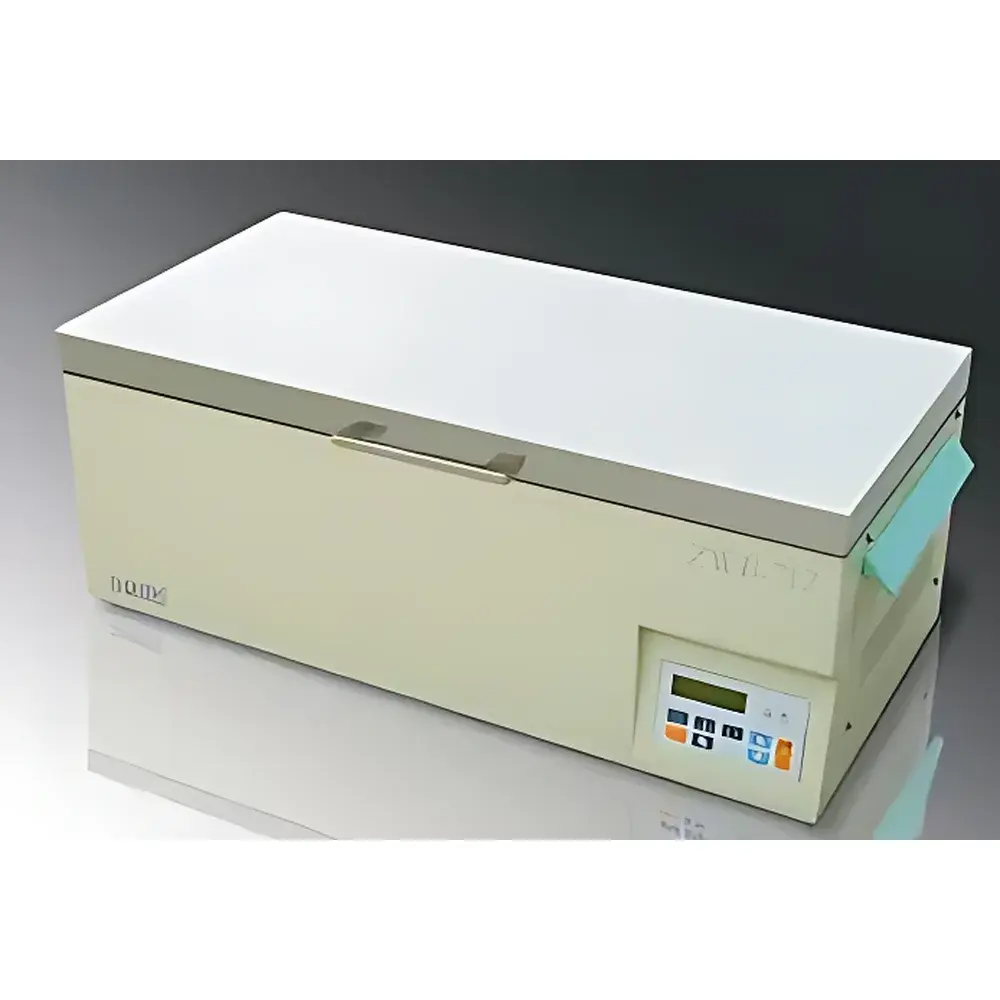
ZSXH-618 Circulating Water Bath Incubator
| Origin | Shanghai, China |
|---|---|
| Manufacturer Type | Authorized Distributor |
| Origin Category | Domestic (China) |
| Model | ZSXH-618 |
| Quotation | Upon Request |
| Temperature Range | Ambient to 65 °C |
| Temperature Stability | ±0.1 °C |
| Chamber Volume | 18 L |
| Interior Dimensions (W×D×H) | 350 × 300 × 175 mm |
| Exterior Dimensions (W×D×H) | 605 × 375 × 270 mm |
| Bath Medium | Water Only |
| Operation Mode | Continuous |
| Display | Backlit LCD |
| Circulation System | Integrated Pump |
| Power Consumption | 1500 W |
| Low-Level & Dry-Burn Protection | Yes |
| Timer Range | Up to 100 h |
| Parameter Lock & Memory Function | Yes |
| Alarm Type | Audible/Visual (Over-Temp, Low-Water) |
Overview
The ZSXH-618 Circulating Water Bath Incubator is an engineered thermal management platform designed for precise, stable, and reproducible temperature control in life science and bioengineering laboratories. It operates on the principle of forced convection via an integrated circulation pump, ensuring uniform thermal distribution throughout the 18 L water-filled chamber—critical for applications requiring minimal spatial temperature gradients (±0.1 °C stability at setpoint). Unlike static water baths, the ZSXH-618 maintains dynamic thermal equilibrium by continuously recirculating heated water across the bath volume, minimizing stratification and enhancing heat transfer efficiency to immersed vessels or external equipment (e.g., viscometers, reaction blocks, or cell culture accessories). Its operational range spans ambient temperature to 65 °C, making it suitable for enzyme assays, DNA hybridization, reagent pre-warming, and incubation of temperature-sensitive biological samples where oil-free, non-hazardous thermal environments are mandated.
Key Features
- Microprocessor-controlled PID temperature regulation with real-time feedback from a high-resolution platinum resistance sensor (PT100-class equivalent), delivering ±0.1 °C thermal stability under steady-state conditions.
- Backlit LCD interface with dual-line display showing both setpoint and real-time bath temperature; intuitive icon-based navigation enables rapid parameter entry without training dependency.
- Integrated circulation pump with adjustable flow rate ensures homogeneous temperature distribution and supports external recirculation loops for jacketed reactors or analytical instrumentation.
- Dual safety architecture: hardware-level low-water level detection coupled with thermal cut-off protection prevents dry-burn events and extends heater lifespan.
- Power-loss recovery function automatically resumes prior operating conditions—including setpoint, timer status, and circulation mode—upon grid power restoration, preserving experimental continuity.
- User-configurable parameter lock prevents accidental modification during shared-lab use; all active settings—including timer duration, temperature setpoint, and alarm thresholds—are retained in non-volatile memory after shutdown.
Sample Compatibility & Compliance
The ZSXH-618 accommodates standard laboratory glassware including beakers (up to 1000 mL), test tubes, flasks, and custom immersion fixtures within its 350 × 300 × 175 mm stainless-steel interior chamber. The unit complies with IEC 61010-1:2010 safety standards for electrical equipment used in laboratory environments and meets CE marking requirements for electromagnetic compatibility (EMC) and low-voltage directive (LVD) conformity. While not certified for GMP or GLP-regulated production environments out-of-the-box, its parameter logging capability (via optional RS232/USB interface), audit-trail-ready operation log, and deterministic thermal response support alignment with FDA 21 CFR Part 11–aligned data integrity practices when integrated into validated workflows.
Software & Data Management
The ZSXH-618 operates as a standalone instrument with embedded firmware supporting local parameter storage, event logging (e.g., alarm triggers, power interruptions), and time-stamped operational history. Optional serial communication (RS232 or USB-to-serial adapter) enables integration with third-party lab information management systems (LIMS) or SCADA platforms for remote monitoring, automated data capture, and centralized calibration record maintenance. Firmware updates are delivered via secure vendor portal and require authenticated access—ensuring traceability and version control per ISO/IEC 17025 clause 5.9.2.
Applications
- Enzyme kinetics studies requiring strict thermal consistency across replicate reactions.
- Pre-incubation of restriction enzymes, ligases, and PCR master mixes prior to thermocycling.
- Controlled solubilization of hydrophobic compounds in aqueous buffers for formulation development.
- Temperature equilibration of optical cuvettes, spectrophotometer cells, and rheometer sample holders.
- Supporting role in bioreactor temperature control loops via external jacketed circulation.
- Calibration verification of contact thermometers and RTDs against NIST-traceable references.
FAQ
Does the ZSXH-618 support external temperature probes for sample-specific monitoring?
Yes—via optional analog voltage output (0–5 V) or digital RS232 interface, enabling synchronization with external Pt100 or thermistor probes placed directly in the sample vessel.
Can the unit maintain temperature stability during extended overnight runs?
Yes—its continuous-duty heating system, thermal mass optimization, and predictive PID algorithm ensure uninterrupted operation up to the full 100-hour timer limit with no observed drift beyond ±0.1 °C.
Is deionized water mandatory for operation?
While not strictly required, use of deionized or distilled water is strongly recommended to prevent mineral scaling on the heating element and circulation pump impeller, thereby maintaining long-term thermal accuracy and service interval integrity.
What is the maximum permissible ambient temperature for safe operation?
The unit is rated for ambient temperatures between 15 °C and 35 °C and relative humidity ≤80% non-condensing; operation outside this range may affect cooling efficiency and sensor calibration stability.
How frequently should calibration verification be performed?
Per ISO/IEC 17025 guidelines, periodic verification using a NIST-traceable reference thermometer is recommended every 6 months—or before critical experiments—especially following transport, mechanical shock, or extended idle periods.