
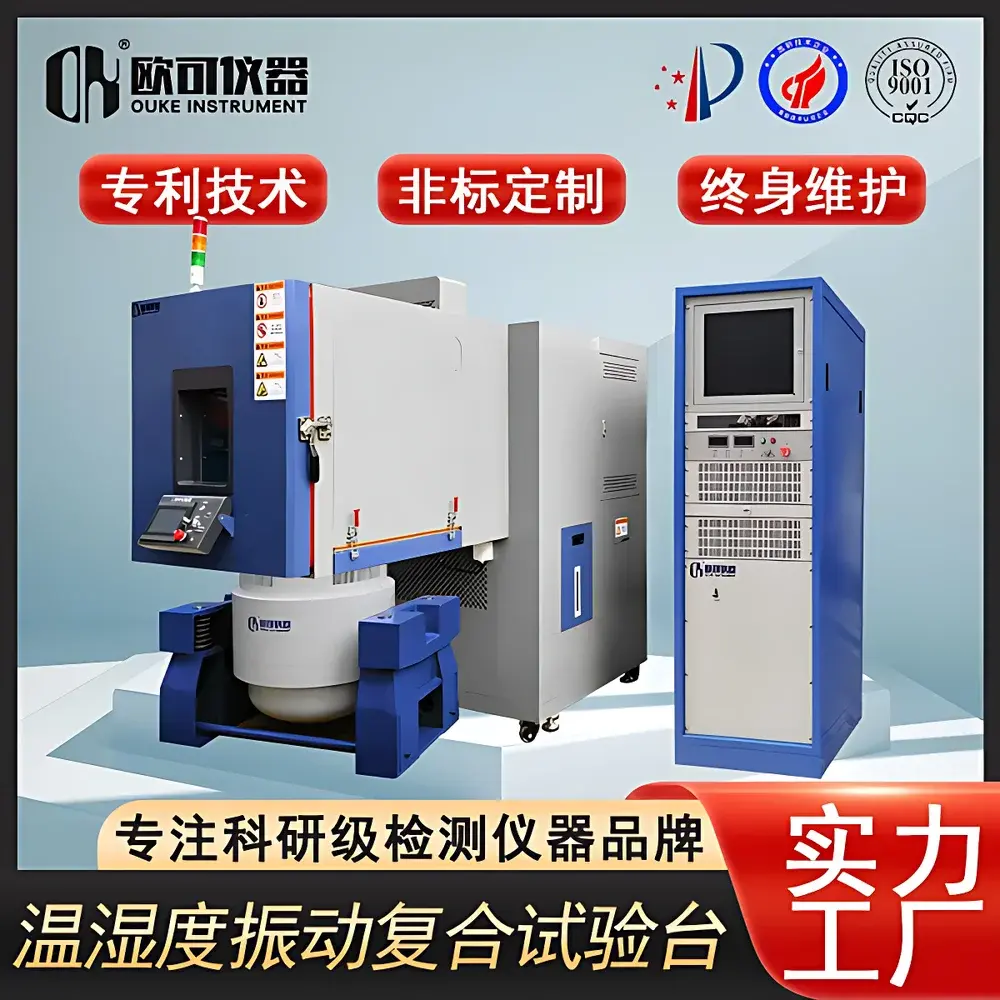
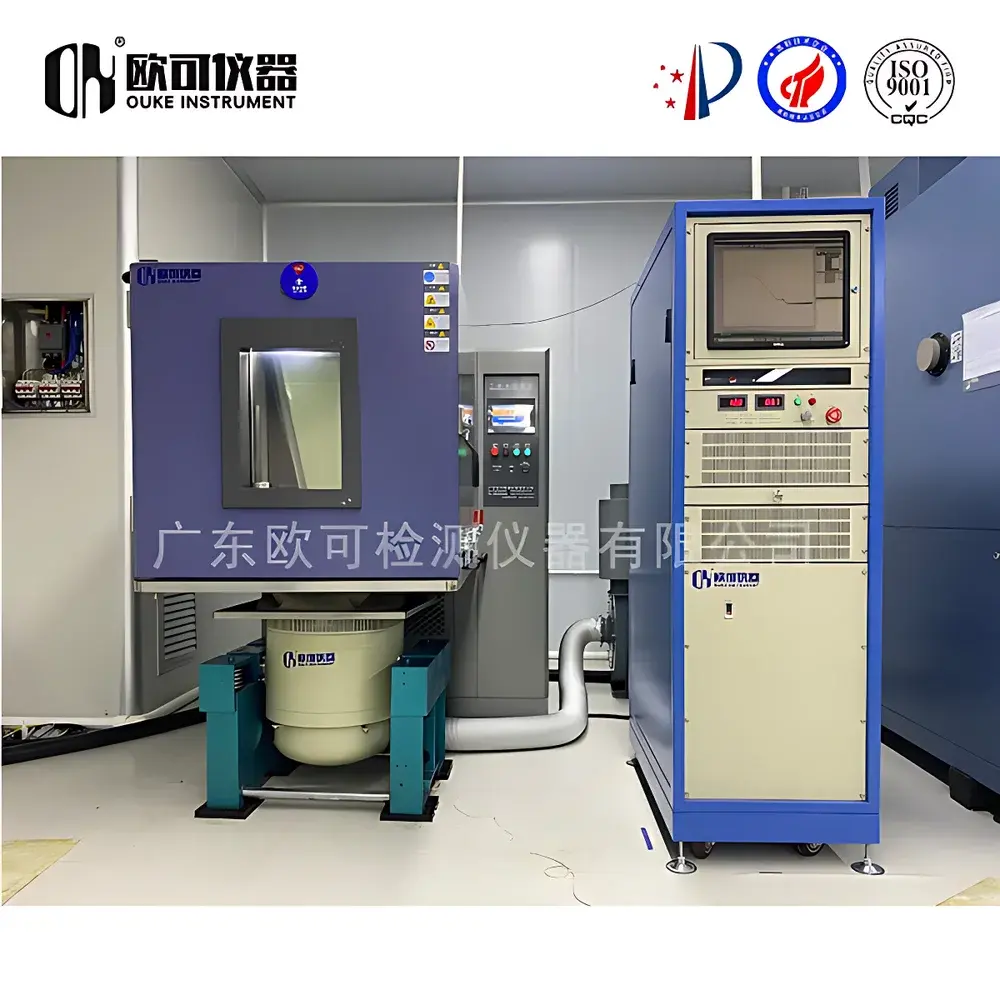
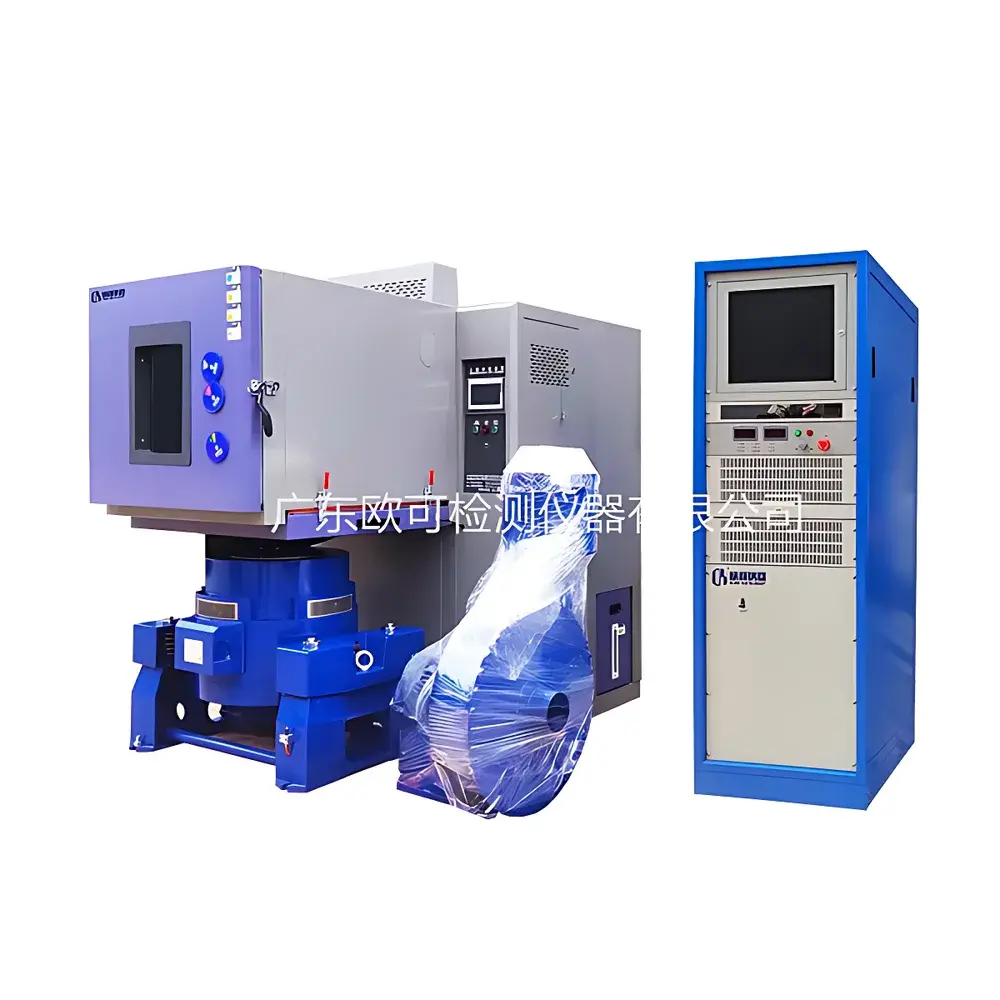
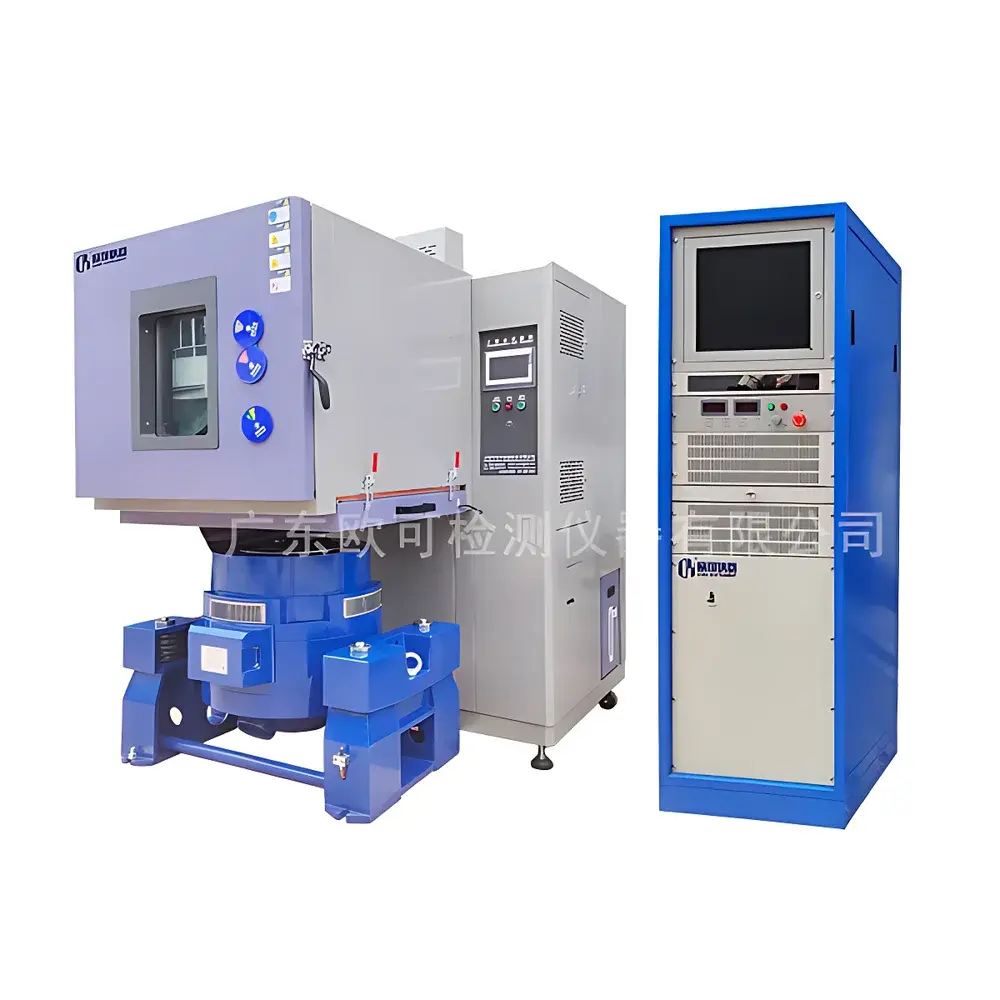
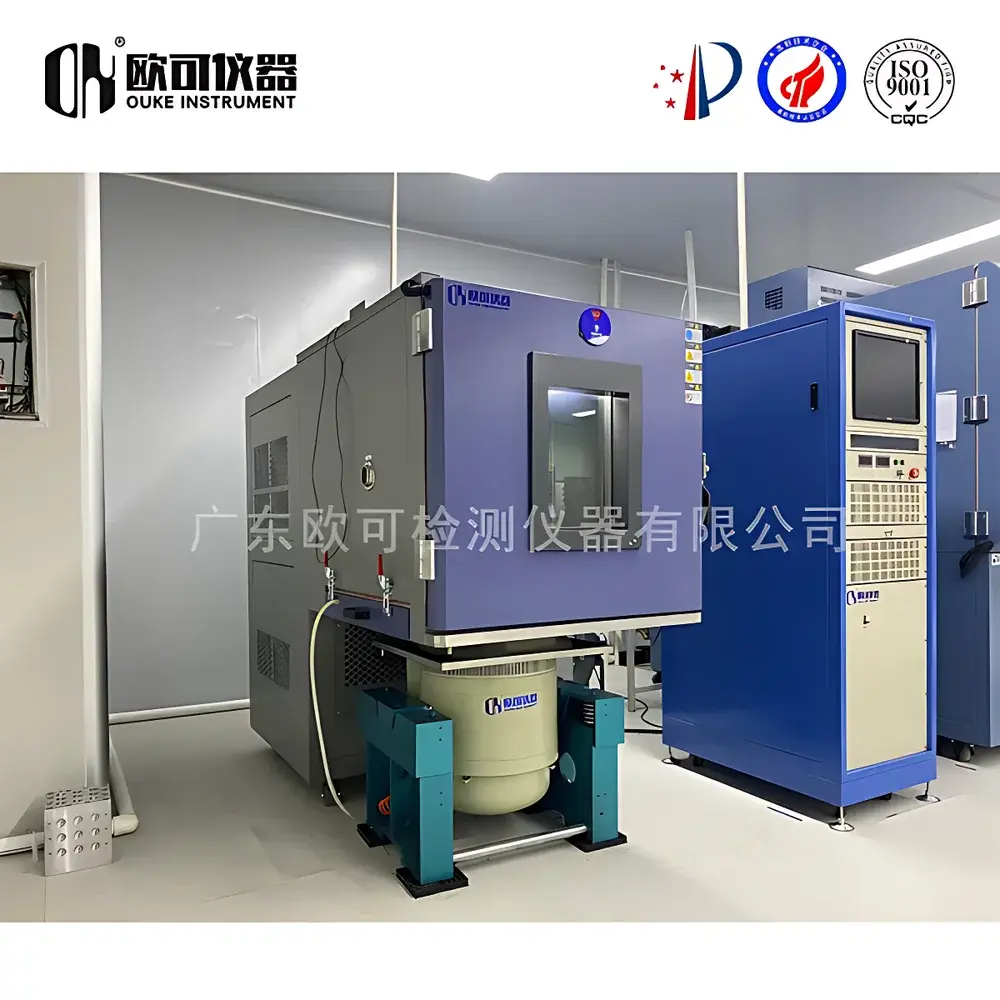
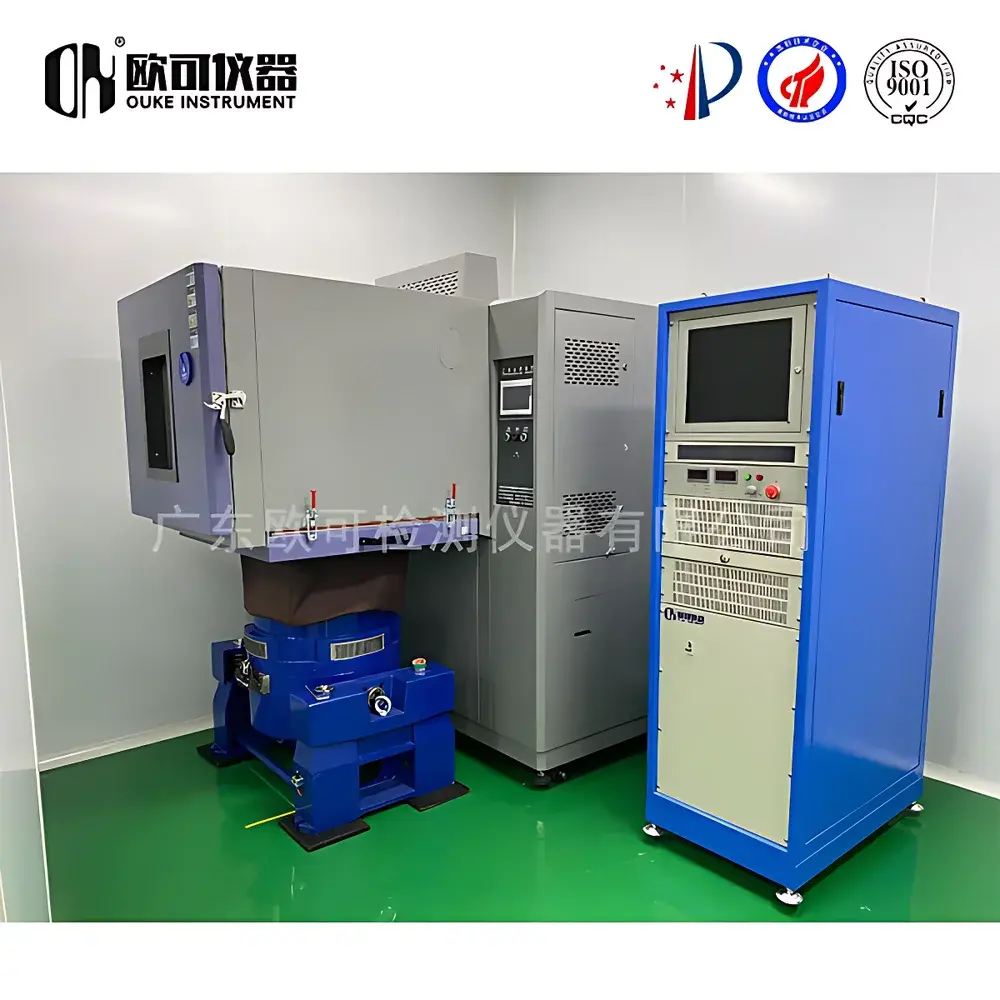
OK-ZTH-1000.0000 Combined Temperature, Humidity and Vibration Environmental Test Chamber
| Brand | OK Instruments |
|---|---|
| Origin | Guangdong, China |
| Manufacturer Type | Direct Manufacturer |
| Country of Origin | China |
| Model | OK-ZTH-1000.0000 |
| Temperature Range | −70 °C to +150 °C |
| Humidity Range | 20–98 %RH at 20–85 °C |
| Temperature Ramp Rate | 5 / 10 / 15 °C/min |
| Temperature Uniformity | ≤ ±0.5 °C |
| Standard Load Capacity | 15 kg aluminum mass (350 W thermal dissipation) |
Overview
The OK-ZTH-1000.0000 Combined Temperature, Humidity and Vibration Environmental Test Chamber is an engineered platform for accelerated environmental reliability assessment under synchronized multi-stress conditions. It integrates three fundamental physical stress domains—thermal (controlled temperature), hygric (regulated relative humidity), and mechanical (electrodynamic vibration)—within a single, dynamically sealed test volume. Unlike sequential or single-factor environmental testing, this system operates on the principle of concurrent stress application, grounded in the physics of coupled degradation mechanisms: thermal expansion/contraction induces microstructural strain; moisture ingress follows capillary action along thermally activated diffusion pathways; and mechanical vibration accelerates crack propagation at stress-concentrated interfaces. This triaxial coupling replicates real-world operational environments where products experience overlapping stresses—e.g., automotive ECUs operating under desert heat while mounted on vibrating chassis, or avionics subjected to rapid altitude-driven thermal transients and turbulent aerodynamic excitation. The chamber’s architecture adheres to the foundational tenets of environmental engineering per MIL-STD-810H, IEC 60068-2 series, and ISO 16750-4, enabling qualification-level testing aligned with design verification, production screening, and failure mode analysis.
Key Features
- Triple-domain synchronization engine: Independent yet time-synchronized control of temperature, humidity, and vibration profiles via a deterministic real-time OS, supporting phase-locked modulation (e.g., random vibration applied only during high-humidity dwell segments).
- Structurally reinforced test chamber: Welded stainless-steel inner chamber with reinforced mounting frame, designed to withstand continuous 0.5–2000 Hz vibration without resonant amplification or fatigue-induced leakage.
- Dynamic sealing system: Dual-lip silicone door gasket with pressure-compensated compression, plus vibration-damped cable feedthroughs rated for IP54 integrity under 5 gRMS broadband excitation.
- Thermal-vibration decoupling: Floating vibration table isolated from chamber base via constrained-layer damping mounts; active thermal shielding minimizes conduction from shaker coil to conditioned air space.
- High-fidelity climate control: PID-controlled refrigeration/heating subsystem with cascade compressor staging, ultrasonic humidifier with deionized water recirculation, and dew-point referenced RH sensing calibrated per ISO 12048.
- Integrated data acquisition interface: 16-channel analog input module (±10 V, 16-bit resolution) for real-time monitoring of DUT telemetry (voltage, current, thermocouple, digital I/O) synchronized to test profile timestamps.
Sample Compatibility & Compliance
The OK-ZTH-1000.0000 accommodates samples up to 15 kg mass with maximum power dissipation of 350 W, using standardized aluminum reference masses for thermal load validation. Sample mounting employs non-resonant T-slot fixtures compatible with MIL-STD-1377 compliant vibration tables. All operational parameters meet traceable calibration requirements per ISO/IEC 17025-accredited procedures. The system supports test execution under regulatory frameworks including AEC-Q200 for automotive electronics, DO-160 Section 25 for airborne equipment, and IEC 60721-3-3 for Class 3K3/3Z2 environmental classifications. Full audit trail generation—including parameter setpoints, actual chamber readings, vibration PSD spectra, and user actions—is maintained in accordance with FDA 21 CFR Part 11 and EU Annex 11 data integrity principles.
Software & Data Management
Control and analysis are executed via OK-EnviroSuite™ v4.2—a Windows-based application built on .NET Framework with deterministic thread scheduling. The software enables graphical programming of complex test sequences: nested loops, conditional branching (e.g., “if DUT voltage drop >5% during 85 °C/85%RH + 1.2 gRMS segment, trigger abort”), and cross-domain triggers (e.g., initiate vibration sweep upon reaching target dew point). All raw sensor data—including chamber air temperature/humidity, shaker armature displacement/acceleration, and user-defined DUT channels—are logged at configurable rates (up to 10 kHz) into encrypted SQLite databases with SHA-256 hash integrity verification. Export formats include CSV, MATLAB .mat, and ASAM MDF4 for downstream FMEA correlation and Weibull life modeling.
Applications
- Automotive: Validation of ADAS sensors, battery management systems, and infotainment units under combined thermal cycling, road-induced vibration, and condensation-prone humidity exposure—mirroring real-world durability requirements per GMW14872 and Ford CETP 00.00-L-467.
- Aerospace & Defense: Mission-profile simulation for UAV flight controllers across ground soak (40 °C/60%RH), climb (−40 °C, low RH), cruise (−55 °C, turbulence-induced random vibration), and descent phases.
- Consumer Electronics: Reliability screening of wearables and mobile devices under body-heat-induced thermal gradients, perspiration-level humidity, and walking-induced mechanical shock/vibration.
- Medical Devices: Verification of implantable device hermeticity and connector integrity under simulated transport (cold chain + road vibration) and clinical use (body temperature + motion artifacts).
- Packaging Engineering: Assessment of sterile barrier integrity for pharmaceutical secondary packaging exposed to maritime transit conditions (35 °C/95%RH + 2–5 Hz sinusoidal vibration).
FAQ
What standards does the OK-ZTH-1000.0000 comply with for environmental testing?
It supports test execution per MIL-STD-810H Methods 502.7 (temperature), 507.6 (humidity), and 514.7 (vibration), as well as IEC 60068-2-14 (thermal shock), -2-78 (damp heat), and -6 (vibration). Calibration traceability follows ISO/IEC 17025.
Can the system perform HALT-like profiles?
No—it is designed for environment-representative testing, not accelerated stress screening. For HALT/HASS applications, OK Instruments offers dedicated high-gradient thermal shakers with non-humidified chambers.
Is remote monitoring and alarm notification supported?
Yes. SNMPv3 and MQTT 3.1.1 interfaces enable integration with enterprise SCADA and CMMS platforms. Email/SMS alerts trigger on deviation thresholds, safety interlock activation, or scheduled maintenance windows.
How is vibration isolation achieved without compromising thermal stability?
A dual-stage isolation system combines passive constrained-layer mounts (for low-frequency energy absorption) and active pneumatic leveling (for sub-Hz drift correction), maintaining thermal uniformity within ±0.5 °C even at full 5 gRMS output.
Does the system support third-party DUT power supplies and signal analyzers?
Yes. The chamber includes 4x isolated 230 VAC/16 A feedthroughs and 8x shielded SMA coaxial ports with EMI-filtered grounding, all rated for operation across the full temperature/humidity envelope.
Related Products



