
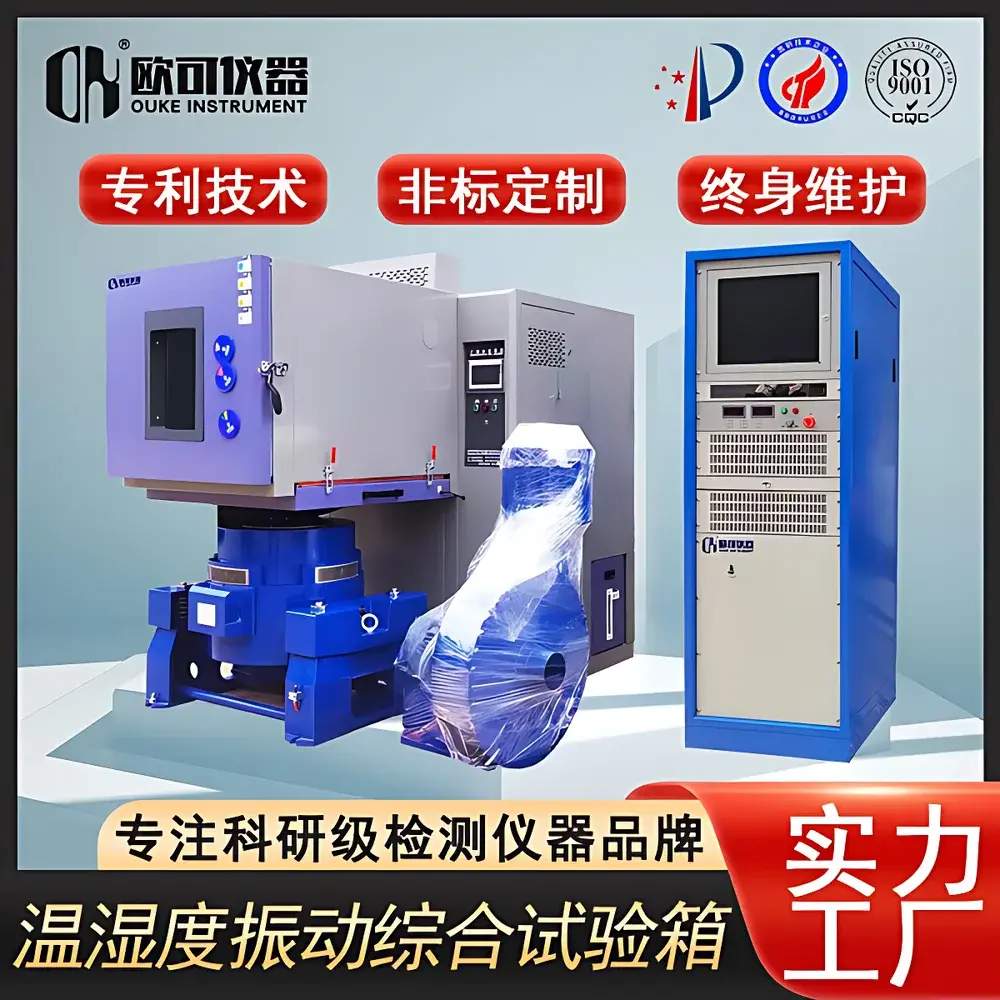
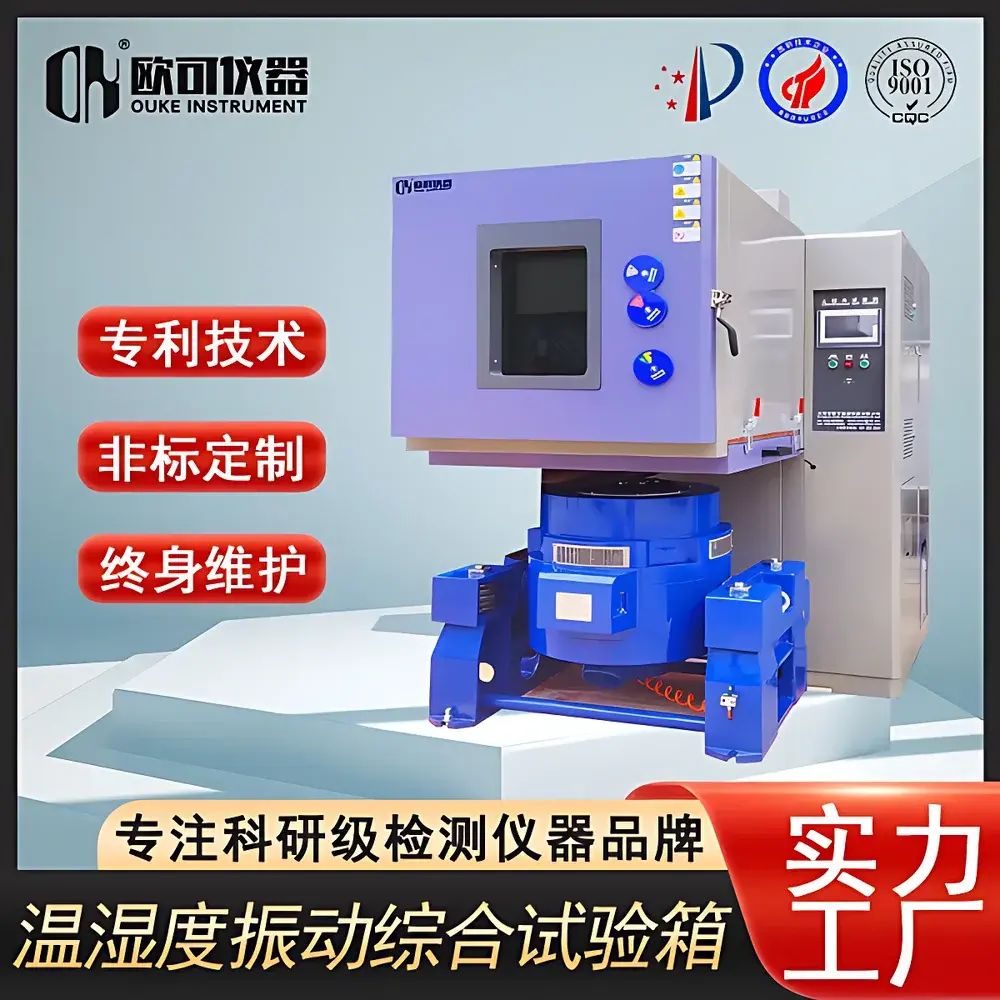
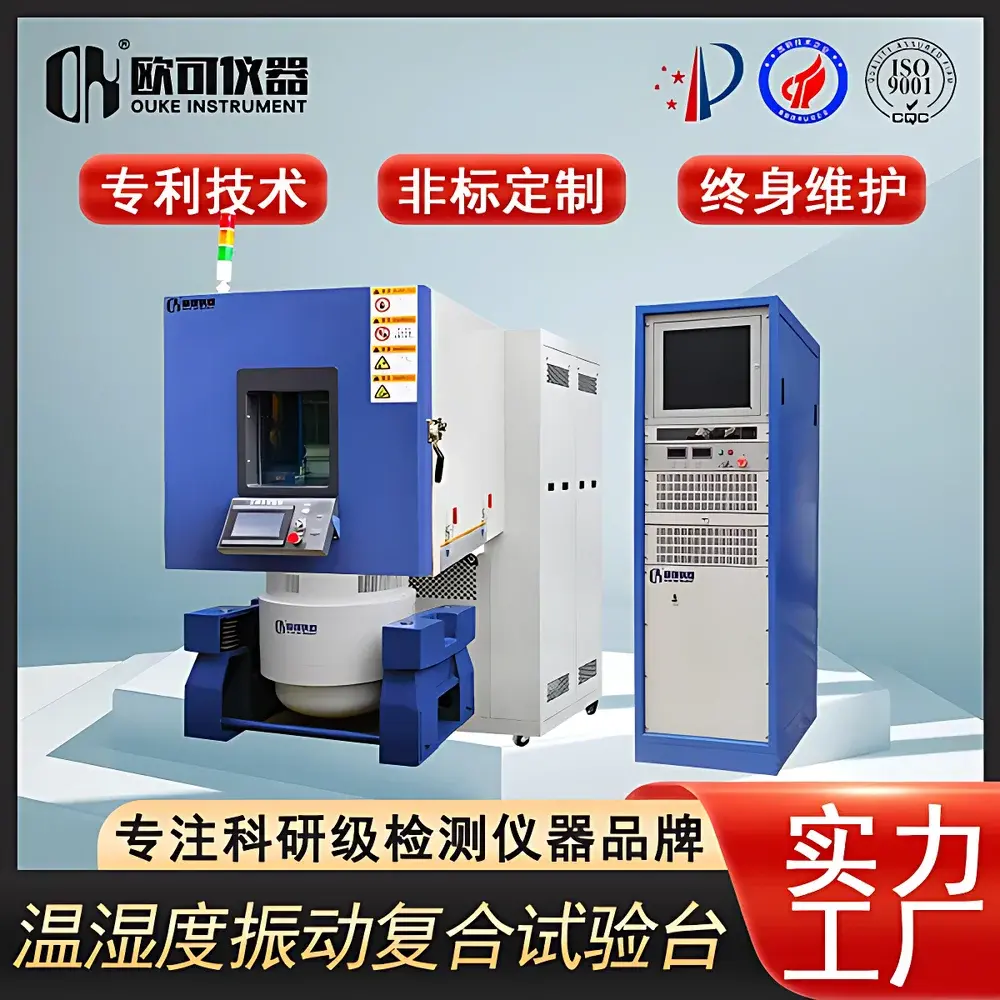
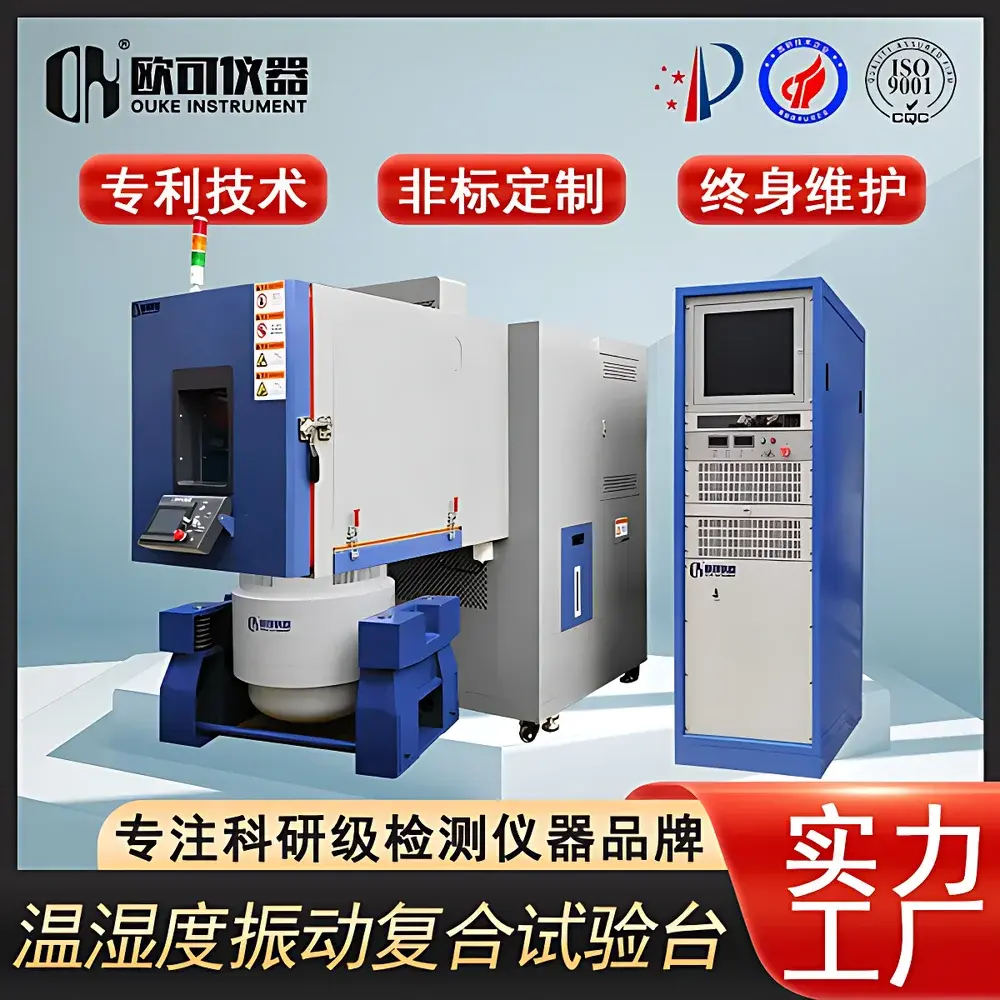
OK-ZTH-1000 Combined Temperature-Humidity-Vibration Test System
| Brand | OK Instruments |
|---|---|
| Origin | Guangdong, China |
| Manufacturer Type | OEM/ODM Manufacturer |
| Product Origin | Domestic (China) |
| Model | OK-ZTH-1000 |
| Temperature Range | −70 °C to +150 °C |
| Humidity Range | 20–98 %RH at 20–85 °C |
| Temperature Ramp Rate | 5 / 10 / 15 °C/min |
| Temperature Uniformity | ≤ ±0.5 °C |
| Standard Load Capacity | 15 kg aluminum mass block |
Overview
The OK-ZTH-1000 Combined Temperature-Humidity-Vibration Test System is an integrated environmental reliability test platform engineered for simultaneous application of thermal, hygric, and mechanical (vibrational) stress profiles. It operates on the principle of coupled multi-stress acceleration—where temperature and humidity are precisely controlled within a vibration-isolated, structurally reinforced climatic chamber, while a high-fidelity electrodynamic shaker delivers programmable sinusoidal, random, shock, or time-history (road-spectrum) excitation directly to the test specimen mounted on the shaker table. This architecture enables replication of real-world service environments such as automotive under-hood thermal cycling with road-induced vibration, aerospace component storage in humid tropical conditions followed by launch-stage shake, or electronic assembly qualification under combined thermal expansion, moisture ingress, and resonant fatigue. Unlike standalone vibration tables or climate chambers, the OK-ZTH-1000 ensures temporal synchronization of all three stress domains—critical for evaluating stress interaction effects including thermally induced resonance shifts, humidity-accelerated fretting corrosion under oscillatory loading, and hygrothermal degradation of damping interfaces.
Key Features
- Electrodynamic shaker system with closed-loop force feedback control, supporting frequency ranges from 5 Hz to 3000 Hz and peak acceleration up to 100 g (configurable per model variant)
- Hermetically sealed, vibration-damped climatic chamber constructed from stainless steel 304 inner walls and polyurethane-insulated double-wall structure, rated for continuous operation under dynamic load
- High-accuracy PID-controlled refrigeration/heating system using cascade two-stage compressor technology for stable low-temperature performance down to −70 °C
- Steam-based humidification and desiccant-assisted dehumidification subsystems enabling precise RH control across the full operating temperature span
- Integrated tri-domain controller with deterministic real-time OS, supporting synchronized ramp-hold-soak-vibration sequences with sub-second timestamp alignment across temperature, humidity, and acceleration channels
- Comprehensive safety interlock architecture compliant with IEC 61000-4-27 and ISO 16750-4: door lock verification, over-temperature/over-humidity cutoff, shaker overtravel limit detection, and emergency stop cascade with hardware-level signal isolation
Sample Compatibility & Compliance
The OK-ZTH-1000 accommodates test specimens up to 15 kg mass on standard aluminum fixture plates, with optional custom interface plates available for aerospace fasteners, automotive ECUs, or PCB assemblies. Chamber internal dimensions allow for DUT mounting configurations compatible with MIL-STD-810H Method 514.7 (vibration), Method 502.7 (temperature), and Method 507.6 (humidity) test protocols. The system supports configuration for GLP/GMP-compliant validation per ASTM E2582-21 (standard practice for vibration testing of medical devices) and ISO 16750-3 (electrical and electronic equipment for road vehicles). Data logging meets FDA 21 CFR Part 11 requirements when used with validated software version (OK-TestSuite v4.2+), including electronic signatures, audit trail, and immutable raw data archiving.
Software & Data Management
OK-TestSuite is the native control and analysis platform, built on a deterministic Linux RT kernel with dual-channel analog I/O for real-time sensor monitoring (accelerometer, PT100, capacitive RH). It provides graphical test profile editors for multi-step composite tests—including conditional branching (e.g., “initiate random vibration only if chamber temperature reaches 85 °C ± 2 °C”), harmonic tracking sweeps across temperature ramps, and failure-triggered abort logic. All measurement data is stored in HDF5 format with embedded metadata (test ID, operator, calibration certificate IDs, environmental setpoints, shaker drive signals). Export modules support CSV, MATLAB .mat, and ASAM MDF 4.1 for integration into enterprise PLM or reliability databases. Remote monitoring via TLS-secured HTTPS API enables integration with factory MES systems.
Applications
- Aerospace: Qualification of avionics enclosures under combined thermal vacuum simulation (via optional low-pressure module), humidity soak, and launch vibration spectra
- Automotive: Validation of ADAS camera modules for condensation resistance during cold-start thermal shock combined with engine-bay vibration harmonics
- Consumer Electronics: Accelerated life testing of flexible printed circuits subjected to repeated thermal cycling (−40 °C ↔ +85 °C) with concurrent 10–2000 Hz random vibration to simulate drop-and-transport scenarios
- Energy Storage: Evaluation of lithium-ion battery pack structural integrity and cell-to-cell impedance drift under humid high-temperature hold (60 °C/95 %RH) with 5–50 Hz sine dwell to simulate EV chassis resonance
- Industrial IoT Sensors: Long-duration burn-in of MEMS accelerometers under 85 °C/85 %RH with 0.5 g RMS random vibration to accelerate solder joint intermetallic growth and microcrack propagation
FAQ
What standards does the OK-ZTH-1000 support for compliance testing?
It is configured to execute test methods defined in MIL-STD-810H, ISO 16750-3/-4, IEC 60068-2-6/-14/-30, and GB/T 2423.10-2019, with traceable calibration certificates available for all transducers and environmental sensors.
Can the system perform independent vibration-only or climate-only tests?
Yes—the controller supports decoupled operation modes: standalone shaker control (with external temperature/humidity monitoring), standalone chamber operation, or fully synchronized tri-domain execution.
Is remote operation and data export supported for regulated industries?
Yes—OK-TestSuite v4.2+ includes 21 CFR Part 11-compliant user access controls, electronic signature workflows, and tamper-evident audit logs. Raw data exports retain full metadata for regulatory submission.
What is the maximum allowable specimen height inside the chamber during vibration?
With standard 15 kg load capacity, vertical clearance above the shaker table is 450 mm; reduced to 320 mm when using optional extended-stroke actuators for low-frequency displacement testing.
How is thermal uniformity maintained during active vibration?
Chamber airflow is dynamically modulated via variable-speed centrifugal fans synchronized to shaker acceleration phase to minimize convective disturbance, while thermal mass distribution and heater zoning ensure ≤ ±0.5 °C spatial uniformity at steady state (per ISO 16750-4 Annex B).



