
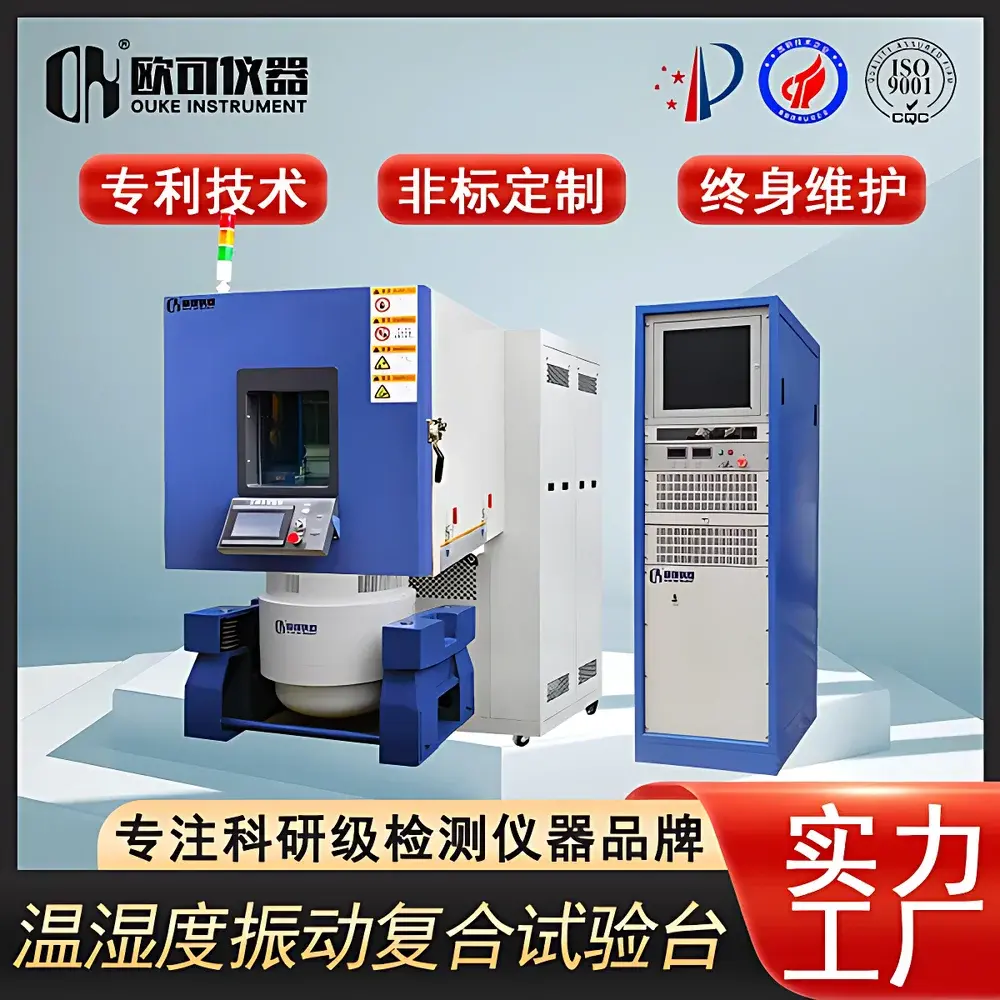
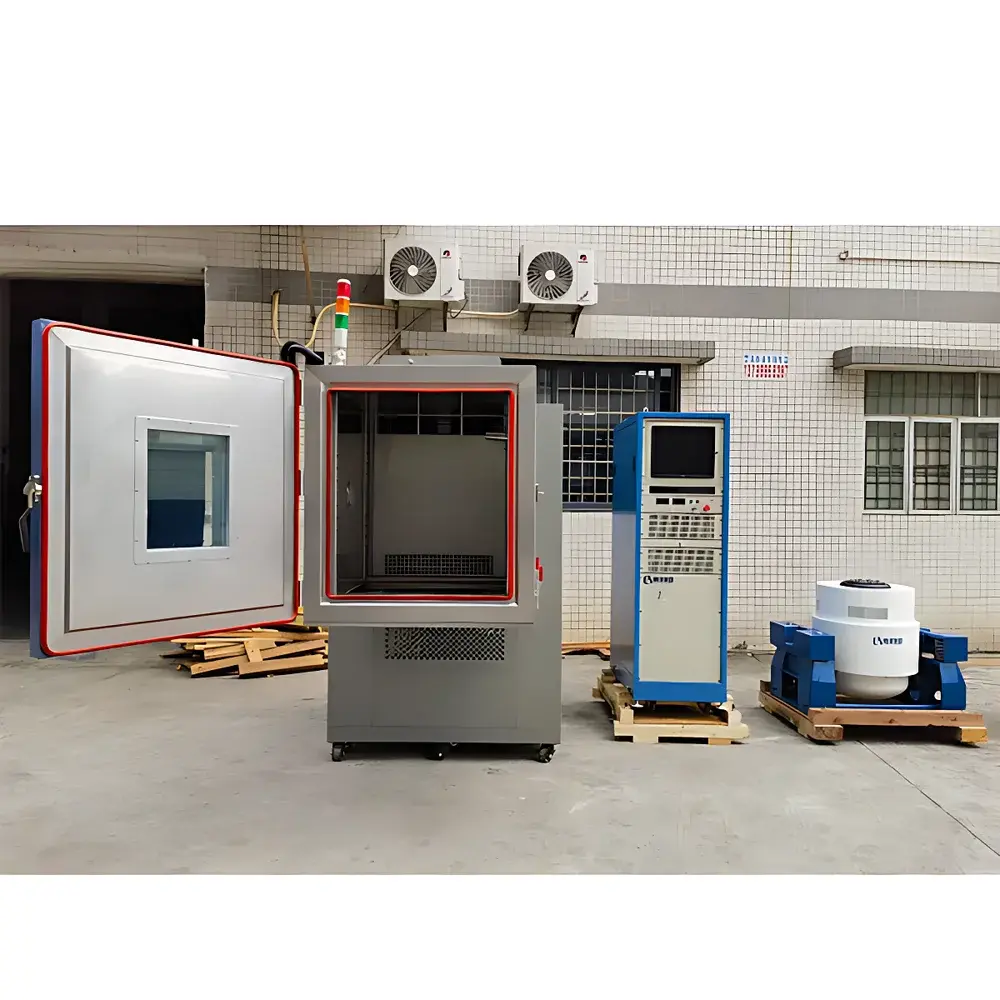
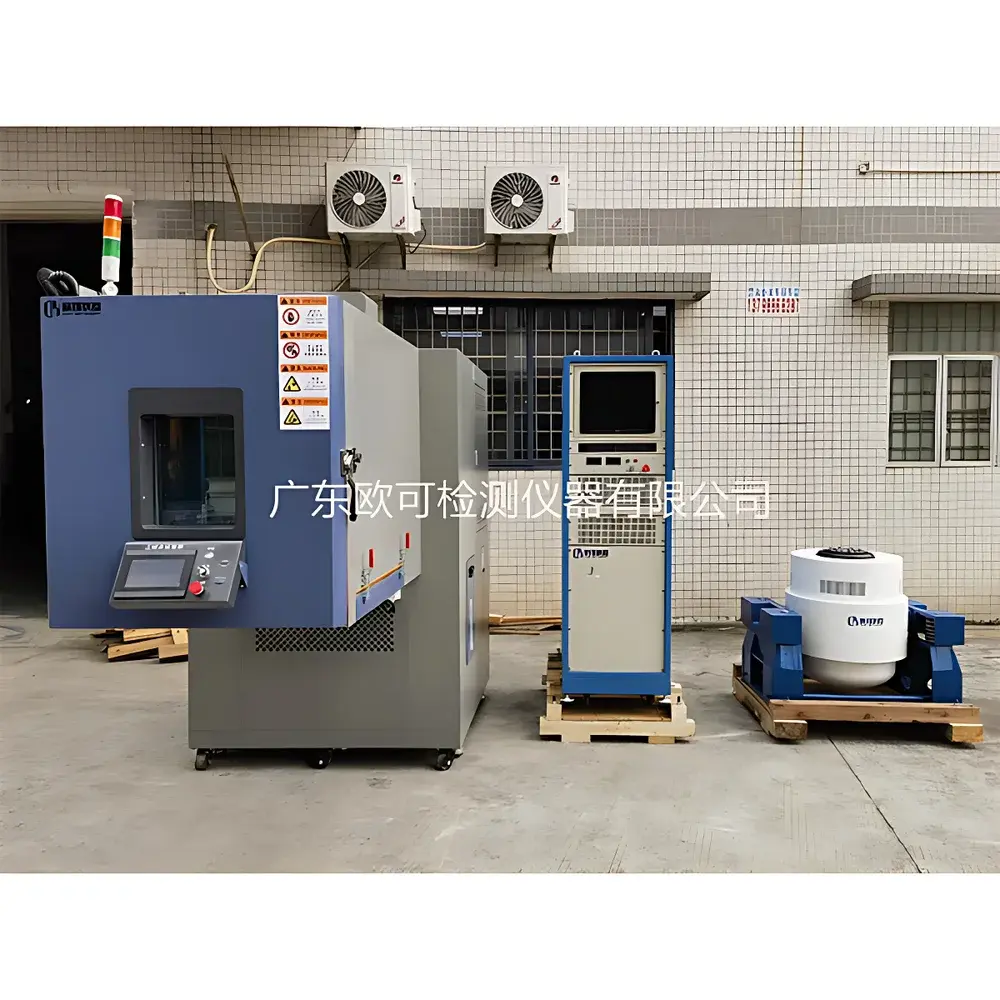
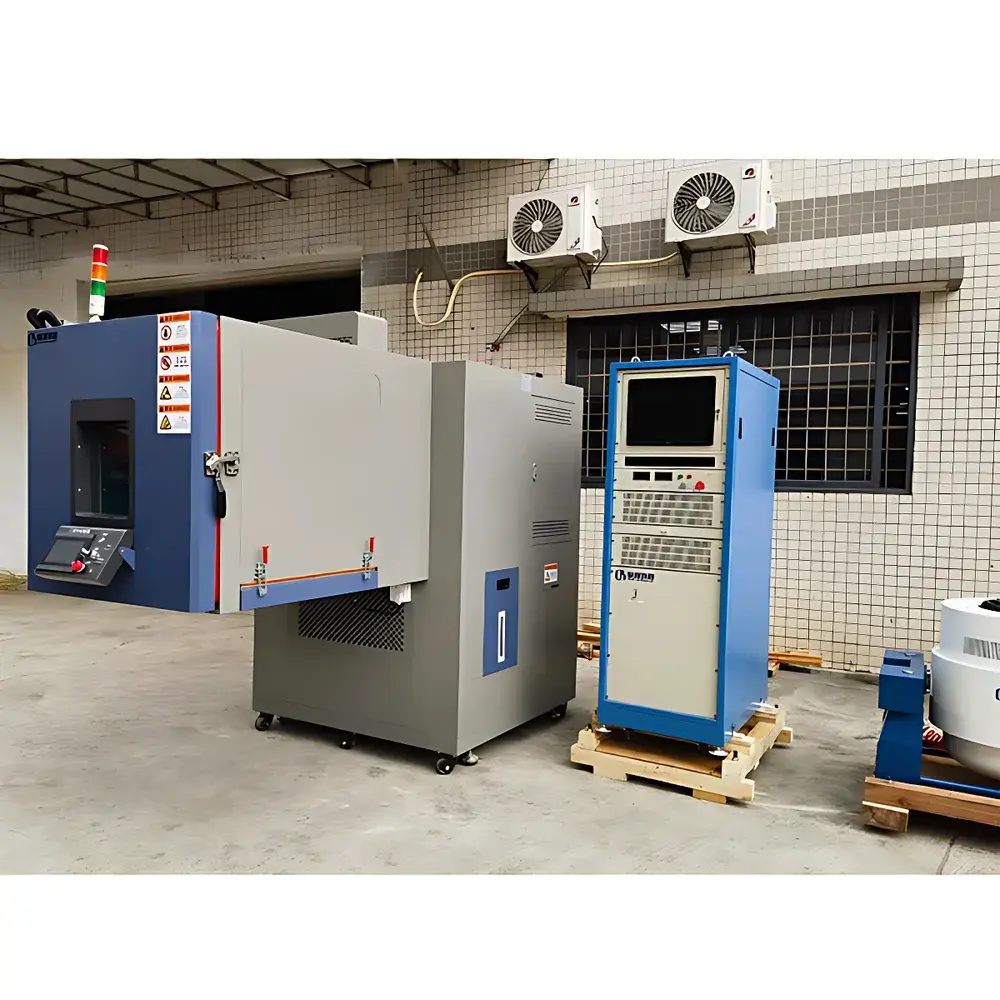
OK-ZTH-1440.22 Combined Temperature-Humidity-Vibration Test System
| Brand | OK Instruments |
|---|---|
| Origin | Guangdong, China |
| Manufacturer Type | Direct Manufacturer |
| Country of Origin | China |
| Model | OK-ZTH-1440.22 |
| Temperature Range | −70 °C to +150 °C |
| Humidity Range | 20–98 %RH at 20–85 °C |
| Temperature Ramp Rate | 5 / 10 / 15 °C/min |
| Temperature Uniformity | ≤ ±0.5 °C |
| Standard Load Capacity | 15 kg aluminum mass with 350 W heat dissipation |
Overview
The OK-ZTH-1440.22 Combined Temperature-Humidity-Vibration Test System is an integrated environmental simulation platform engineered for concurrent application of thermal, hygrothermal, and mechanical vibrational stressors. It operates on the principle of multi-stress synergy—simultaneously imposing controlled temperature gradients, relative humidity profiles, and broadband electrodynamic vibration (via Lorentz-force-driven shaker) to replicate real-world operational, transportation, and storage conditions. Unlike sequential single-stress testing, this triaxial combined chamber enables accelerated reliability assessment under coupled environmental loads—a requirement explicitly referenced in MIL-STD-810H Method 520.3 (Combined Environments), IEC 60068-2-68, and GB/T 2423.35–2019. The system supports both closed-loop vibration control and open-loop thermal/humidity regulation, with independent PID tuning per subsystem to ensure traceable, repeatable test execution across laboratory, QC, and certification environments.
Key Features
- Triple-stress integration: Simultaneous operation of temperature (-70 °C to +150 °C), humidity (20–98 %RH within 20–85 °C), and electrodynamic vibration (frequency range DC–3 kHz, max. acceleration ≥ 100 g, displacement peak-to-peak ≥ 51 mm, depending on payload).
- High-fidelity thermal performance: Programmable ramp rates of 5/10/15 °C/min with thermal uniformity ≤ ±0.5 °C across the working volume; equipped with dual-stage refrigeration, stainless-steel insulated chamber walls, and precision Pt100 sensor array.
- Dedicated vibration subsystem: OK-branded electromagnetic shaker with 22 kN force capacity, water-cooled voice coil, and integrated slip table for horizontal-axis excitation; compliant with ISO 10816-1 for vibration severity classification.
- Robust mechanical architecture: 15 kg standard load rating with 350 W internal heat dissipation capability; reinforced aluminum test table with T-slots for fixture mounting; optional seismic anchoring and safety interlock-rated enclosure.
- Modular controller interface: IEEE-488 (GPIB), Ethernet (TCP/IP), and USB 2.0 connectivity; supports third-party vibration controllers (e.g., Vibration Research VR9500, Data Physics Quattro) via analog/digital I/O and Ethernet protocols.
Sample Compatibility & Compliance
The OK-ZTH-1440.22 accommodates samples up to 15 kg mounted on standardized aluminum fixtures, with clearance dimensions optimized for PCB assemblies, automotive ECUs, avionics modules, and small mechanical subassemblies. Its chamber geometry and airflow design comply with ASTM E145 Class B requirements for thermal uniformity and IEC 60068-3-5 for humidity stability. All thermal and vibrational control algorithms are validated against NIST-traceable calibration standards. The system supports audit-ready documentation per GLP and GMP Annex 11 requirements, including electronic signatures, change control logs, and full 21 CFR Part 11-compliant data integrity features when paired with OK’s optional VTS-Manager software suite.
Software & Data Management
- VTS-Manager v3.2 (optional): Unified GUI for synchronized profile programming, real-time monitoring of temperature/humidity/vibration spectra, and automated report generation (PDF/CSV/XLSX) compliant with ISO/IEC 17025 reporting templates.
- Vibration control integration: Supports PSD synthesis, sine sweep, shock pulse generation (half-sine, trapezoidal), and time-history replay (TWR) mode for field-data reproduction—enabling direct correlation between road-test telemetry and lab validation.
- Data traceability: Full audit trail with user login timestamps, parameter change history, and raw binary acquisition buffers stored in HDF5 format; encryption-enabled export for secure transfer to external QA databases.
- Remote operation: Web-based HMI accessible via TLS 1.2-secured HTTPS; compatible with enterprise SCADA systems through OPC UA server module (add-on).
Applications
This system is routinely deployed in aerospace component qualification (e.g., satellite battery modules under thermal cycling + random vibration per ECSS-E-ST-10-03C), automotive electronics validation (ISO 16750-4 for powertrain ECUs), medical device sterilization-cycle survivability (EN 60601-1 Clause 11.1.2), and defense-grade connector endurance testing (MIL-DTL-38999 Series III). Its ability to sustain high-humidity conditions during active vibration eliminates condensation-induced failure modes often missed in sequential testing—critical for evaluating conformal coating integrity, solder joint fatigue, and MEMS package hermeticity. In R&D labs, it serves as a physical counterpart to modal analysis simulations, enabling experimental verification of finite element models under realistic boundary conditions.
FAQ
What standards does the OK-ZTH-1440.22 support for combined environment testing?
It meets the technical requirements of MIL-STD-810H Method 520.3, IEC 60068-2-68, GB/T 2423.35–2019, and ASTM D4728 for random vibration in humid thermal environments.
Can the system perform vibration-only or temperature-only tests?
Yes—each subsystem (vibration, temperature, humidity) operates independently; users may disable any two stresses while maintaining full control authority over the active channel.
Is third-party vibration controller compatibility verified?
Yes—OK provides documented interface specifications and signal-level validation reports for VR9500, Quattro, and m+p VibControl systems, including synchronization timing jitter < 100 µs.
What is the maximum allowable payload for simultaneous triple-stress operation?
The certified load limit is 15 kg at ambient temperature; derating applies above 85 °C or below -40 °C per thermal expansion and cooling capacity constraints—detailed in the System Derating Handbook (OK-TN-022).
Does the system include calibration certificates?
Each unit ships with factory calibration certificates for temperature (±0.3 °C), humidity (±2 %RH), and vibration transducer sensitivity (±1 %), all traceable to CNAS-accredited reference standards.



