
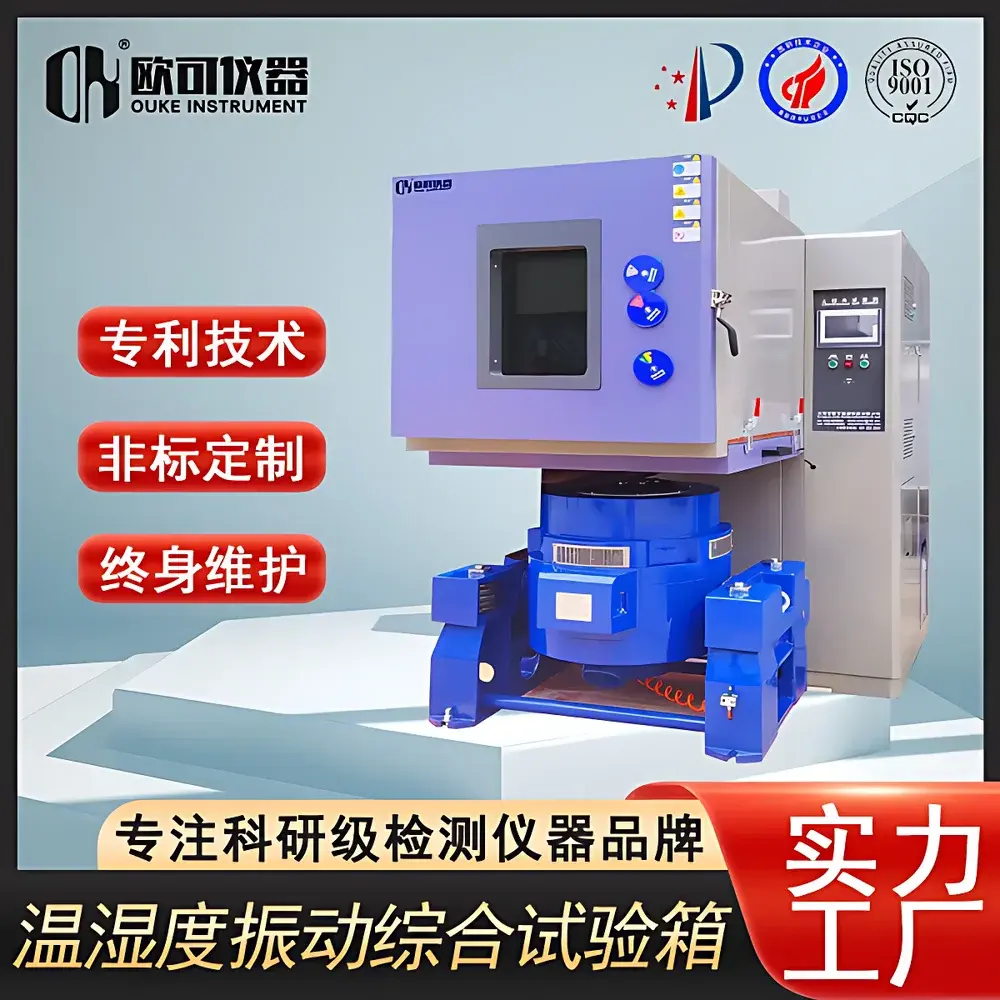
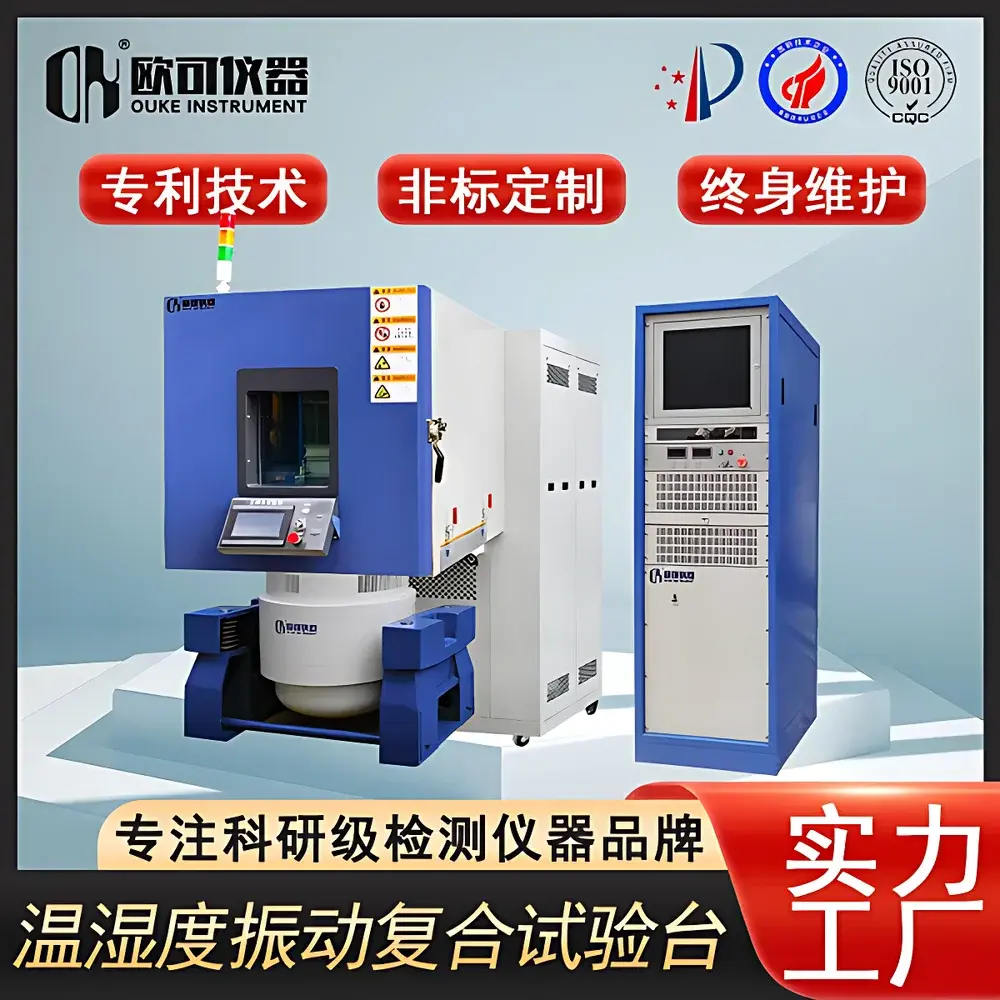
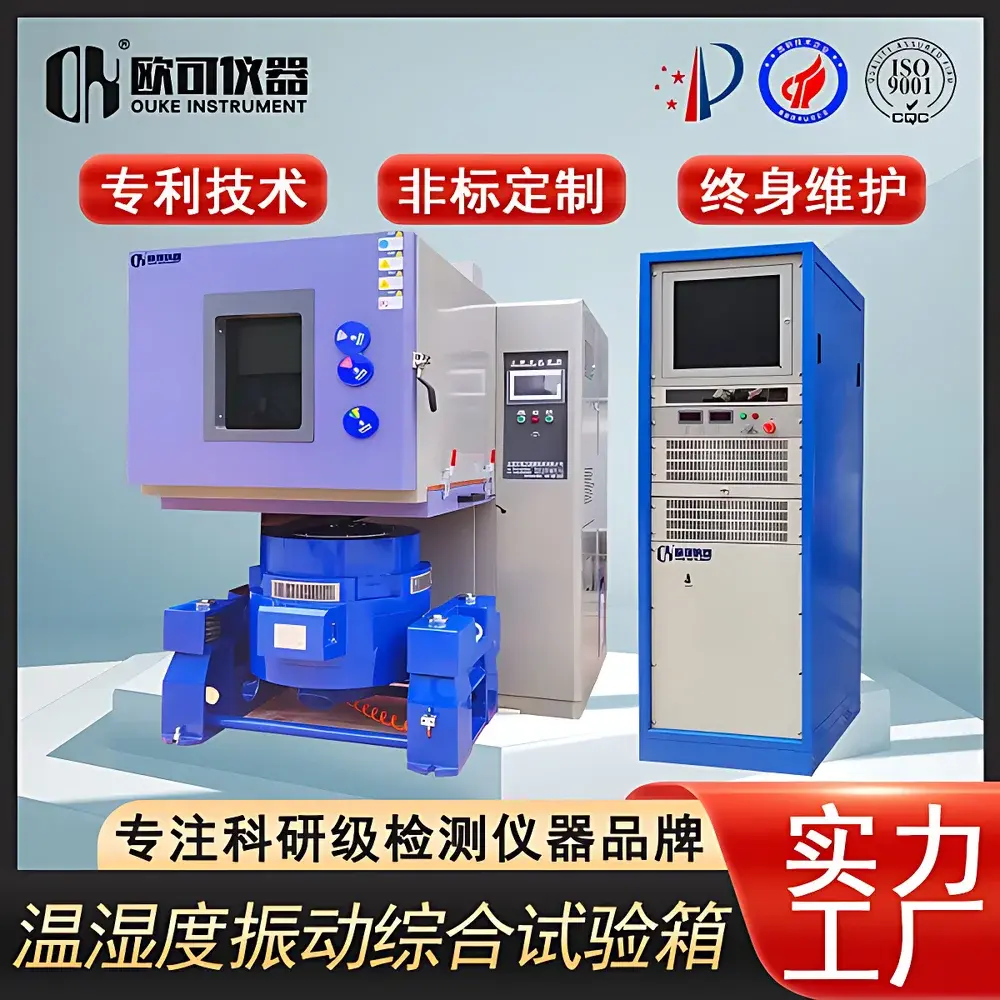
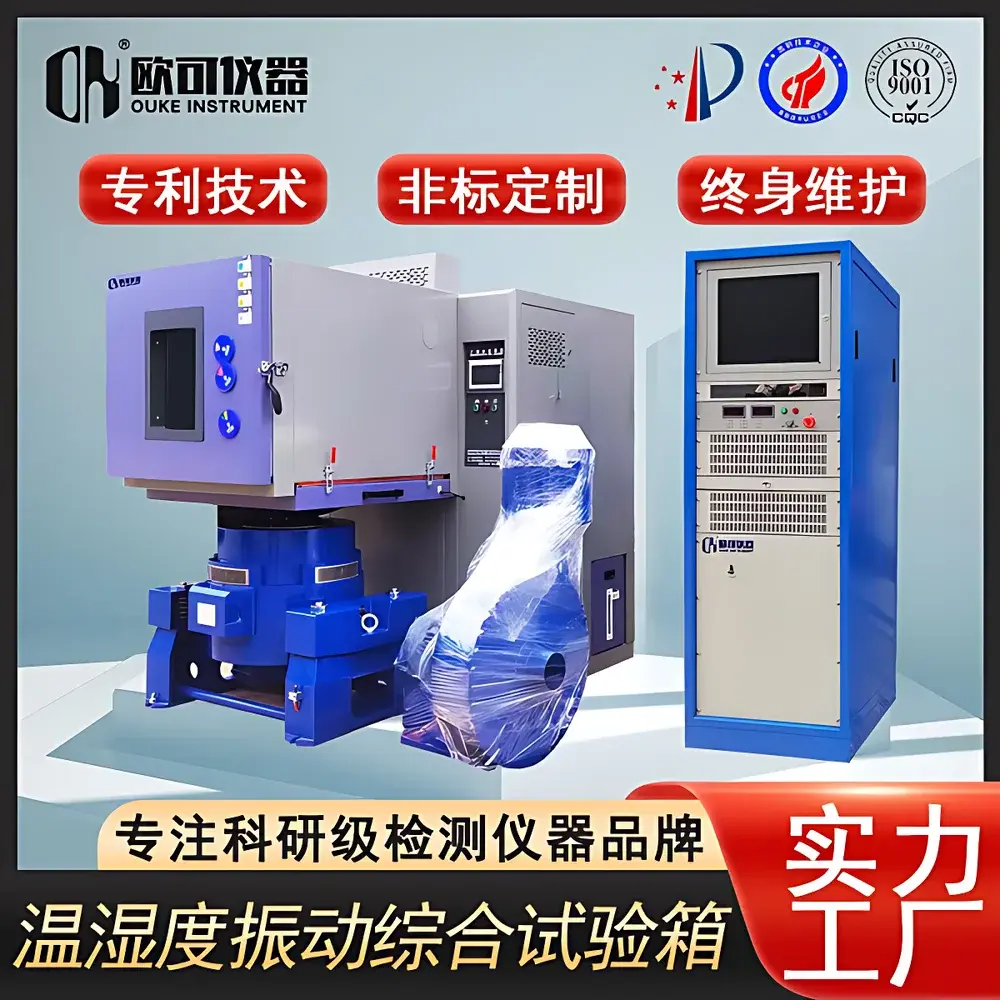
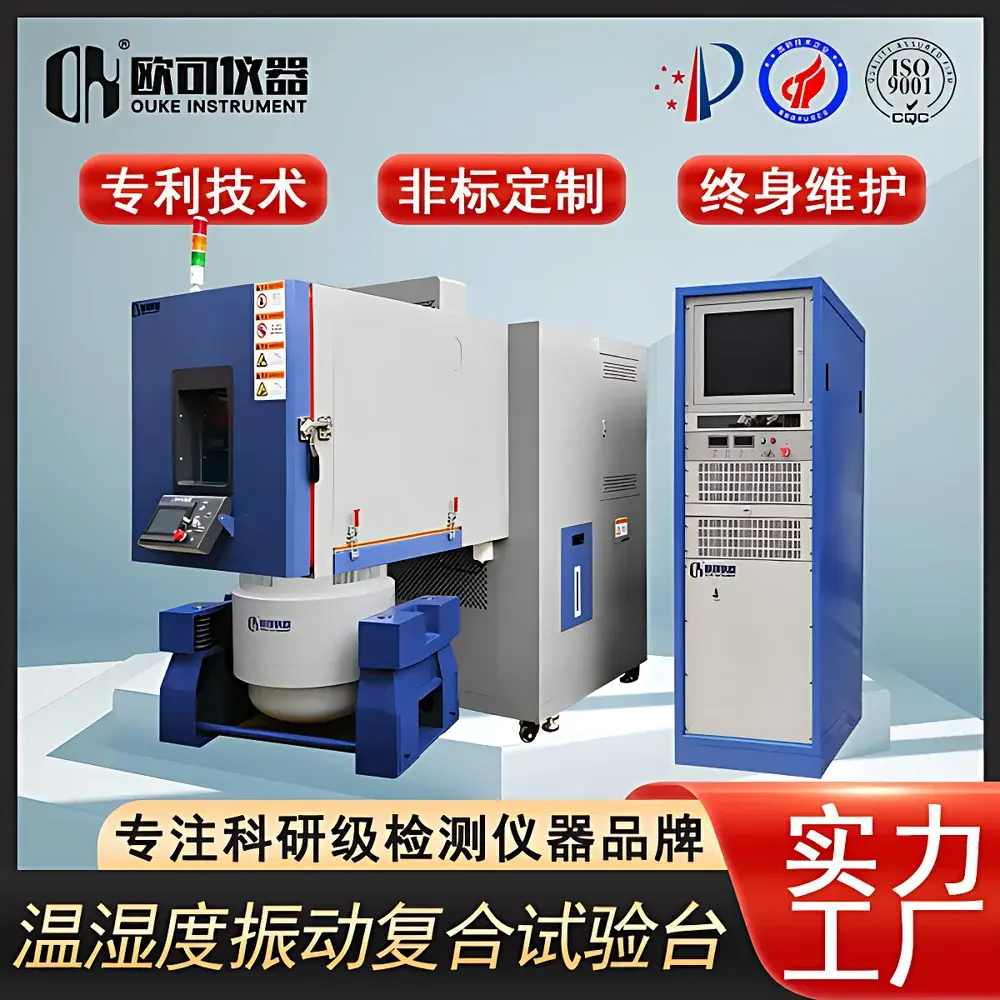
OK-ZTH-391 Combined Temperature-Humidity-Vibration Environmental Test Chamber
| Brand | OK Instruments |
|---|---|
| Origin | Guangdong, China |
| Manufacturer Type | Direct Manufacturer |
| Model | OK-ZTH-391 |
| Price | USD 21,000 (FOB Guangdong) |
| Temperature Range | −70 °C to +150 °C |
| Humidity Range | 20–98 %RH at 20–85 °C |
| Temperature Ramp Rate | 5 / 10 / 15 °C/min |
| Temperature Uniformity | ≤ ±0.5 °C |
| Standard Load Capacity | 15 kg aluminum mass block |
Overview
The OK-ZTH-391 Combined Temperature-Humidity-Vibration Environmental Test Chamber is an integrated reliability validation platform engineered for simultaneous application of thermal, hygrometric, and dynamic mechanical stressors. It operates on the principle of multi-stress coupling—precisely synchronizing programmable temperature-humidity conditioning with high-fidelity electrodynamic vibration excitation—to replicate real-world operational and transit environments where thermal expansion, moisture-induced corrosion, and mechanical fatigue interact synergistically. Unlike standalone environmental chambers or unidimensional shaker systems, the OK-ZTH-391 implements a co-located, mechanically decoupled architecture: a high-power electrodynamic shaker is rigidly mounted beneath a vibration-isolated, reinforced environmental chamber enclosure, enabling stable broadband vibration (5–3000 Hz) while maintaining tight climatic control (−70 °C to +150 °C; 20–98 %RH). This configuration complies with the functional definition of combined environmental testing per MIL-STD-810H Method 520.4 (Combined Stress Testing) and IEC 60068-2-68 (Combined Temperature/Humidity/Vibration).
Key Features
- Triple-stress synchronization: Real-time coordinated control of temperature ramping, humidity modulation, and vibration profile execution (sine, random, shock, road-spectrum replay) within a single test sequence.
- Reinforced environmental chamber: Constructed with stainless steel inner walls, double-wall vacuum-insulated panels, and anti-condensation heating elements—designed to withstand continuous mechanical excitation without structural resonance or seal degradation.
- High-dynamic electrodynamic shaker system: Equipped with a 15 kg payload-rated moving coil, linear force output up to 10 kN peak, and integrated slip-table interface for horizontal-axis testing configurations.
- Programmable thermal performance: Three selectable ramp rates (5 / 10 / 15 °C/min) across the full temperature span; temperature stability maintained at ≤ ±0.5 °C under static load and ≤ ±1.0 °C under 15 kg dynamic load with 350 W internal heat generation.
- Integrated safety interlock architecture: Hardware-enforced door lock verification, over-temperature/over-humidity cutoff, vibration-triggered chamber pressure equalization, and emergency stop cascade across all subsystems.
Sample Compatibility & Compliance
The OK-ZTH-391 accommodates test specimens up to 15 kg mounted on standardized aluminum mass blocks—ensuring consistent modal loading and thermal mass calibration. Internal usable volume accounts for shaker armature displacement and fixture clearance, supporting typical automotive ECUs, avionics modules, PCB assemblies, and consumer electronics enclosures. The system meets structural and operational requirements referenced in ASTM D4728 (Random Vibration Testing of Shipping Containers), ISO 16750-4 (Road Vehicles – Environmental Conditions), and GB/T 2423.34 (Chinese national standard for combined temperature/humidity/vibration testing). All control firmware and data logging modules are designed to support audit-ready traceability per GLP and GMP frameworks, including timestamped parameter logs, user authentication, and change history tracking.
Software & Data Management
The OK-ZTH-391 is operated via OK-TestSuite v4.2—a Windows-based integrated control platform supporting multi-channel synchronized acquisition (up to 16 analog inputs), real-time FFT analysis, and hierarchical test sequencing. Users define composite profiles using graphical drag-and-drop logic: e.g., “Ramp from −40 °C to +85 °C at 10 °C/min while applying 0.2 g²/Hz random vibration from 10–2000 Hz.” Raw sensor data (acceleration, chamber temperature, RH, chamber pressure) are recorded at ≥10 kHz sampling rate and stored in IEEE-compliant .tdms format. Export options include CSV, MATLAB .mat, and PDF compliance reports. Software architecture adheres to FDA 21 CFR Part 11 principles: electronic signatures, role-based access control, and immutable audit trails for all test modifications and execution events.
Applications
- Accelerated reliability screening of electronic assemblies under thermo-mechanical cycling—identifying solder joint fatigue, connector fretting corrosion, and delamination onset under coupled humidity-thermal-vibration stress.
- Thermal-shifted modal analysis: Mapping resonant frequencies and damping ratios of structural components (e.g., battery packs, sensor housings) across −40 °C to +125 °C to inform robust mounting design and avoid in-service resonance.
- Transport simulation: Replicating combined road vibration spectra (ISO 8608), temperature gradients (−20 °C cold soak → +70 °C desert exposure), and humidity cycling (30–95 %RH) experienced during global logistics.
- Qualification testing per automotive OEM specifications (e.g., GMW14872, Ford EM-MC-2019), aerospace standards (DO-160 Section 25), and industrial IoT device certifications (IEC 62368-1 Annex G).
FAQ
What distinguishes the OK-ZTH-391 from a standard temperature-humidity chamber with an external shaker?
Unlike externally coupled setups, the OK-ZTH-391 integrates the shaker directly into the chamber baseplate with active vibration isolation and thermal expansion compensation—eliminating misalignment, parasitic resonance, and signal attenuation caused by flexible couplings or air gaps.
Can the system perform independent vibration-only or climate-only tests?
Yes. The controller supports standalone operation modes: pure vibration testing (with chamber ambient conditions), pure environmental cycling (with shaker idled and locked), and fully synchronized combined stress protocols.
Is remote monitoring and diagnostic support available?
Standard Ethernet/IP connectivity enables secure remote access via VPN; optional OK-RemoteDiagnostics module provides real-time health monitoring of amplifier status, cooling circuit pressure, humidity generator duty cycle, and shaker coil impedance.
What maintenance intervals are recommended for long-term reliability?
Preventive maintenance is scheduled every 500 operational hours: shaker armature centering verification, humidity saturator cleaning, refrigerant pressure calibration, and safety interlock functional validation—all documented in accordance with ISO/IEC 17025 traceability requirements.



