
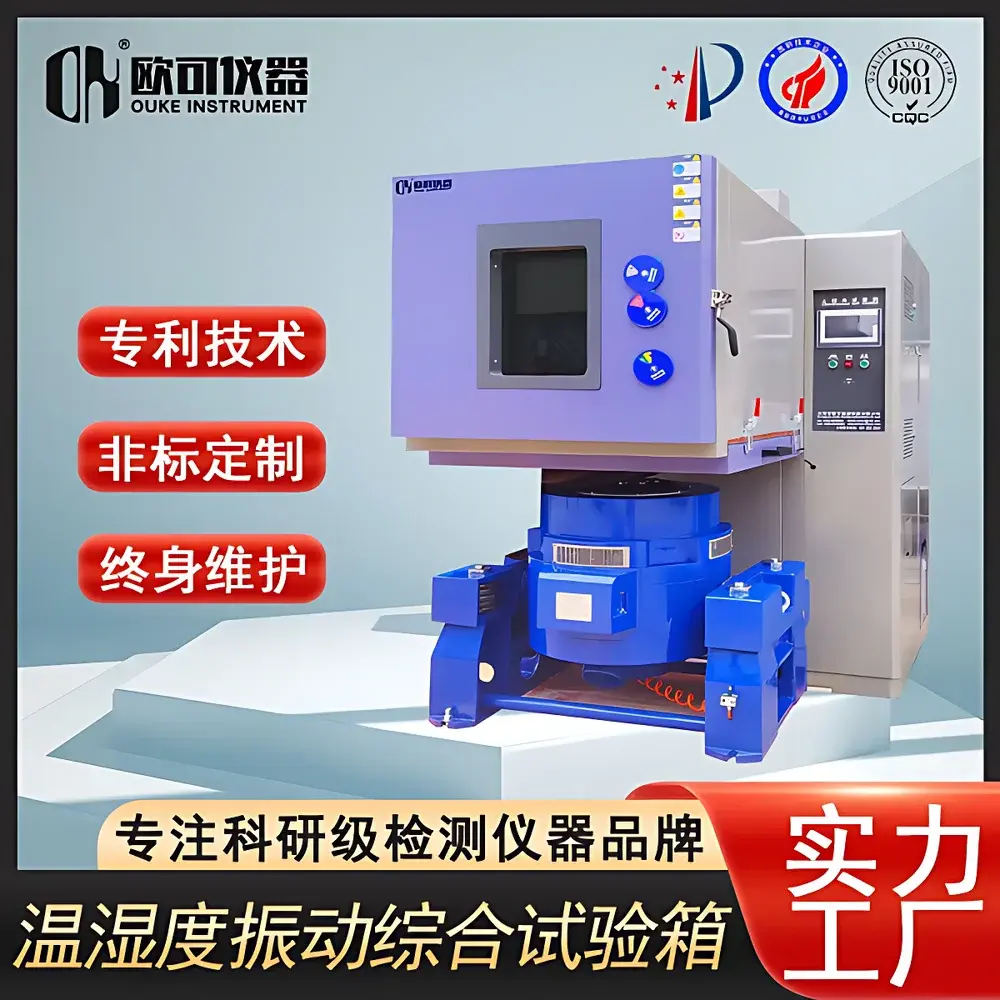
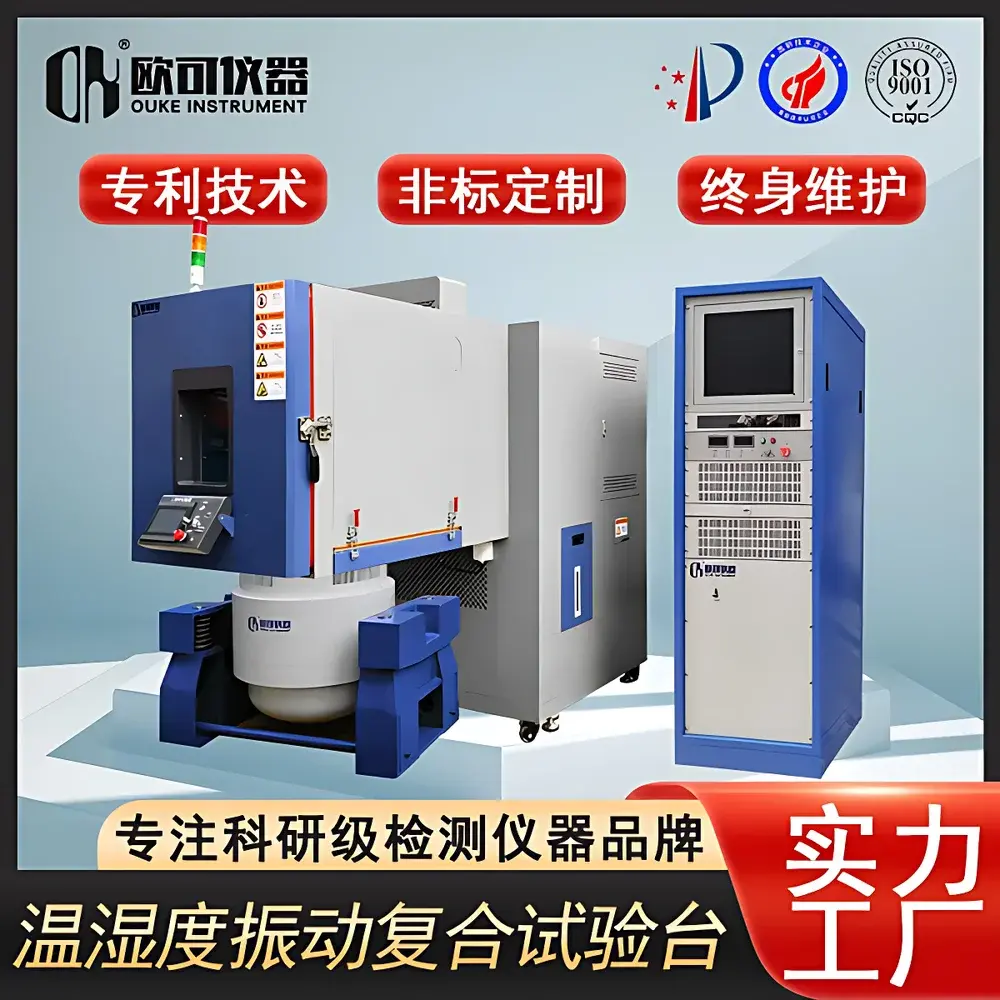
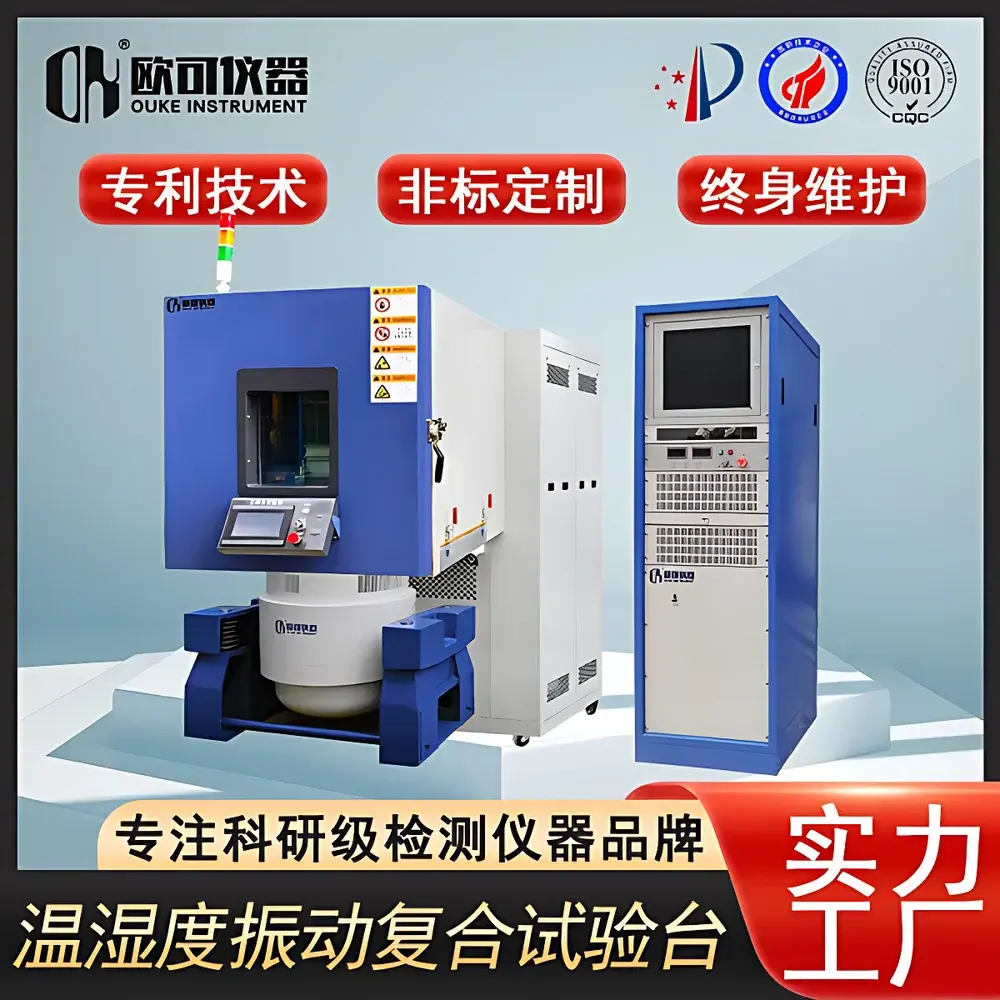
OK-ZTH-393 Combined Temperature-Humidity-Vibration Test System
| Brand | OK Instruments |
|---|---|
| Origin | Guangdong, China |
| Manufacturer Type | Direct Manufacturer |
| Product Origin | Domestic (China) |
| Model | OK-ZTH-393 |
| Temperature Range | −70 °C to +150 °C |
| Humidity Range | 20–98 %RH at 20–85 °C |
| Temperature Ramp Rate | 5 / 10 / 15 °C/min |
| Temperature Uniformity | ≤ 0.5 °C |
| Standard Load Capacity | 15 kg aluminum mass block |
Overview
The OK-ZTH-393 Combined Temperature-Humidity-Vibration Test System is an integrated environmental reliability testing platform engineered for simultaneous application of thermal, hygric, and dynamic mechanical stress profiles. It operates on the principle of multi-stress coupling—precisely synchronizing programmable temperature-humidity conditioning with high-fidelity electrodynamic vibration excitation—to replicate real-world operational, transportation, and storage environments where thermal expansion, moisture-induced corrosion, and mechanical fatigue interact synergistically. Unlike standalone climate chambers or unidimensional shakers, the OK-ZTH-393 integrates a high-performance electromagnetic shaker system (with closed-loop acceleration/velocity/displacement control), a vibration-compatible environmental chamber with reinforced structural integrity, and a unified deterministic controller architecture. This architecture enables true time-synchronized, phase-aligned test execution—critical for evaluating thermally dependent modal shifts, humidity-accelerated fretting wear, or cold-brittle fracture under vibratory loading.
Key Features
- Electrodynamic shaker subsystem with force rating suitable for 15 kg standard load (aluminum reference mass), supporting sine, random, shock, and time-history (road profile) excitation modes.
- Vibration-compatible environmental chamber featuring double-wall insulated construction, stainless-steel interior, and anti-condensation heating zones to maintain stable humidity control during active vibration.
- Programmable temperature ramp rates of 5, 10, and 15 °C/min across the full operating range (−70 °C to +150 °C), with temperature stability maintained at ≤ ±0.5 °C under static and dynamic load conditions.
- Humidity control calibrated to 20–98 %RH within 20–85 °C ambient, compliant with ISO 16750-4 and MIL-STD-810H humidity exposure protocols.
- Unified deterministic controller with synchronized multi-channel I/O, enabling precise temporal alignment between thermal transients and vibration spectra—including ramp-and-hold, dwell-and-sweep, and transient-triggered vibration onset.
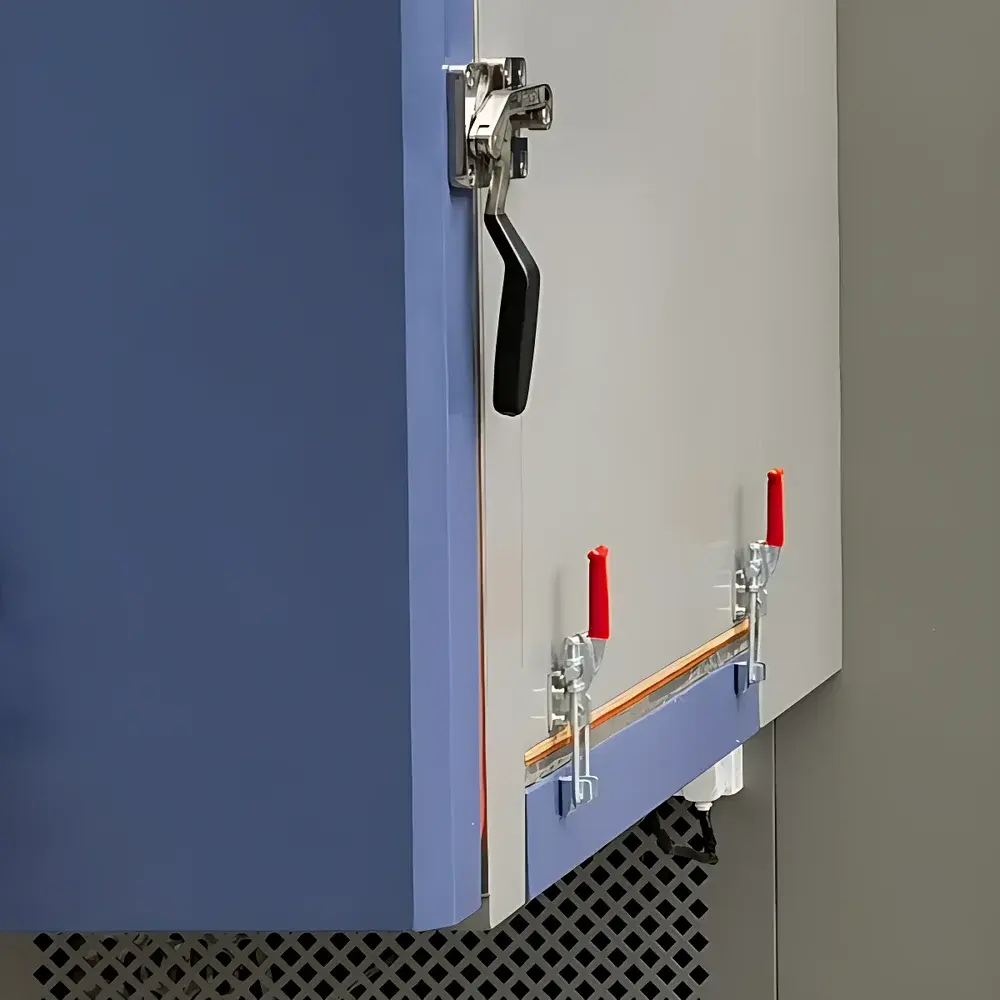
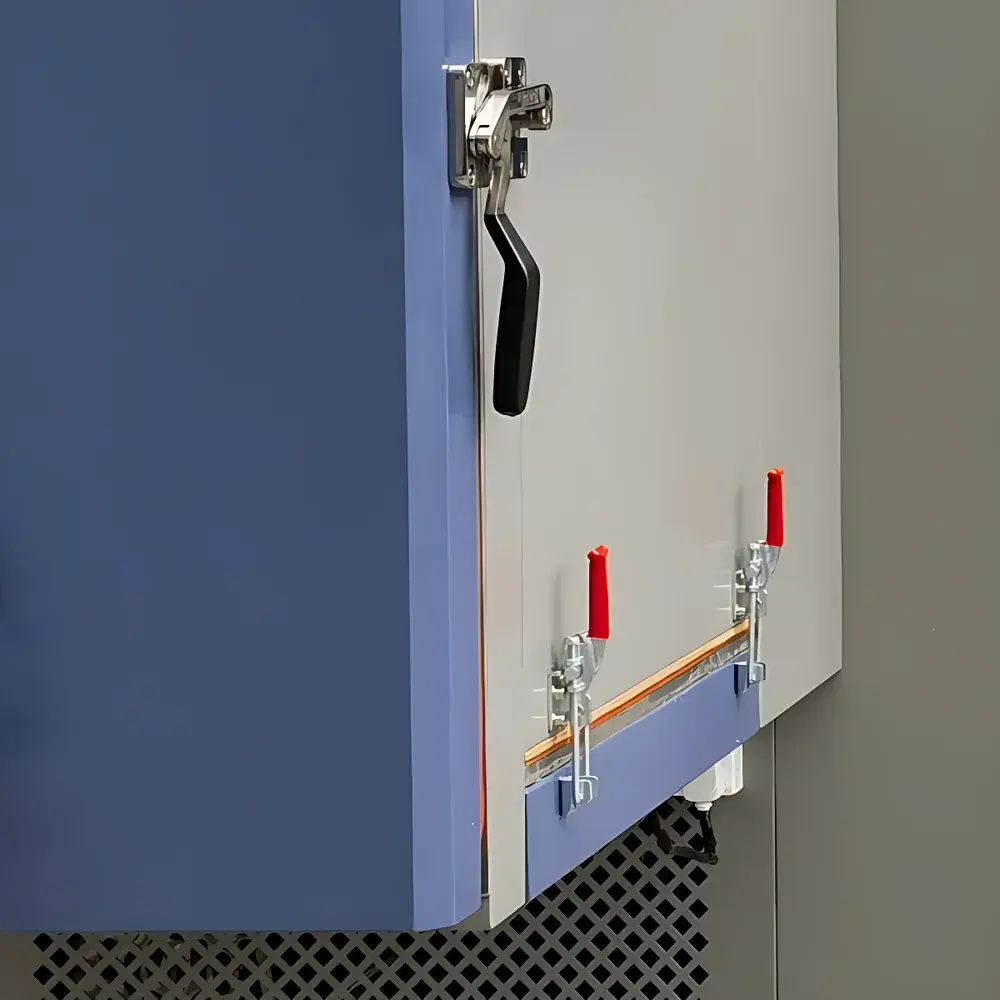
- Hardware-enforced safety interlocks: door lock verification prior to vibration initiation, over-temperature/over-humidity shutdown, emergency stop cascade linking shaker amplifier, refrigeration unit, and humidification system.
Sample Compatibility & Compliance
The OK-ZTH-393 accommodates samples up to 15 kg mounted on a rigid aluminum fixture, with usable internal chamber dimensions derived after subtracting shaker armature and fixture clearance (typical net workspace: W × D × H ≈ 600 × 600 × 600 mm). It supports industry-standard mounting interfaces (e.g., 10–24 UNC threaded inserts on shaker table surface) and is compatible with external accelerometers, thermocouples (Type K/T), and RH sensors for in-situ monitoring. The system meets functional requirements referenced in ASTM D4728 (random vibration of packaged products), IEC 60068-2-64 (vibration—broadband random), IEC 60068-2-30 (damp heat, cyclic), and US Department of Defense standards MIL-STD-810H Method 514.7 (vibration) and Method 507.6 (humidity). Its control architecture supports audit-ready data logging aligned with GLP/GMP documentation practices, including timestamped parameter traces, operator login records, and configuration change logs.
Software & Data Management
The embedded OK-TestSuite software provides a deterministic real-time operating environment (RTOS-based) for constructing multi-segment composite test profiles. Users define thermal ramps, dwell periods, humidity transitions, and vibration spectra—including user-defined PSDs, synthesized road profiles, and imported time histories—in a single hierarchical test sequence. All channels are sampled synchronously at ≥10 kHz with hardware timestamping. Export formats include IEEE C37.118-compliant .cfg/.dat, CSV with metadata headers, and encrypted binary archives for long-term archival. The system supports 21 CFR Part 11-compliant user access control (role-based permissions), electronic signatures for test initiation/approval, and automated report generation (PDF/HTML) containing traceable calibration certificates, environmental setpoints, vibration spectra, and pass/fail criteria per test segment.
Applications
- Aerospace electronics validation: Assessing solder joint integrity and connector contact resistance under combined thermal cycling and broadband random vibration—simulating flight envelope transitions.
- Automotive ECU and ADAS module qualification: Replicating under-hood thermal gradients while subjecting units to powertrain-induced vibration spectra (e.g., 5–2000 Hz random with 12 g RMS).
- Medical device sterilization packaging integrity: Evaluating seal strength degradation during accelerated aging cycles involving 85 °C/85 %RH holds followed by drop-simulation vibration bursts.
- Renewable energy inverter reliability: Testing thermal-mechanical fatigue of IGBT modules under 15 °C/min ramp-to-peak temperature while applying switching-frequency harmonics as forced vibration inputs.
- Defense-grade battery pack safety: Monitoring impedance rise and thermal runaway propagation during vibration-synchronized charge-discharge cycles at −40 °C and +60 °C.
FAQ
What distinguishes the OK-ZTH-393 from a standard temperature-humidity chamber with an add-on shaker?
Unlike mechanically bolted or externally coupled configurations, the OK-ZTH-393 features monolithic structural integration—its chamber is designed with reinforced base plates, decoupled suspension mounts, and dynamic compensation algorithms that eliminate vibration transmission to refrigeration compressors and humidification nozzles.
Does the system support remote operation and monitoring via Ethernet or industrial protocols?
Yes—it includes native Modbus TCP and OPC UA server functionality for integration into factory MES/SCADA systems, with secure TLS 1.2 encryption and configurable polling intervals down to 100 ms.
Can the controller execute asynchronous test segments—for example, initiating vibration only when a specific temperature threshold is reached?
Absolutely—the deterministic scheduler supports event-triggered actions, including conditional branching based on real-time sensor feedback (e.g., “start 20–2000 Hz random vibration when chamber temperature reaches 75 °C ±0.3 °C”).
Is third-party calibration certification available for both environmental and vibration subsystems?
OK Instruments provides NIST-traceable calibration certificates (per ISO/IEC 17025) for temperature, humidity, and acceleration sensors, with optional on-site verification using accredited metrology partners.
How is thermal uniformity verified under active vibration conditions?
Uniformity mapping is performed per IEC 60068-3-5 using a 9-point thermocouple array mounted on a non-resonant aluminum grid, with vibration applied at 1 g RMS across 10–1000 Hz while recording spatial deviation over 30 minutes.



