
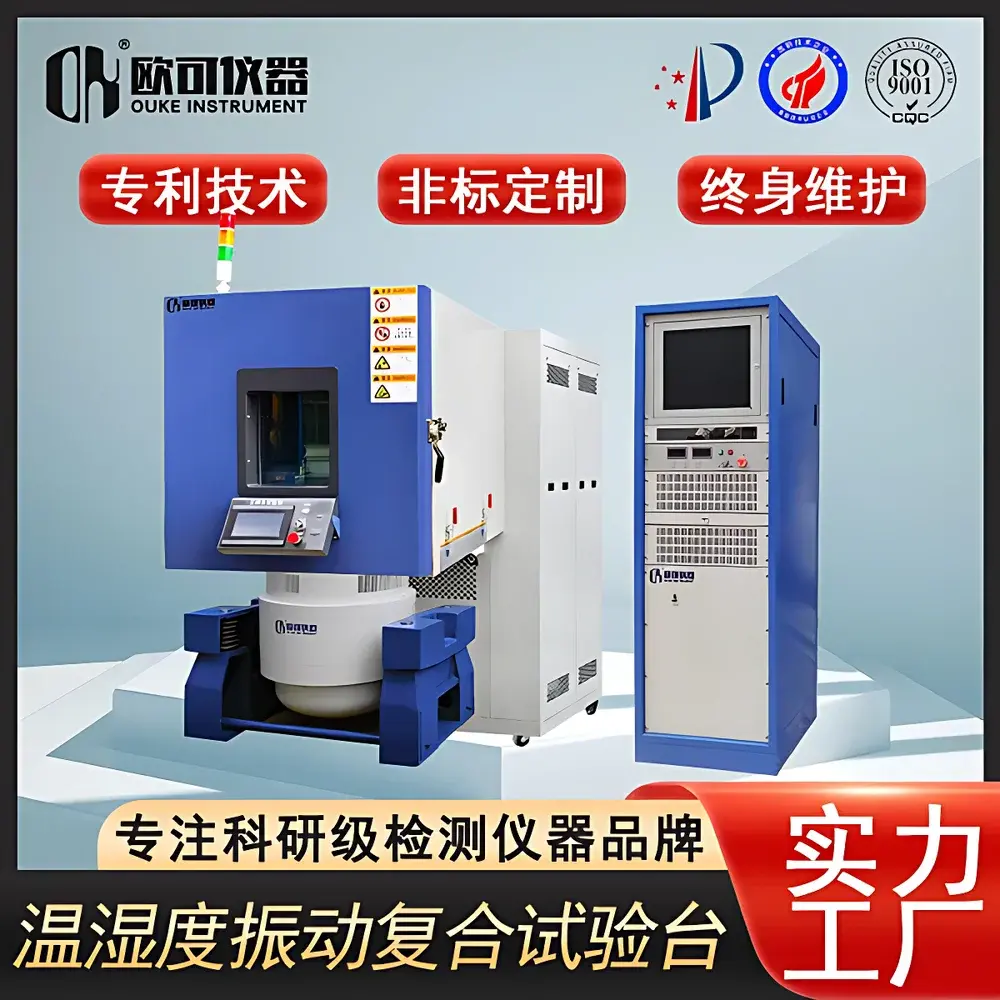
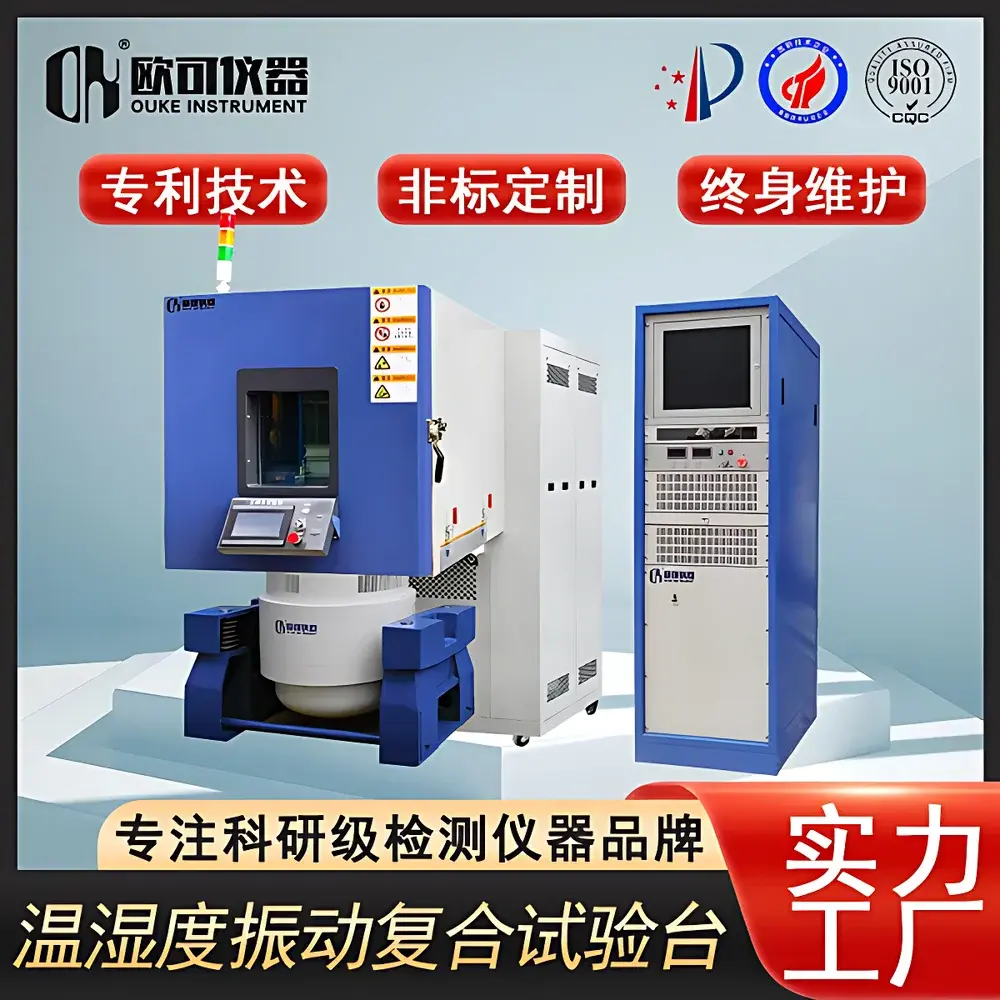
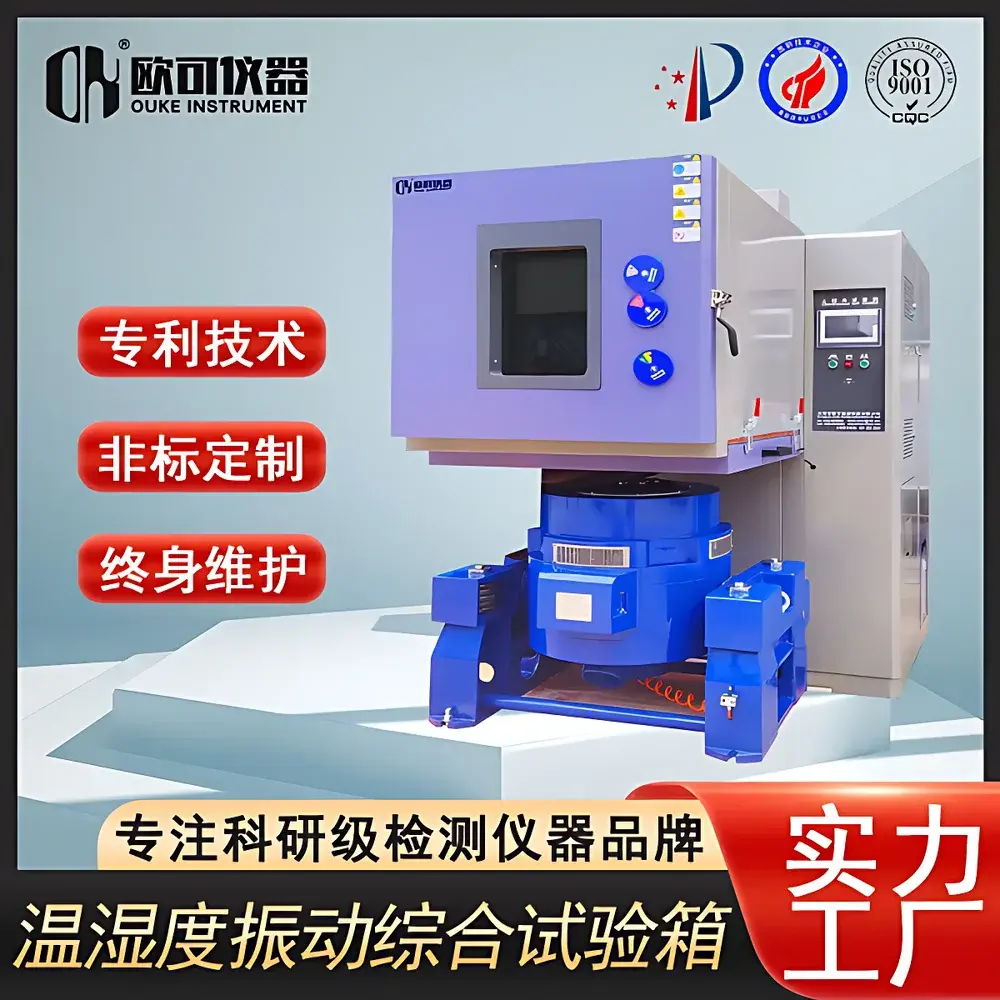
OK-ZTH-395 Combined Temperature-Humidity-Vibration Environmental Test Chamber
| Brand | OK Instruments |
|---|---|
| Origin | Guangdong, China |
| Manufacturer Type | Direct Manufacturer |
| Product Origin | Domestic (China) |
| Model | OK-ZTH-395 |
| Price | USD 21,000 (FOB Guangdong) |
| Temperature Range | −70 °C to +150 °C |
| Humidity Range | 20–98 %RH at 20–85 °C |
| Temperature Ramp Rate | 5 / 10 / 15 °C/min |
| Temperature Uniformity | ≤ ±0.5 °C |
| Standard Load Capacity | 15 kg aluminum mass with 350 W internal heat dissipation |
Overview
The OK-ZTH-395 Combined Temperature-Humidity-Vibration Environmental Test Chamber is an integrated reliability validation platform engineered for simultaneous application of thermal, hygrothermal, and mechanical stress stimuli. It operates on the principle of multi-stress coupling—precisely synchronizing programmable climatic conditioning (temperature and relative humidity) with controlled electrodynamic vibration excitation across a defined frequency and amplitude envelope. Unlike standalone environmental chambers or single-axis shakers, the OK-ZTH-395 embeds a high-fidelity vibration system within a structurally reinforced, vibration-isolated chamber enclosure designed to maintain climate stability under dynamic loading. This architecture enables true time-synchronized stress application—critical for replicating real-world operational profiles such as automotive under-hood thermal cycling during road-induced vibration, avionics exposure to humid tropical conditions during flight-induced broadband shake, or electronics subjected to temperature-dependent resonance shifts while undergoing random vibration per MIL-STD-810H Method 514.8.
Key Features
- Electrodynamic vibration system with closed-loop acceleration control, supporting sine, random, shock, and time-history (road profile) excitation modes.
- Climate chamber constructed with double-wall stainless steel insulation, forced-air circulation, and PID-controlled refrigeration/heating/humidification subsystems compliant with IEC 60068-3-5 and ISO 16750-4 requirements.
- Integrated master controller enabling synchronized or asynchronous test sequencing—e.g., ramping temperature from −40 °C to +85 °C while applying 5–500 Hz Gaussian random vibration at 1.5 grms.
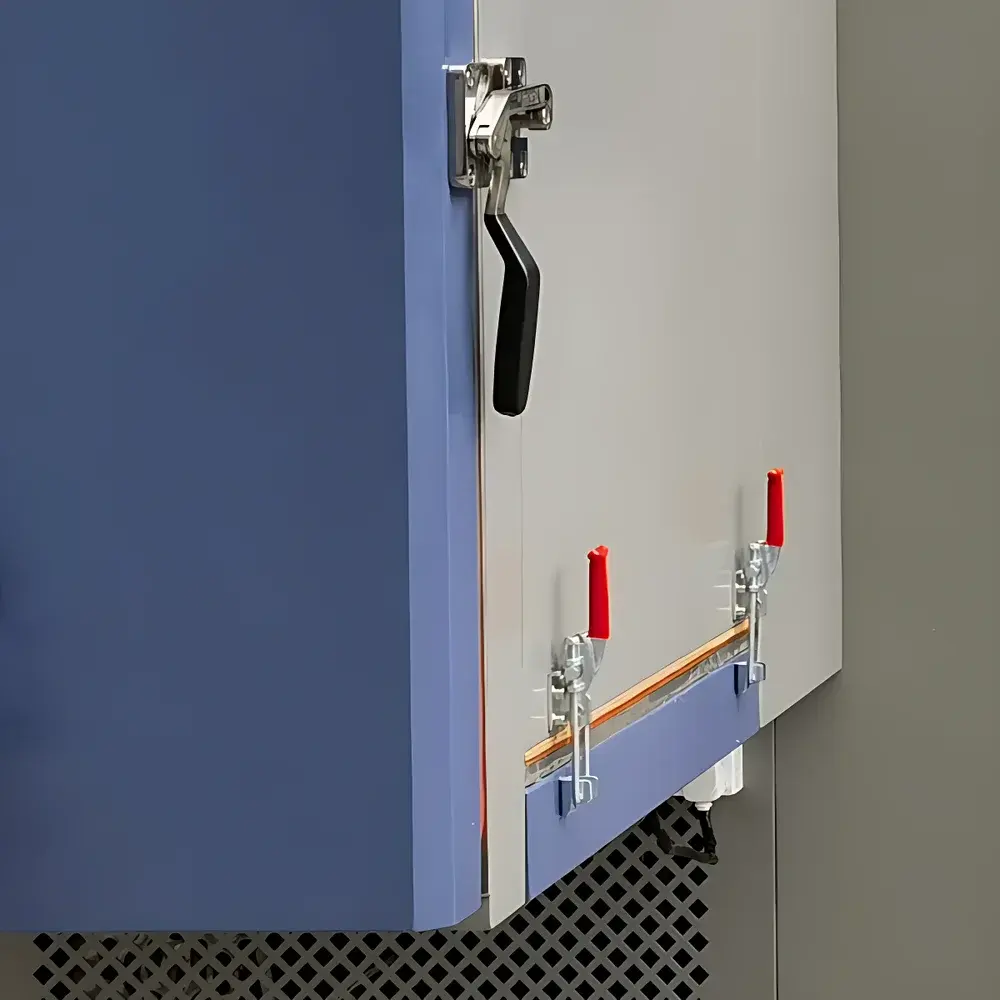
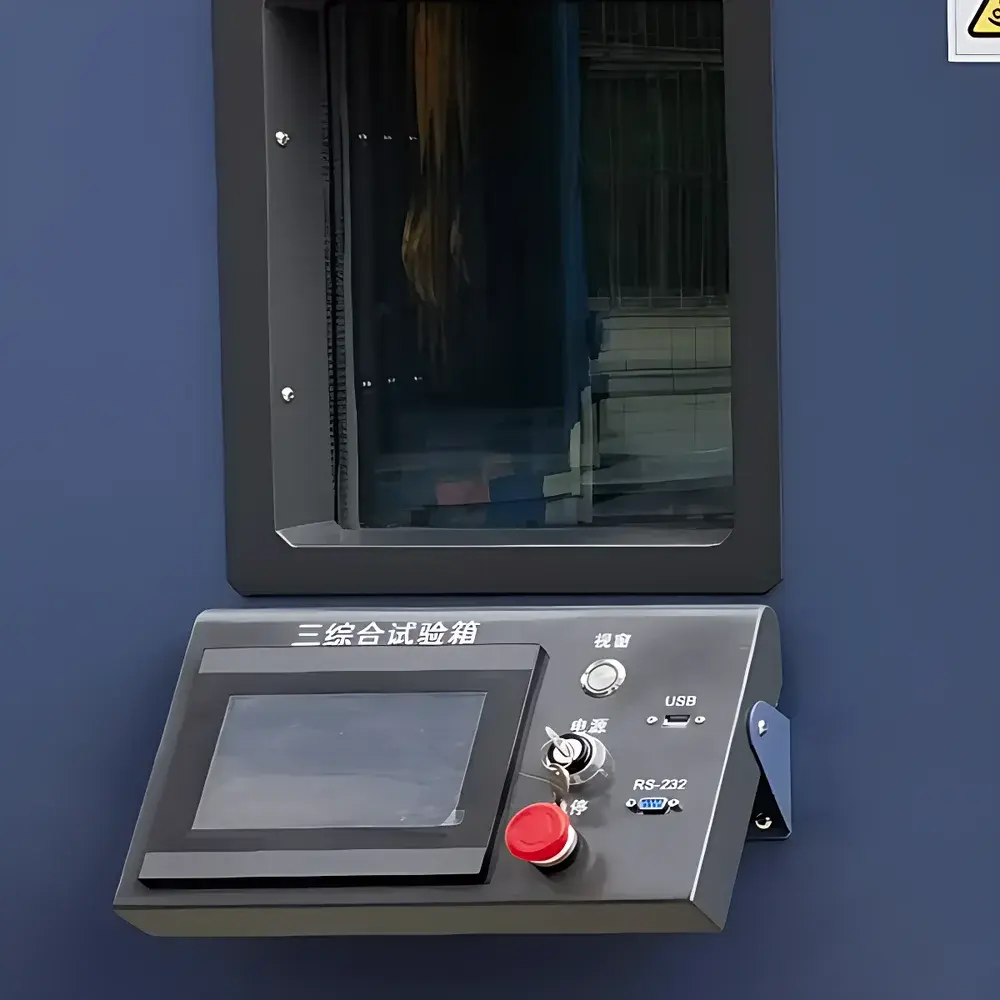
- Real-time safety interlock architecture: door lock verification, over-temperature/over-humidity cutoff, vibration emergency stop, and thermal runaway detection with automatic power-down.
- Vibration table rated for 15 kg payload with 350 W internal heat load capacity—validated using standardized aluminum reference mass per ASTM E1828 Annex A1.
- Thermal performance certified to ≤ ±0.5 °C temperature fluctuation and ≤ ±2 %RH humidity variation at steady-state conditions (measured per ISO 16750-4 Annex B).
Sample Compatibility & Compliance
The OK-ZTH-395 accommodates samples up to 15 kg mounted on standard fixture interfaces (M8/M10 threaded inserts), with usable internal chamber dimensions optimized to retain ≥70 L net volume after vibration table and shaker armature integration. It supports compliance testing per major international standards including: IEC 60068-2-1 (cold), IEC 60068-2-2 (dry heat), IEC 60068-2-30 (damp heat cyclic), ISO 16750-4 (road vehicle environmental conditions), MIL-STD-810H Methods 502.7, 507.7, and 514.8, and GB/T 2423.1–2423.10 (Chinese national equivalents). All control firmware and data logs are structured to support GLP/GMP audit trails, including user authentication, parameter change history, and timestamped event logging—fully traceable for FDA 21 CFR Part 11–aligned quality systems.
Software & Data Management
The proprietary OK-TestSuite v4.2 software provides a unified interface for defining multi-segment test profiles with cross-domain dependencies (e.g., “initiate 10 gpk half-sine shock only if chamber temperature exceeds 60 °C”). It supports real-time dual-channel monitoring of vibration acceleration (via IEPE sensor input) and chamber thermohygrometric parameters, with synchronized waveform capture at up to 51.2 kHz sampling rate. Export formats include CSV, UFF58, and MATLAB .mat; raw data files are digitally signed and checksum-verified to ensure integrity. Remote operation via secure TLS 1.2 API enables integration into enterprise MES/QMS platforms without compromising data sovereignty.
Applications
- Accelerated vibration fatigue assessment of solder joints, connectors, and structural welds under thermally induced embrittlement (−40 °C) or creep softening (+125 °C).
- Temperature-dependent modal analysis: tracking shifts in natural frequency and damping ratio of aerospace components across thermal gradients to validate finite element models.
- Connector reliability validation: evaluating contact resistance drift and intermittent open-circuit events in PCB-mounted interfaces subjected to combined thermal cycling, humidity soak, and broadband vibration.
- Automotive ECU qualification: simulating engine bay thermal transients while applying road-spectrum vibration to verify long-term signal integrity and housing seal performance.
- Defense electronics hardening: verifying survivability of radar modules under MIL-STD-810H-compliant combined environments prior to field deployment.
FAQ
What distinguishes the OK-ZTH-395 from a standard temperature-humidity chamber with external vibration?
It features fully integrated, mechanically decoupled hardware—vibration actuator mounted directly beneath the chamber floor, not externally coupled—and a single deterministic control loop ensuring sub-second synchronization between thermal setpoint changes and vibration command updates.
Does the system support third-party sensor integration?
Yes—IEEE 1451.4-compliant TEDS channels are available for plug-and-play accelerometer, strain gauge, and thermocouple inputs, with automatic calibration coefficient ingestion.
Is remote diagnostics and firmware update capability included?
Yes—embedded Ethernet port supports secure SSH access, diagnostic log streaming, and over-the-air (OTA) firmware upgrades with rollback protection.
Can test profiles be exported for regulatory submission?
All executed profiles include embedded metadata (operator ID, calibration due date, chamber serial number) and generate PDF-certified reports compliant with ISO/IEC 17025 documentation requirements.
What maintenance intervals are recommended for sustained accuracy?
Re-calibration of temperature/humidity sensors and vibration transducers is advised every 12 months or after 2,000 operating hours, per manufacturer’s metrology schedule aligned with ISO/IEC 17025 Clause 6.5.



