
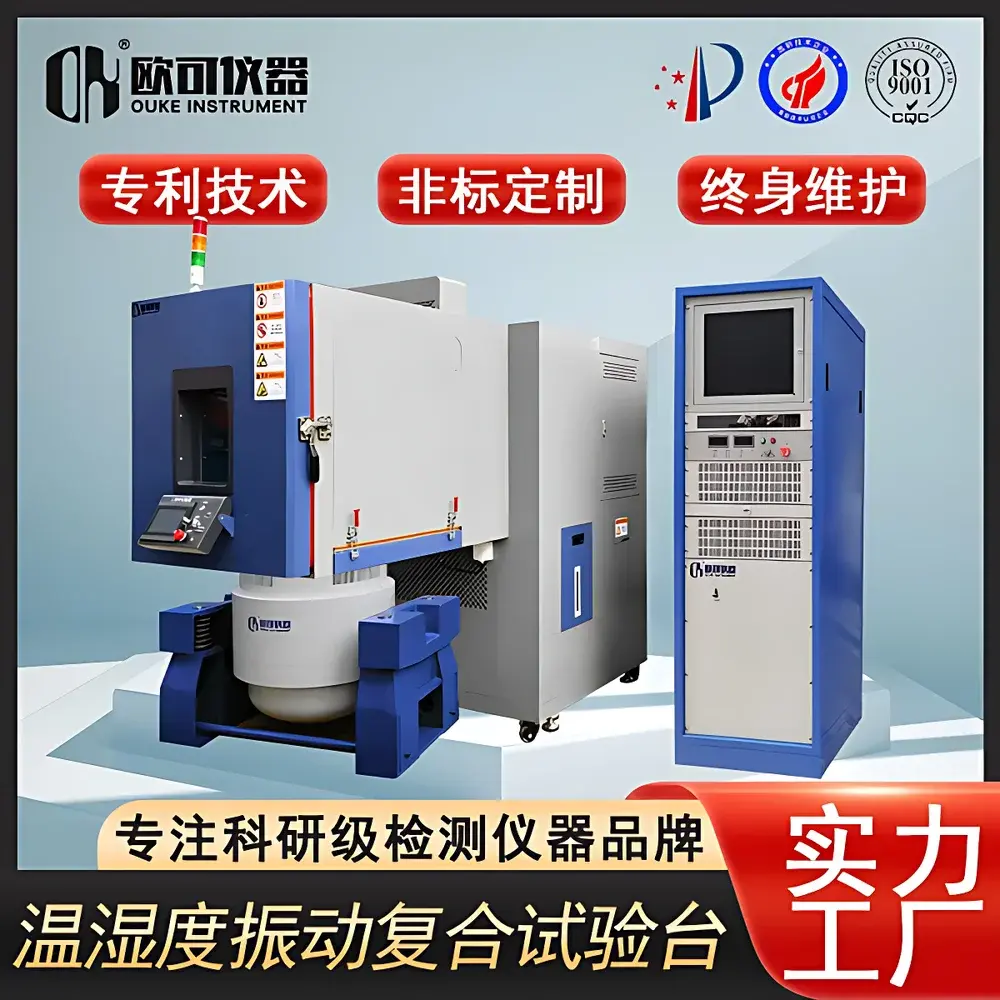
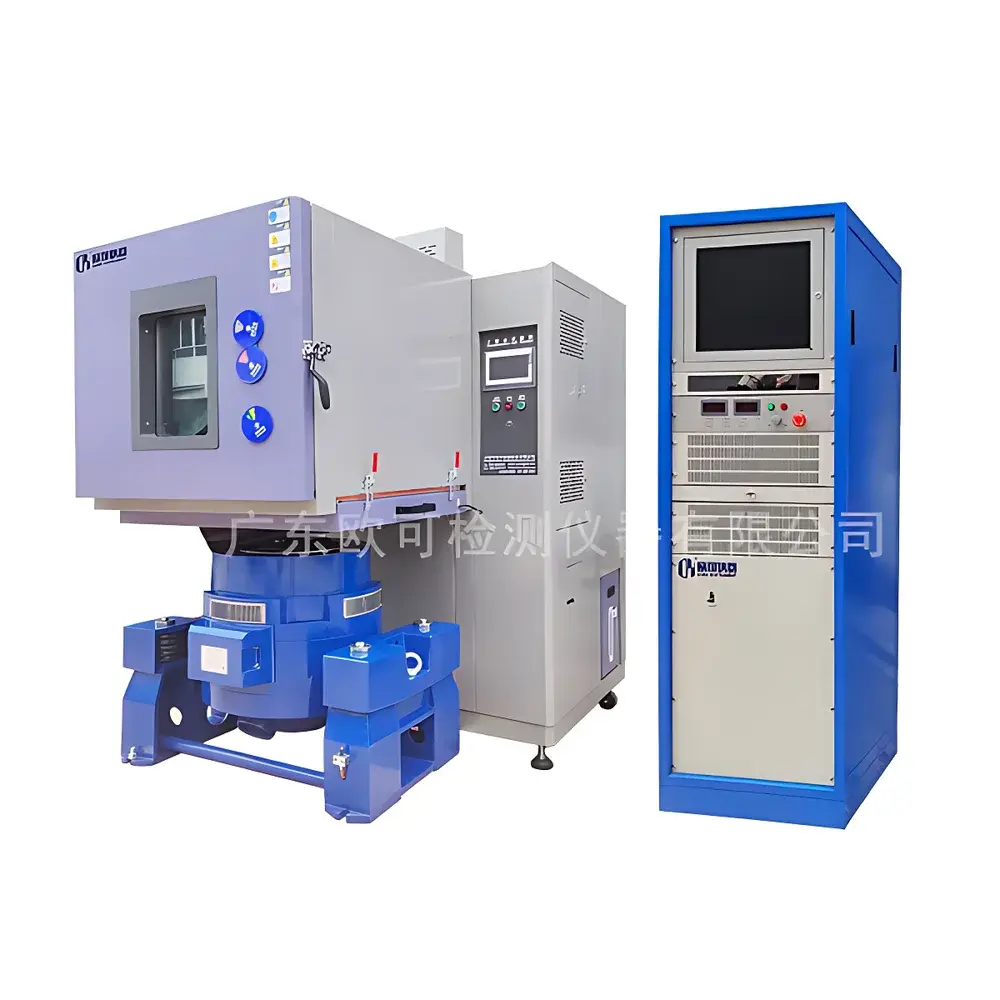
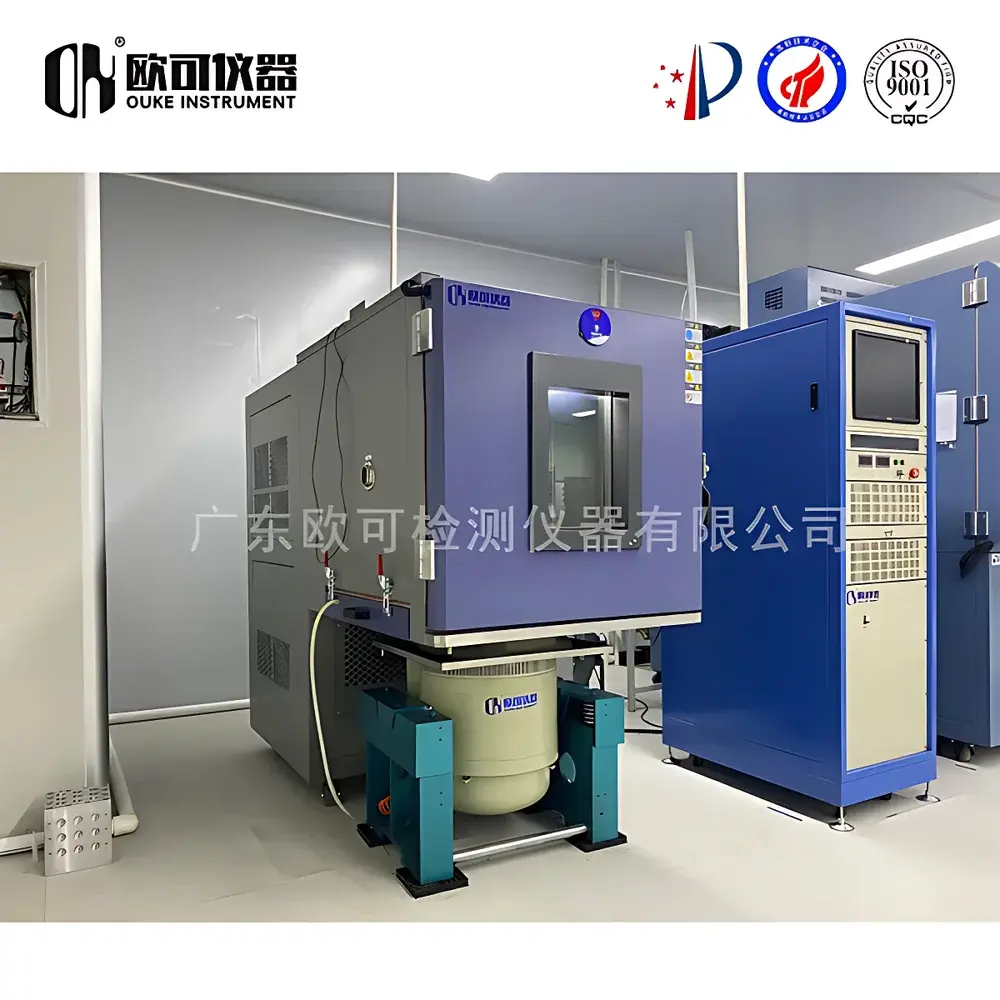
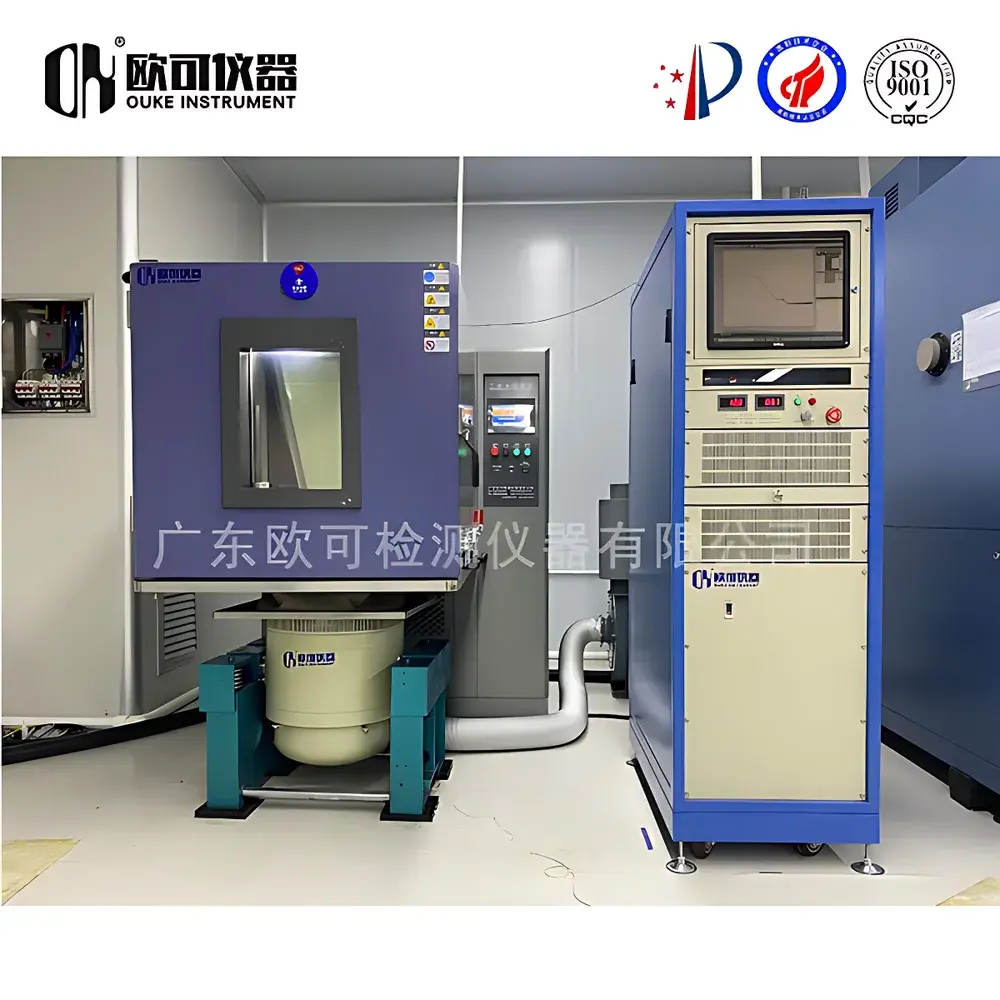
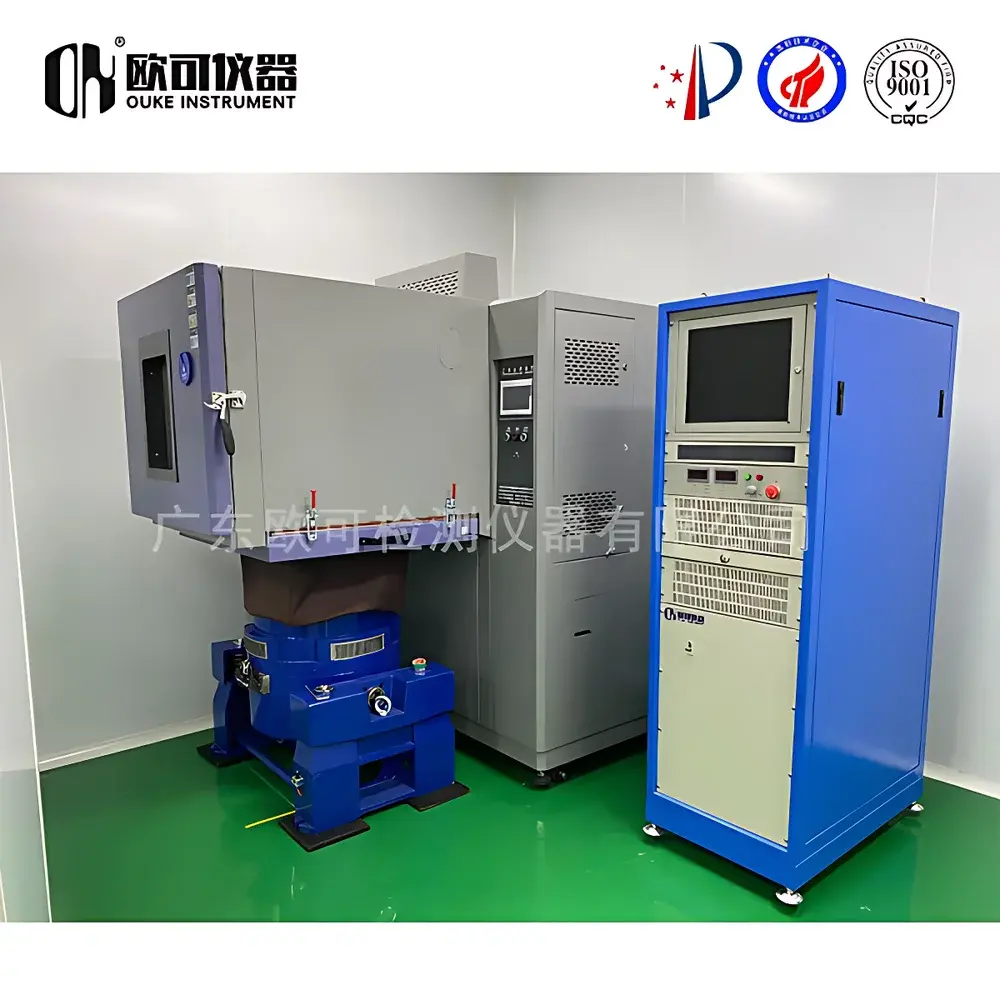
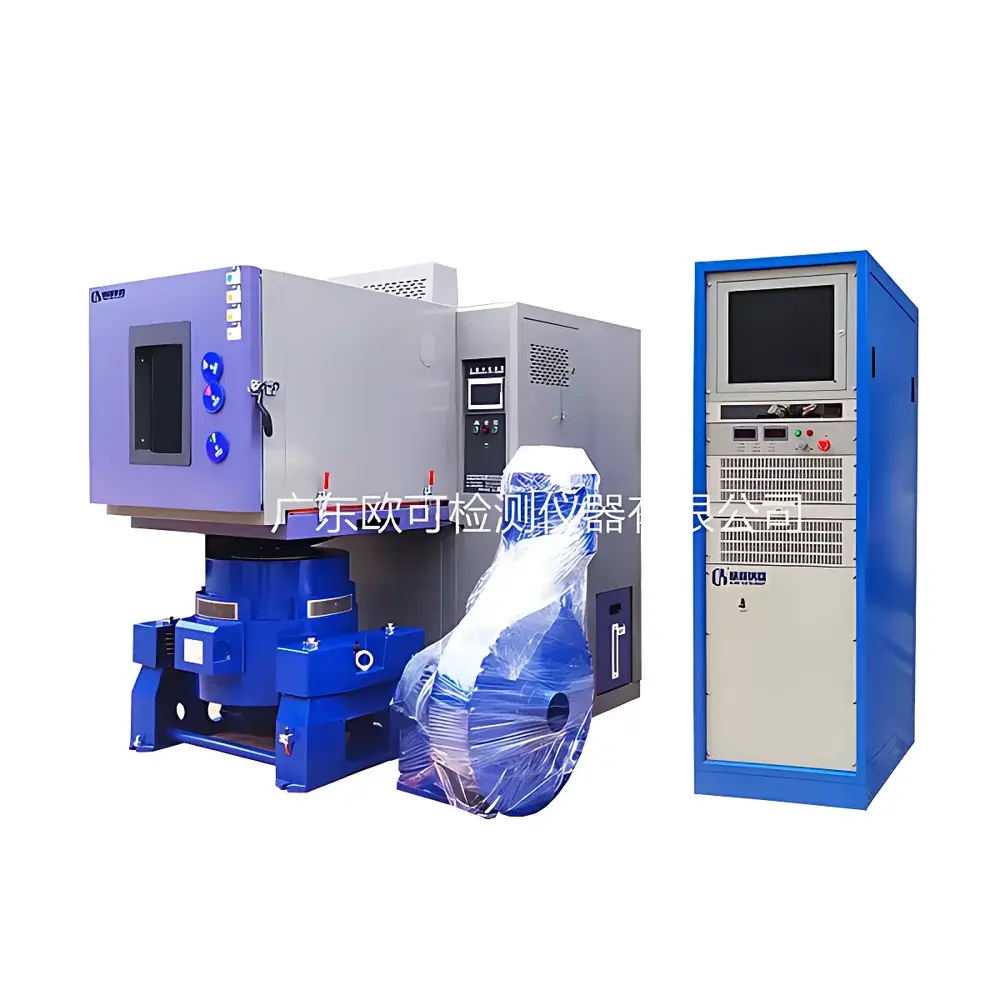
OK-ZTH-399 Combined Temperature-Humidity-Vibration Test System
| Brand | OK Instruments |
|---|---|
| Origin | Guangdong, China |
| Manufacturer Type | OEM/ODM Manufacturer |
| Country of Origin | China |
| Model | OK-ZTH-399 |
| Temperature Range | −70 °C to +150 °C |
| Humidity Range | 20–98 %RH at 20–85 °C |
| Temperature Ramp Rate | 5 / 10 / 15 °C/min |
| Temperature Uniformity | ≤ ±0.5 °C |
| Standard Load Capacity | 15 kg (aluminum mass block), 350 W thermal dissipation |
Overview
The OK-ZTH-399 Combined Temperature-Humidity-Vibration Test System is an integrated environmental reliability testing platform engineered for simultaneous application of thermal, hygric, and dynamic mechanical stress profiles. It operates on the principle of synchronized multi-stress coupling—where a high-fidelity electrodynamic shaker generates controlled vibration (sinusoidal, random, shock, or road-spectrum replication) while a vibration-resistant climatic chamber concurrently maintains programmable temperature and humidity conditions. Unlike standalone vibration tables or static environmental chambers, this system enables true time-synchronized exposure: for example, executing a 5–500 Hz random vibration profile during a linear thermal ramp from −40 °C to +85 °C. Its architecture adheres to the fundamental requirements of accelerated life testing standards—including ASTM D4728, MIL-STD-810H Method 514.7 (vibration), and Method 502.7 (temperature/humidity)—and supports test protocols aligned with automotive OEM specifications (e.g., GMW14872, Ford CETP 00.00-L-467) and aerospace qualification frameworks (e.g., RTCA DO-160 Section 20/21).
Key Features
- Electrodynamic shaker core with broadband frequency capability (5–3000 Hz typical operational envelope), optimized for low-distortion force delivery under thermally variable boundary conditions.
- Vibration-resistant climatic chamber featuring reinforced structural integrity, dual-stage refrigeration, and steam-based humidification—designed to maintain stable environmental conditions while subjected to continuous mechanical excitation up to 100 gpk (system-dependent).
- Unified control architecture integrating real-time vibration spectrum generation, PID-controlled thermal/hygric regulation, and synchronized event triggering—enabling complex multi-segment test profiles with precise phase alignment between stress domains.
- Dual-layer safety interlock system: hardware-level door lock verification, over-temperature/over-humidity cutoffs, shaker motion inhibition during chamber access, and automatic emergency shutdown upon parameter deviation exceeding ISO 16750-4 defined thresholds.
- Modular load interface accommodating standard aluminum test masses (15 kg nominal), with provisions for custom fixture integration and thermal load compensation up to 350 W.
Sample Compatibility & Compliance
The OK-ZTH-399 accommodates electronic assemblies, PCB modules, automotive ECUs, avionics enclosures, and small mechanical subassemblies within its usable workspace—accounting for dynamic clearance around the shaker armature and chamber insulation thickness. Chamber internal dimensions are engineered to preserve ≥90 % of rated vibration performance across the full temperature range (−70 °C to +150 °C) and humidity band (20–98 %RH). The system supports compliance documentation per ISO/IEC 17025 calibration traceability, and its control software architecture permits audit-ready data logging with timestamped parameter records—fully compatible with GLP/GMP environments requiring FDA 21 CFR Part 11-compliant electronic signatures and change history tracking.
Software & Data Management
The proprietary OK-ControlSuite™ provides a unified GUI for defining coupled test sequences, including nested loops, conditional branching, and real-time monitoring of all three stress domains. Vibration spectra are imported in standard formats (.sdf, .rsd, .wav), while thermal/humidity profiles support ramp-soak-dwell programming with user-defined rate constraints. All raw sensor data (acceleration, temperature, RH, chamber pressure) are logged at ≥1 kHz sampling resolution and exported in ASCII or HDF5 format. Built-in FFT analysis, coherence calculation, and PSD integration support post-test modal correlation and failure root-cause analysis. Data archives include metadata tags for operator ID, calibration certificate validity, and environmental chamber validation reports (per ISO 16750-4 Annex A).
Applications
- Accelerated vibration fatigue assessment under thermally induced material property shifts—e.g., evaluating solder joint integrity degradation in lead-free electronics exposed to −40 °C/85 %RH while undergoing 20–2000 Hz random vibration.
- Thermo-mechanical modal analysis: mapping shifts in natural frequencies and damping ratios across temperature gradients to identify resonance risks in structural components (e.g., battery packs, radar housings).
- Connector and harness reliability validation: detecting intermittent opens/closes arising from combined CTE mismatch, oxidation, and fretting wear under cyclic thermal-hygric-vibrational loading.
- Transport simulation: replicating combined stresses experienced during air freight (low-pressure cooling), maritime shipping (high-RH salt fog), and ground logistics (road-induced broadband vibration).
- Qualification testing per IEC 60068-2 series, JEDEC JESD22-B103 (mechanical shock), and IPC-9701A (solder interconnect performance).
FAQ
What distinguishes the OK-ZTH-399 from a standard vibration table with an external environmental chamber?
Unlike externally coupled systems—where vibration and climate control operate independently with limited synchronization—the OK-ZTH-399 integrates both subsystems at the hardware and firmware levels, ensuring nanosecond-level timing alignment and eliminating phase drift during extended thermal ramps.
Can the system perform vibration tests at extreme low temperatures (e.g., −70 °C)?
Yes; the chamber’s refrigeration system and shaker’s cold-rated voice coil assembly are validated for continuous operation at −70 °C, with thermal soak stability maintained within ±0.5 °C per IEC 60068-3-5.
Is the controller compliant with FDA 21 CFR Part 11 requirements?
The OK-ControlSuite™ supports role-based user authentication, electronic signatures, and immutable audit trails—including operator actions, parameter modifications, and calibration events—with optional PKI certificate integration.
What is the maximum allowable payload when operating at 150 °C?
Payload capacity remains 15 kg at elevated temperatures; however, thermal derating of shaker force output applies above 85 °C per manufacturer’s thermal management curve—documented in the system’s technical specification supplement.
Does the system support remote monitoring and alarm notification?
Yes; Ethernet-enabled SNMP v3 communication allows integration into facility-wide SCADA networks, with configurable email/SMS alerts for critical fault conditions (e.g., chamber overpressure, shaker coil overtemperature, humidity sensor timeout).
Related Products



