
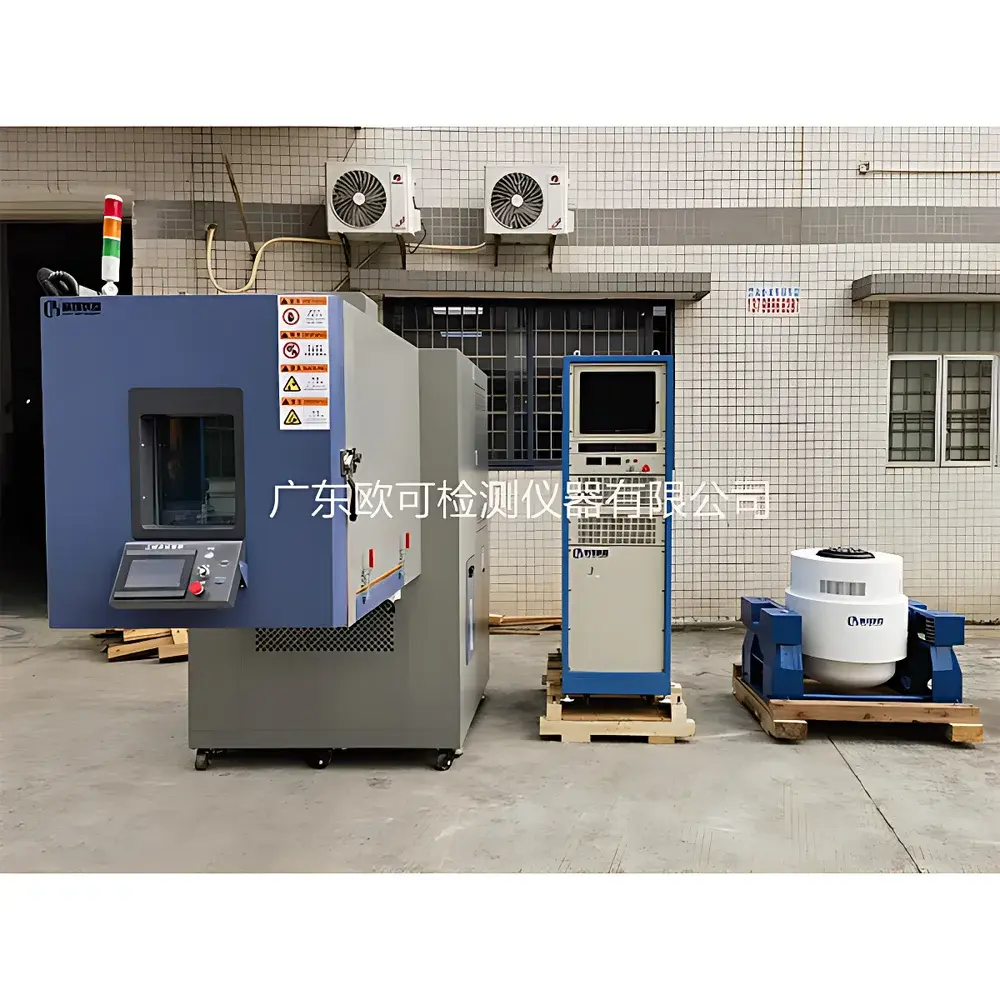
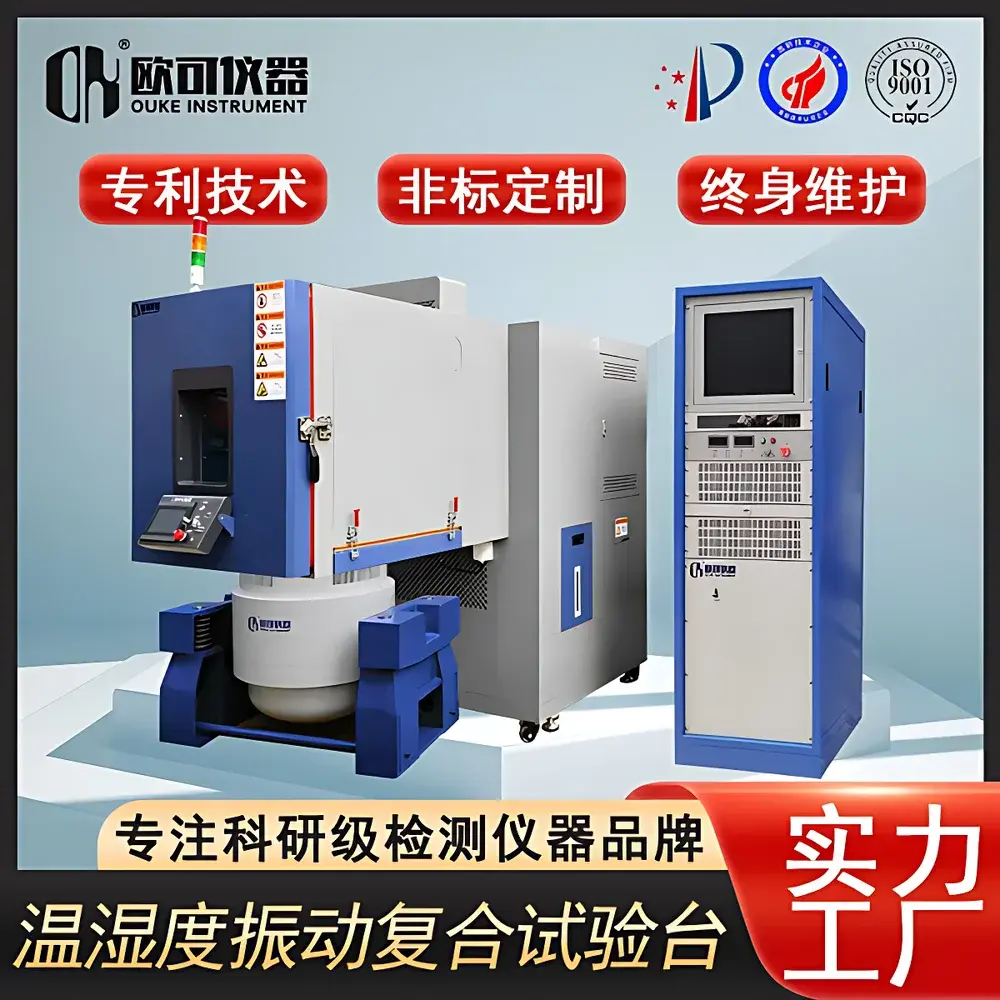
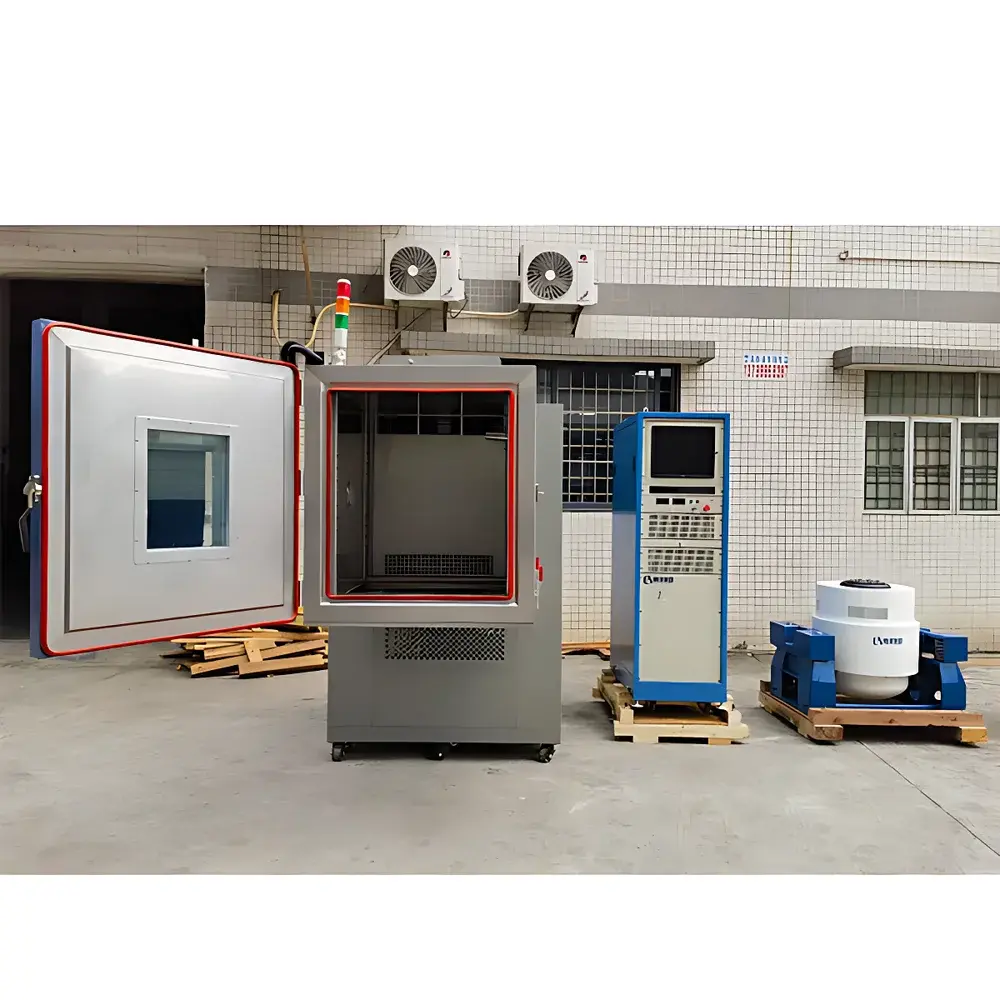
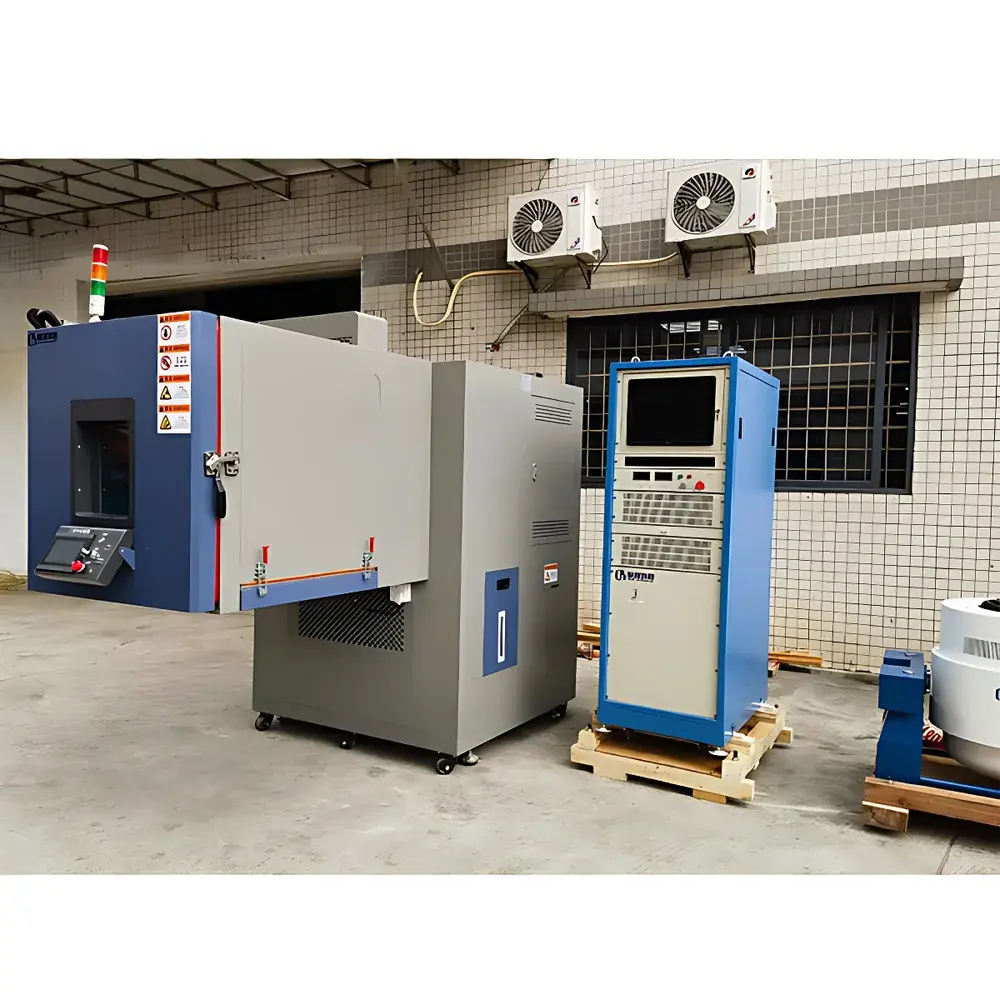
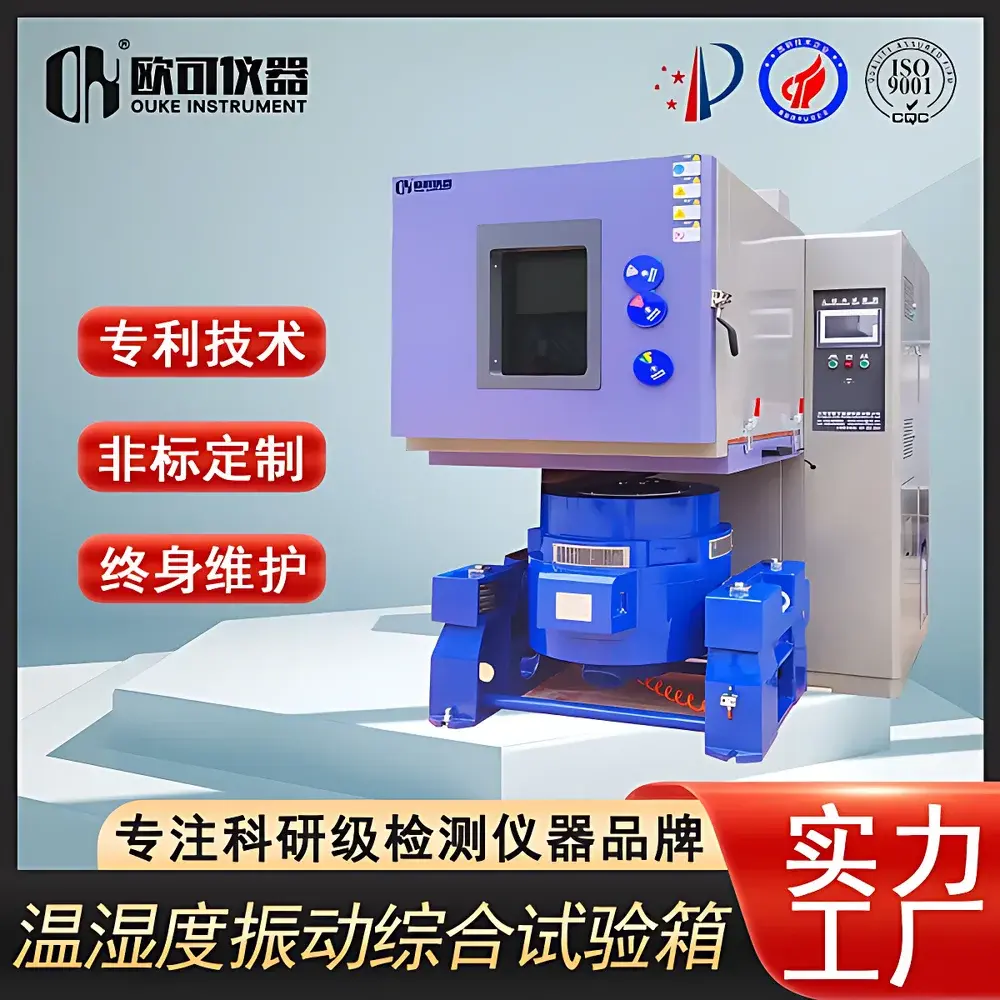
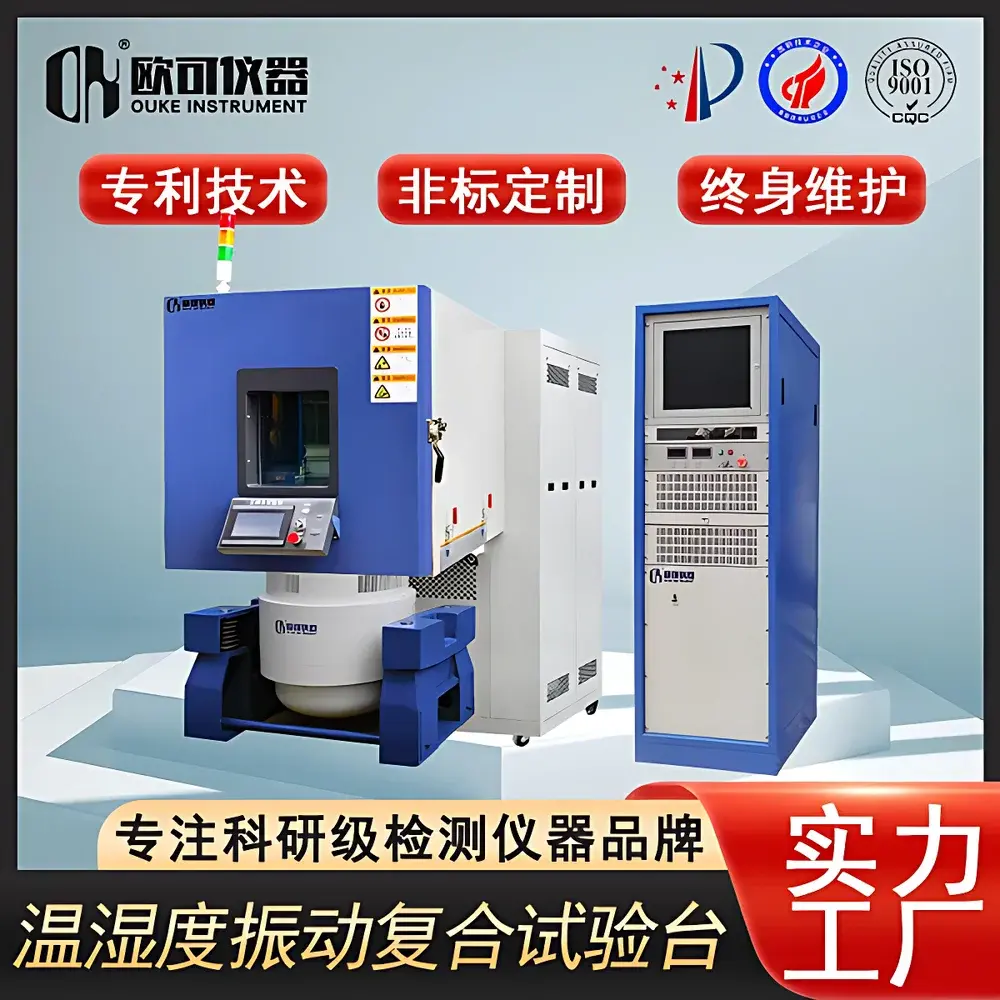
OK-ZTH-512.132 Combined Temperature-Humidity-Vibration Test System
| Brand | OK Instruments |
|---|---|
| Origin | Guangdong, China |
| Manufacturer Type | Direct Manufacturer |
| Product Origin | Domestic (China) |
| Model | OK-ZTH-512.132 |
| Temperature Range | −70 °C to +150 °C |
| Humidity Range | 20–98 %RH (at 20–85 °C) |
| Temperature Ramp Rate | 5 / 10 / 15 °C/min |
| Temperature Uniformity | ≤ ±0.5 °C |
| Standard Load Capacity | 15 kg aluminum mass block |
Overview
The OK-ZTH-512.132 Combined Temperature-Humidity-Vibration Test System is an integrated environmental stress screening platform engineered for high-fidelity simulation of multi-physics operational and transport environments. Unlike sequential or loosely coupled test setups, this system implements true concurrent control of thermal, hygric, and mechanical stimuli—enabling precise synchronization of temperature profiles, humidity setpoints, and vibration spectra in real time. Its operational principle relies on tightly coordinated feedback loops across three independent yet interdependent subsystems: a high-stability climate chamber with active dew-point control, a high-force electrodynamic shaker with broadband spectral generation capability, and a rigidly coupled vibration transmission interface designed to maintain structural integrity across −70 °C to +150 °C. The system complies with fundamental requirements of accelerated reliability testing standards including IEC 60068-2-64 (random vibration), IEC 60068-2-14 (thermal cycling), and IEC 60068-2-30 (damp heat cyclic), and serves as a foundational platform for HALT (Highly Accelerated Life Testing) and HASS (Highly Accelerated Stress Screening) methodologies per ASTM E1820 and MIL-STD-344A.
Key Features
- Triple-stimulus integration: Simultaneous, programmable control of temperature, relative humidity, and vibration—including sine sweep, random PSD, shock pulse, and mixed-mode profiles.
- Climate chamber architecture: Double-wall vacuum-insulated construction with low-thermal-conductivity polyurethane foam; tempered double-glazed observation window with anti-fog heating film; multiple shielded cable ports (IP65-rated) for sensor and DUT cabling.
- Thermal subsystem: Dual-stage mechanical refrigeration (cascade compressor system) enabling rapid cooling to −70 °C; PID-controlled electric heating elements; axial airflow system with turbulence-dampened ducting for ±0.5 °C uniformity at steady state.
- Humidity subsystem: Steam-based humidification via stainless-steel boiler with auto-drain; condensation-type dehumidification using sub-zero evaporator coils; dew-point referenced RH control with NIST-traceable capacitive sensors (±1.5 %RH accuracy).
- Vibration subsystem: 100 kN peak force electrodynamic shaker (optional pneumatic assist for HALT-grade displacement); 5–2000 Hz operating bandwidth; integrated slip table and thermal-isolated extension head with dynamic stiffness > 2.5 MN/m at 2 kHz.
- Control architecture: Real-time deterministic controller (Linux RT kernel) with synchronized 10 kHz sampling across all domains; dual-channel closed-loop vibration control with acceleration feedback; embedded audit trail and electronic signature support compliant with FDA 21 CFR Part 11 Annex 11 requirements.
Sample Compatibility & Compliance
The OK-ZTH-512.132 accommodates DUTs up to 15 kg mounted on standardized aluminum mass blocks, with thermal load handling capacity of 350 W at ambient conditions. Internal dimensions (W × H × D) are optimized for aerospace avionics modules, automotive ECUs, battery management systems, and telecom base station components. All materials in contact with the test space—including gaskets, insulation, and interior cladding—meet UL94 V-0 flame rating and outgassing specifications per NASA ASTM E595. The system supports compliance verification against ISO 16750-4 (road vehicles), DO-160G Section 25 (avionics), MIL-STD-810H Method 520.5 (combined environments), and GB/T 2423.34–2012 (Chinese national standard for combined temperature/humidity/vibration testing). Calibration certificates are provided traceable to CNAS-accredited laboratories.
Software & Data Management
The proprietary OK-TestSuite™ software provides unified configuration, execution, and post-processing of multi-domain test profiles. Users define hierarchical test sequences—including ramp-hold cycles, stepwise stress escalation, and failure-triggered abort logic—with full parameter interlocking (e.g., limiting vibration amplitude during extreme low-temperature holds). Raw data streams from thermocouples, RH sensors, and triaxial accelerometers are timestamped with microsecond resolution and stored in HDF5 format for long-term archival. Built-in analysis tools include PSD estimation, fatigue damage calculation (using Steinberg’s three-band method), thermal gradient mapping, and cross-correlation between thermal transients and vibration response peaks. Export options include CSV, MATLAB .mat, and PDF reports compliant with GLP/GMP documentation requirements. Remote monitoring and role-based access control are supported via TLS-encrypted web interface.
Applications
- HALT development: Identification of design margin limits through controlled over-stress profiling—e.g., simultaneous 15 °C/min thermal ramp and 60 Grms random vibration at −40 °C—to expose latent weaknesses in solder joints, conformal coatings, or MEMS packaging.
- HASS deployment: 100% production screening of power inverters or Li-ion battery packs using statistically derived stress profiles that target infant mortality without inducing wear-out.
- Transport simulation: Replication of maritime container environments (high RH + low-frequency road/ship vibration) or air cargo hold transitions (rapid pressure/temperature shifts + broadband shake).
- Qualification testing: Validation of outdoor IoT enclosures per IEC 60529 IP66 and IEC 60068-2-68 for dust/water ingress resistance under dynamic thermal cycling.
- Materials research: Investigation of hygrothermal aging effects on polymer composites subjected to resonant vibration at elevated humidity—quantifying modulus degradation and interfacial delamination onset.
FAQ
What is the maximum allowable DUT power dissipation inside the chamber during vibration?
The system is rated for 350 W continuous internal heat load under static conditions; during active vibration, derating to 280 W is recommended to maintain thermal stability within ±0.5 °C.
Can the vibration profile be modulated by temperature or humidity readings in real time?
Yes—the controller supports conditional logic triggers (e.g., increase Grms by 20% when chamber temperature crosses 85 °C) via programmable event rules.
Is the system compatible with third-party vibration controllers such as Vibration Research VR9500 or m+p VibRunner?
It supports IEEE 1451.4 TEDS-compliant transducers and offers analog/digital I/O interfaces for external controller synchronization; however, full closed-loop integration requires OK’s native control firmware.
How is thermal drift compensated during extended low-temperature vibration tests?
The extension head incorporates passive thermal compensation sleeves and active heater bands; chamber temperature sensors are strategically relocated away from vibration-induced air turbulence zones.
Does the system provide validation documentation for ISO/IEC 17025 accredited labs?
Yes—factory acceptance test (FAT) reports, uncertainty budgets, and calibration certificates aligned with ILAC-MRA signatory laboratories are included with delivery.



